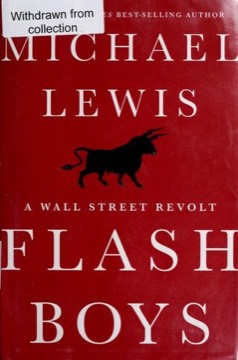
Flash Boys
Michael Lewis's account of high-frequency trading: the fibre-optic line dug through Pennsylvania to save three milliseconds, and the traders who worked out that the market had been rearranged around speed.
- First published
- 2014
- Publisher
- W.W. Norton & Company
- Pages
- 320
- Shelf
- Money
- Level
- Core
- ISBN-13
- 9780393244663
Record checked against
Catalogue note
- Reads as
- StrategicAbout choosing between options under uncertainty.
- Level
- Core / BuildingAssumes general familiarity with the subject.
- Approach
- Applied
- Written for
- Investors and savers, Readers with some grounding
Saved in this browser only — no account, nothing sent anywhere. My library
Read this if
- You want to see the incentives underneath the headlines.
- You want to understand what technology is doing to how we live.
- You read for the writing as much as for the argument.
- You are weighing options and want a way to think about the trade-offs.
- You know roughly how the subject works and want the fuller account.
The story
Lewis opens with Spread Networks laying a cable in a straight line from Chicago to New Jersey — through mountains rather than around them — to reduce round-trip time from 17 to 13 milliseconds, and selling access for enormous sums.
The central figure is Brad Katsuyama, a Royal Bank of Canada trader who noticed that whenever he tried to buy, the price moved away before his order arrived, and spent years working out why.
Somebody dug a tunnel through a mountain to save three milliseconds, and people paid for it.
Devmark’s reading — not a quotation from the book
The mechanism
Lewis's explanation is front-running by latency: faster participants see an order reach one exchange, infer the rest, and reach the other exchanges first. The fragmentation of US equity markets across many venues is what makes it possible.
Katsuyama's response, Thor and then the IEX exchange with its deliberate speed bump, is the book's resolution: a venue designed so that speed advantage stops paying.
The argument about it
The book prompted genuine controversy. Critics — including exchange operators and some academics — argued Lewis overstated the harm to ordinary investors, that spreads have narrowed substantially in the HFT era, and that "rigged" was the wrong word.
Defenders point out that the practices described were real, that IEX was approved as an exchange, and that several investigations followed publication. The disagreement is about magnitude rather than existence.
Nobody disputes that it happened. The dispute is about how much it cost whom.
Devmark’s reading — not a quotation from the book
How it reads
Lewis's usual method: a technical subject delivered through a small number of people with something at stake, at thriller pace.
It is the most accessible account of market microstructure available, and worth reading alongside a sceptical review rather than alone.
It is also short, which matters for a book about market plumbing: Lewis gets in and out before the technical material becomes a burden, which is much of why it reached a general audience.
The rule that fragmented the market
The structural precondition Lewis explains is regulatory: a rule requiring brokers to route orders to whichever venue displayed the best price distributed a single market across many, and created the gap the book is about. A participant fast enough to see an order arrive at one venue can act at the others before it gets there. The advantage is created by the architecture, not by rule-breaking.
Order types
Some of the most damaging material concerns the proliferation of exotic order types offered by exchanges, designed with high-frequency participants and understood by almost nobody else. Lewis's point is less about any single one than about the asymmetry: a venue selling complexity to one class of customer that the other class cannot parse.
The speed bump
The engineering answer at the centre of the narrative is a length of coiled fibre installed to add a deliberate delay to every incoming order, eliminating the latency advantage without banning anyone. It is an elegant solution because it changes the physics rather than policing behaviour, and the venue built around it later became a registered exchange.
They did not ban the fast traders. They added distance, and the advantage evaporated.
Devmark’s reading — not a quotation from the book
The programmer
A long subplot follows a bank programmer prosecuted over code he took on leaving, whose conviction was subsequently overturned. Lewis uses it to illustrate what the institutions considered worth defending, and the section is also the book's clearest demonstration of its method: the technical argument delivered through one person's predicament.
What the critics actually argue
The pushback is substantive. Exchange operators, academics and some practitioners argue that bid-ask spreads narrowed and retail transaction costs fell over the period in question, that high-frequency firms displaced human intermediaries who charged more, and that "rigged" overstates a real but much smaller transfer. Regulatory reviews did not find the market broken in the way the book's framing implies.
What is not disputed
Both sides agree on the underlying facts: the latency arbitrage exists, the cable was built, the order types were sold, and the structural incentives are real. The argument is about magnitude and about who ultimately paid — long-term institutional investors rather than retail traders, on most accounts.
What to take from it
Read it for the mechanism, which is explained better here than almost anywhere, and read a critical review alongside it for the scale. Lewis is a superb explainer and a committed advocate in the same sentence, and this book requires the reader to hold those apart.
What to take away
- 01Three millisecondsA cable dug straight through mountains to shorten a route.
- 02Latency front-runningSeeing an order at one venue and reaching the others first.
- 03Fragmentation enables itMany exchanges is the structural precondition.
- 04IEXA venue with a deliberate speed bump, designed to remove the advantage.
- 05Contested magnitudeThe practices are documented; the harm to small investors is argued.