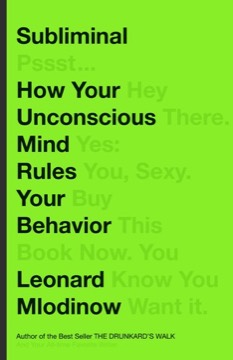
Subliminal
The New Unconscious and What It Teaches Us
Leonard Mlodinow's survey of unconscious processing — the argument that a large majority of mental activity happens outside awareness, and that the conscious account we give of our own behaviour is a reconstruction rather than a record.
- First published
- 2012
- Publisher
- Okuyan Us Yayinlari
- Pages
- 272
- Shelf
- Mind
- Level
- Core
- ISBN-13
- 9780307472250
Record checked against
Only one source carried a publication date for this work, so the year is uncorroborated.
Catalogue note
- Reads as
- ConceptualExplains how something works before what to do about it.
- Level
- Core / BuildingAssumes general familiarity with the subject.
- Approach
- Theoretical
- Written for
- Curious general readers, Readers with some grounding
Saved in this browser only — no account, nothing sent anywhere. My library
Read this if
- You want to know the specific ways your own judgement misleads you.
- You are curious what is actually happening in the brain.
- You want to understand how it works before deciding what to do about it.
- You know roughly how the subject works and want the fuller account.
The two-tier mind
Mlodinow's framing is that the unconscious in modern cognitive science is nothing like Freud's: not a repository of repressed material but a vast, fast, largely automatic processing system that handles most of what the brain does.
His claim is that consciousness is a small, slow, expensive layer sitting on top, and that it has considerably less access to its own machinery than it believes.
The modern unconscious is not Freud's basement. It is the processing system, and consciousness is the thin layer on top.
Devmark’s reading — not a quotation from the book
Perception is construction
His opening demonstrations concern vision, memory and hearing: the brain fills gaps, resolves ambiguity by inference, and delivers a finished product without flagging how much was supplied rather than sensed.
The blind spot is his cleanest example — a substantial hole in the visual field that nobody perceives, because the gap is filled in before it reaches awareness.
Memory as reconstruction
His treatment of memory covers the evidence that recollection is reassembled at the moment of recall rather than retrieved intact, and that the reassembly incorporates later information.
The eyewitness material is the most consequential: confidence and accuracy correlate weakly, and confidence can be increased by feedback that has nothing to do with accuracy — a finding with direct legal implications.
Social categorisation
His chapters on implicit social cognition cover the speed of categorisation, in-group favouritism, and the influence of category on judgement.
This is the material a reader should hold most carefully. The Implicit Association Test, which features prominently, has since faced serious methodological criticism regarding test-retest reliability and its weak prediction of individual behaviour. The existence of implicit categorisation is well supported; the measurement is contested.
Reading other people
His account of nonverbal communication is more careful than most popular treatments: humans extract a great deal from voice, posture and micro- expression, and are simultaneously overconfident about what they extract.
His observation that people believe they are good at detecting deception while performing near chance in controlled studies is well established and worth carrying.
People believe they can detect lying and perform near chance. The confidence is the finding, not the ability.
Devmark’s reading — not a quotation from the book
Motivated reasoning
His treatment of how goals shape conclusions: we apply more scrutiny to evidence we dislike, accept congenial evidence faster, and experience the asymmetry as ordinary rigour.
He connects this to self-assessment — the general tendency to rate oneself above average on desirable traits — and argues that this is largely functional rather than pathological, which is the more interesting claim.
Where the evidence has shifted
The book was published in 2012, before the replication debates reshaped several areas it draws on. Social priming in particular — the finding that incidental cues substantially alter behaviour — has fared badly.
The core claims about perception, memory reconstruction and automaticity rest on much firmer ground and have held. A reader should separate the two categories, which the book does not do because it could not have.
Where it is strong
Mlodinow is a physicist writing about psychology, and the outsider's clarity shows: he explains experimental designs carefully and is consistently good at conveying why a particular study design licenses a particular conclusion.
His writing is also unusually clean and the book is short, which makes it a good entry point despite its dated sections.
How it compares
Against Kahneman it is lighter, broader and less rigorous — Kahneman is describing his own research programme, Mlodinow is surveying a field.
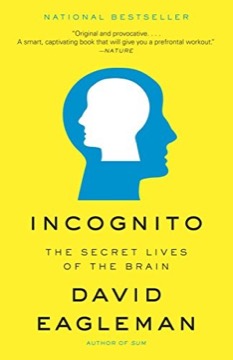
Against Eagleman's *Incognito* it covers similar ground with more attention to social cognition and less to neurology. The two overlap substantially and reading both is largely redundant.
What to take from it
The reconstruction insight is the durable one: the account you give of why you did something is generated after the fact and feels identical to a memory of deciding.
And the confidence calibration — that certainty about a memory, a judgement of character, or a detection of deception carries much less information than it feels like it does.
What to take away
- 01Consciousness has little access to its machineryThe processing happens below; the conscious layer receives a finished product with no note on what was supplied.
- 02Memory is reassembled at recallAnd the reassembly absorbs later information, which is why confidence and accuracy correlate so weakly.
- 03Deception detection is near chanceThe well-established finding is the confidence, not the ability.
- 04Separate the automaticity from the primingPerception and memory findings held; social priming did not, and the book predates that.
- 05The explanation arrives after the actAnd it feels exactly like remembering having decided.