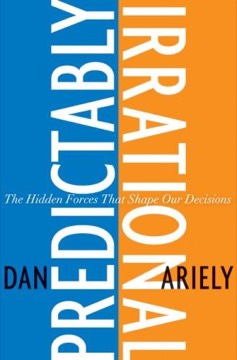
Predictably Irrational
The Hidden Forces That Shape Our Decisions
Dan Ariely's account of the systematic, repeatable ways people depart from economic rationality — and his argument that because the departures are predictable, they can be designed for rather than merely lamented.
- First published
- 2008
- Publisher
- HarperCollins
- Pages
- 368
- Shelf
- Mind
- Level
- Entry
- ISBN-13
- 9780062018205
Record checked against
Catalogue note
- Reads as
- ConceptualExplains how something works before what to do about it.
- Level
- Accessible / FoundationalNo prior reading assumed.
- Approach
- Theoretical
- Written for
- Curious general readers, Newcomers to the subject
- Ideas
Saved in this browser only — no account, nothing sent anywhere. My library
Read this if
- You want to know the specific ways your own judgement misleads you.
- You want to understand how it works before deciding what to do about it.
- You are starting from scratch here and want a way in that assumes no prior reading.
The core claim
Standard economics assumes people know their preferences and choose to maximise them. Ariely's experiments suggest preferences are constructed on the spot, heavily influenced by context, and unstable in ways that follow patterns.
The word doing the work is *predictably*. His argument is not that people are random but that the departures repeat, which makes them studiable — and which is what separates behavioural economics from a complaint about human nature.
Not that people are irrational, but that they are irrational in the same directions, repeatedly.
Devmark’s reading — not a quotation from the book
Relativity and the decoy
People struggle to judge absolute value and are comfortable judging comparisons, so a third option that nobody chooses can change which of the other two they pick.
His most-cited demonstration concerns a subscription offer where an obviously inferior middle option substantially shifted choices. The practical warning is symmetrical: when a comparison is being made easy for you, ask who arranged the set.
Arbitrary coherence
One of the book's most striking results. Participants asked to write down the last two digits of an identity number before bidding on items bid substantially more when those digits were high — but their *relative* valuations across items stayed consistent.
Ariely's reading is that initial anchors are close to arbitrary, and that once set they become the reference point for every subsequent judgement. The first price you saw for something continues to shape what you think it is worth long afterwards.
The cost of zero
Free is treated as a different category rather than a very low price. Ariely's experiments show people switching to a worse option when it becomes free, forgoing greater absolute value.
His explanation is that zero removes the possibility of loss, and that the appeal is about avoiding downside rather than about the price. It is the most immediately recognisable finding in the book for anyone who has accepted something free they did not want.
Social and market norms
The distinction that has travelled furthest. Social norms govern favours, help and community; market norms govern price, wage and exchange. People behave generously under the first and transactionally under the second.
The consequential finding is the asymmetry: introducing money converts a social relationship into a market one, and the conversion is very difficult to reverse. A small payment for something previously done as a favour reliably produces less effort than no payment at all.
Introduce money into a social exchange and it becomes a market exchange. Taking the money away does not undo it.
Devmark’s reading — not a quotation from the book
Self-control and precommitment
Ariely's work on procrastination found that students given externally imposed deadlines outperformed those choosing their own, and that those choosing their own did better when they set interim deadlines with real penalties.
His conclusion is practical rather than moralising: since the failure is predictable, the remedy is structural. Precommitment devices — deadlines, automatic transfers, removing the option — work where resolve does not.
Dishonesty
Ariely's experiments suggested most people cheat a little when the opportunity arises and the self-image cost is low, and that reminders of moral standards immediately beforehand sharply reduced it.
This material now requires a significant caveat. Data underlying a prominent later study on honesty pledges, on which Ariely was an author, was found to have been fabricated; Ariely has denied responsibility and investigations followed. Related dishonesty findings have also failed to replicate.
How to hold the evidence
Be explicit about the gradient. Anchoring, relativity, the effect of free, and precommitment are supported by broad literatures beyond this book and have largely held.
The dishonesty chapter should be treated as unreliable pending resolution. Some social-priming-adjacent results are on much weaker ground than the confident telling suggests. This is a book to read for the questions and to check before citing any specific number.
Where it is limited
Much of the underlying research uses student participants in laboratory settings with small stakes, and the gap between that and consequential real-world decisions is real and not much discussed.
The book is also organised as a sequence of engaging experiments rather than as a theory, so it accumulates findings without ever quite explaining why these particular deviations and not others.
What to take from it
The durable contribution is the framing: that irrationality is patterned, and that a pattern can be designed around. That single move is what turned a set of curiosities into an applied field.
Practically: notice the option nobody is meant to choose; notice what number you saw first; notice when money has just entered a relationship that was not previously transactional; and build structure where you know your own resolve will fail.
What to take away
- 01Preferences are constructed, not retrievedThe context supplies much of the answer, which is why the same person values the same thing differently.
- 02Ask who arranged the comparisonAn option nobody is expected to choose is usually there to change which of the others you do.
- 03Free is a category, not a priceZero removes the possibility of loss, which is why people take worse options when they cost nothing.
- 04Money converts a relationship irreversiblyA small payment for a former favour produces less effort than no payment, and removing it does not restore the norm.
- 05Check the dishonesty chapter before citing itData underlying related later work was found fabricated; several findings have not replicated.