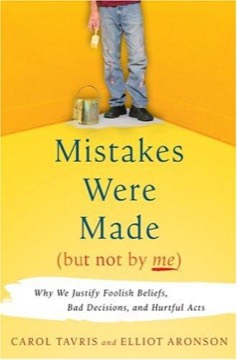
Mistakes Were Made (But Not by Me)
Carol Tavris and Elliot Aronson on self-justification — the mechanism by which people who have done something wrong come sincerely to believe they did not, and why the process is invisible to the person undergoing it.
- First published
- 2007
- Publisher
- Harcourt
- Pages
- 304
- Shelf
- Mind
- Level
- Core
- ISBN-13
- 9780151010981
Record checked against
Catalogue note
- Reads as
- ConceptualExplains how something works before what to do about it.
- Level
- Core / BuildingAssumes general familiarity with the subject.
- Approach
- Theoretical
- Written for
- Curious general readers, Readers with some grounding
- Ideas
Saved in this browser only — no account, nothing sent anywhere. My library
Read this if
- You want to know the specific ways your own judgement misleads you.
- You want to understand how it works before deciding what to do about it.
- You know roughly how the subject works and want the fuller account.
Cognitive dissonance as the engine
Their foundation is Festinger's theory, developed through Aronson's refinement: the discomfort of holding an action and a self-concept that conflict drives a change in one of them, and the self-concept is more defended.
The consequence is that someone who has behaved badly does not typically conclude they behaved badly. They conclude the behaviour was justified, and they believe it.
Nobody concludes they are a bad person who did a bad thing. They conclude the thing was justified.
Devmark’s reading — not a quotation from the book
The pyramid of choice
Their central image. Two people start in nearly identical positions at the apex of a pyramid. Each makes a small decision in a different direction. Each then justifies that decision, which makes the next step in the same direction easier.
By the base they are far apart and each is certain they have always held their position. The mechanism explains radicalisation, escalating corruption and gradual ethical drift without requiring anyone to have made a big decision.
Memory as a self-justifying archive
Their treatment of autobiographical memory: recollection is reconstructed in line with the current self-concept, so evidence contradicting our self-image is quietly revised.
This is why people can recount past events with total sincerity and total inaccuracy, and why "I remember it clearly" carries so little evidential weight in disputes about what happened.
Applications: the justice system
Their most consequential chapter examines wrongful convictions and prosecutors' resistance to exonerating evidence, including DNA results.
Their argument is that the resistance is not usually corruption but dissonance reduction — accepting the evidence would mean having helped imprison an innocent person, which is intolerable to a self-concept built on doing justice.
Applications: therapy and memory
Their chapter on recovered memory and therapeutic practice is careful and uncomfortable, covering how confident clinicians using suggestive techniques produced sincere false memories.
Their point is about the practitioners as much as the patients: a therapist whose self-concept is built on helping cannot easily entertain having harmed, which prevents the correction.
A clinician whose identity rests on helping cannot easily consider having harmed. That is what blocks the correction.
Devmark’s reading — not a quotation from the book
Applications: relationships
Their treatment of marital conflict is the most immediately useful for a general reader. Each partner constructs a narrative in which their own behaviour is reasonable and the other's is characterological.
The asymmetry — my lateness has reasons, your lateness is who you are — is the standard attribution error running inside a relationship, continuously, with memory doing the archiving.
Why apology is so hard
Their explanation for the difficulty of admitting error: an apology requires holding the dissonance rather than resolving it, which is genuinely aversive.
They distinguish real apology — acknowledging the act, the harm and the responsibility — from the non-apology that reduces the speaker's dissonance while acknowledging nothing, and the taxonomy is useful.
What they recommend
Their prescriptions are modest, which is appropriate. Separate the person from the act in your own self-assessment, so that admitting a mistake does not require conceding you are a bad person.
Build in external correction, since the mechanism is invisible from inside. And notice the physical feeling of dissonance as a signal rather than as something to be resolved immediately.
Where to be careful
The book draws on social psychology from a period substantially affected by the replication debates, and a few specific studies it cites have not held up.
The central mechanism — dissonance and self-justification — is among the better-supported findings in the field and is not in serious doubt, but individual demonstrations should be treated with the usual caution.
Why it is worth reading
Because it describes something you are doing while you read it, and the book is constructed to make that difficult to avoid noticing.
Its practical value is a single habit: when you catch yourself constructing a reason why an uncomfortable piece of evidence does not apply, treat the smoothness of the reason as the warning sign.
What to take away
- 01The self-concept is defended, not the behaviourWhich is why wrongdoing produces justification rather than admission, sincerely.
- 02Small steps do the workThe pyramid of choice explains drift and radicalisation without anyone making a large decision.
- 03Memory archives the justificationRecollection is revised to match the current self-image, so sincerity and accuracy come apart.
- 04Separate the act from the personAdmitting a mistake is only possible if it does not require conceding you are the kind of person who makes them.
- 05A smooth reason is the warningWhen the explanation for dismissing uncomfortable evidence arrives easily, that is the signal.