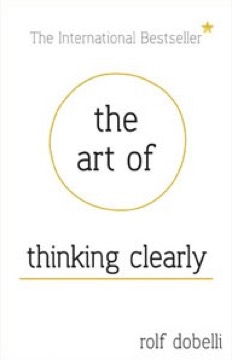
The Art of Thinking Clearly
Rolf Dobelli's catalogue of ninety-nine cognitive errors, each given roughly three pages — a reference rather than an argument, assembled from behavioural economics and psychology for a general reader.
- First published
- 2013
- Publisher
- Sceptre (UK), Farrar, Straus and Giroux (US)
- Pages
- 384
- Shelf
- Mind
- Level
- Entry
- ISBN-13
- 9780062273840
Record checked against
Two sources agreed on 2013; a third reported differently (openlibrary 2013, wikidata 2011, wikipedia 2013).
Catalogue note
- Reads as
- ReferenceBuilt to be consulted rather than read straight through.
- Level
- Accessible / FoundationalNo prior reading assumed.
- Approach
- Practical
- Written for
- Curious general readers, Newcomers to the subject
- Ideas
Saved in this browser only — no account, nothing sent anywhere. My library
Read this if
- You want to know the specific ways your own judgement misleads you.
- You want something to keep nearby and return to, rather than read once.
- You are starting from scratch here and want a way in that assumes no prior reading.
The form
Ninety-nine short chapters, each naming a bias or fallacy, illustrating it with a scenario, and offering a brief corrective. There is no through-line, no chapter order that matters, and no theory connecting them.
Dobelli is explicit that this is a compilation rather than original work, and the book is best understood as an index to a literature rather than a contribution to it.
Ninety-nine entries with no connecting argument. It is an index to a literature, and says so.
Devmark’s reading — not a quotation from the book
The strongest entries
The well-established ones are handled cleanly: survivorship bias, confirmation bias, sunk cost fallacy, availability, anchoring, base-rate neglect, hindsight bias and the illusion of control.
For these, the three-page treatment is adequate — the concept is simple, the example is apt, and the corrective is actionable. This is the book working as intended.
Survivorship bias, done well
His opening chapter is the book's best and does more work than the length suggests: the systematic invisibility of failures means any inference drawn from visible successes is drawn from a sample selected on the outcome.
He applies it to authors, musicians, entrepreneurs and investment strategies, and the accumulation makes the point more forcefully than any single case would.
The negative-advice framing
His organising philosophy, borrowed openly from Taleb and Munger: avoiding stupidity is easier and more reliable than achieving brilliance, so a list of errors to avoid is more usable than a list of virtues to acquire.
This is the closest thing the book has to an argument, and it justifies the format — a catalogue of ways to be wrong is exactly what that philosophy calls for.
Where it is unreliable
This must be stated. The book presents ninety-nine effects at uniform confidence, and they are not uniformly supported. Several rest on studies from areas hit hard by the replication crisis, and Dobelli provides no indication of which findings are robust and which are single studies.
A reader has no way to tell from the text whether an entry describes a well-replicated phenomenon or a striking result that did not survive.
Ninety-nine effects presented at identical confidence. They are not equally supported, and the book gives no way to tell.
Devmark’s reading — not a quotation from the book
The plagiarism controversy
Worth knowing. Nassim Taleb publicly accused Dobelli of drawing on his work without adequate attribution, and there was a subsequent dispute about sourcing more broadly.
The material genuinely is derivative by design — Dobelli says so — but the attribution in the original German edition was thinner than the borrowing warranted, and readers should know the book is a compilation of other people's research.
The repetition problem
Several entries describe substantially the same underlying phenomenon under different names, which inflates the headline count without adding any content a reader can use.
Anyone who knows the underlying literature will notice that ninety-nine distinct errors is a generous accounting, and that perhaps forty genuinely distinct mechanisms are being described across the ninety-nine chapters. The number is doing marketing work rather than analytical work.
How it compares
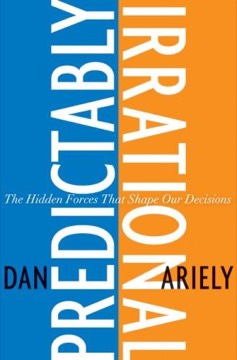
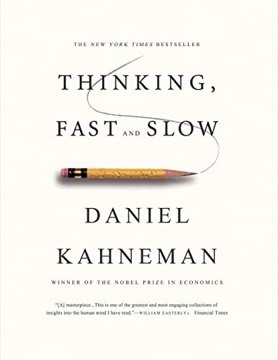
Against Kahneman it is far shallower and far easier — a reference card versus a research programme. Against Cialdini it covers more ground with less depth and no applied method.
Its genuine advantage is format: three pages is short enough to read one entry while waiting for something, which is how most people actually use it.
Who it suits
Useful for someone who wants the vocabulary quickly and will follow up elsewhere on anything that matters to them. Useful as a reference to check a decision against.
Poorly suited to anyone who wants to understand why these effects occur, or who will treat the entries as established science without further checking.
What to take from it
Read it as a list of hypotheses about your own reasoning rather than a list of facts. The entries are prompts to look more closely, not conclusions.
The most valuable habit it can install is the survivorship question — who is not in this sample — which appears first for good reason and is worth more than the ninety-eight that follow.
What to take away
- 01Avoiding error beats pursuing brillianceThe organising philosophy, borrowed from Taleb and Munger, and the justification for the catalogue format.
- 02Ask who is not in the sampleThe survivorship question is the book's first entry and worth more than most of the rest.
- 03The entries are not equally supportedSeveral rest on findings that did not survive replication, and the book gives no signal of which.
- 04Ninety-nine is generous accountingMany entries describe the same mechanism under different names.
- 05Treat it as prompts, not factsIt is an index to a literature. Anything that matters to you should be checked at the source.