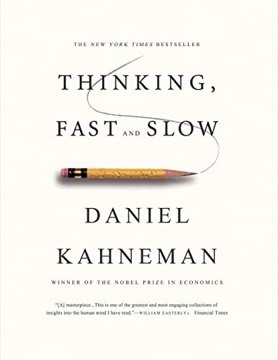
Thinking, Fast and Slow
Daniel Kahneman's summary of a career's work in judgement and decision-making, organised around the idea that thought runs on two systems — one fast, automatic and associative, the other slow, effortful and lazy — and that most predictable errors come from the second failing to check the first.
- First published
- 2011
- Publisher
- Farrar, Straus and Giroux
- Pages
- 528
- Shelf
- Mind
- Level
- Deep
- ISBN-13
- 9789585433564
Record checked against
Catalogue note
- Reads as
- FoundationThe standard first book on its subject.
- Level
- Advanced / AdvancedAssumes you have read around the subject already.
- Approach
- Balanced
- Written for
- Curious general readers, Specialists and serious readers
Saved in this browser only — no account, nothing sent anywhere. My library
Read this if
- You want to know the specific ways your own judgement misleads you.
- You want to decide better when the information is incomplete.
- You want evidence about why people behave as they do, not folklore.
- You want the book people are sent to first on this subject.
- You have read around this already and want a book that assumes it.
The two systems
Kahneman's framing device is deliberately simple. System 1 operates automatically and quickly, with no sense of voluntary control: it reads faces, completes familiar phrases, and produces impressions. System 2 allocates attention to effortful mental activity, including complex computation and deliberate choice.
He is explicit that these are not structures in the brain but fictional characters used to make the psychology memorable. The argument is about the division of labour: System 1 generates suggestions continuously, and System 2 mostly endorses them with little scrutiny.
System 1 proposes. System 2 is supposed to check, and usually does not.
Devmark’s reading — not a quotation from the book
Why the errors are predictable
The book's importance rests on a specific claim: that the mistakes people make are not random noise but systematic, patterned and reproducible. That patterning is what makes them studiable, and what makes debiasing at least conceivable.
Kahneman is careful about the normative point. These shortcuts are generally efficient and usually right; they are studied through their failures because failures are where the mechanism becomes visible, not because the mechanism is poor.
Heuristics: substitution and availability
The unifying mechanism is substitution. Faced with a hard question — how likely is this? — the mind quietly answers an easier one: how easily does an example come to mind? The answer to the easy question is then reported as the answer to the hard one, without any sense that a swap occurred.
Availability is the best-known instance. Events that are vivid, recent or heavily reported feel more probable, which distorts judgement about risk in directions that are broadly predictable.
Anchoring, framing and WYSIATI
Anchoring is the pull of an irrelevant number on a subsequent estimate, and it survives even when people know the number is arbitrary. Framing shows that logically equivalent descriptions produce different choices.
Underneath both sits the acronym Kahneman treats as central: what you see is all there is. System 1 builds the most coherent story it can from the information available and does not register what is missing, which is why confidence tracks coherence rather than evidence.
Prospect theory and loss aversion
The work with Amos Tversky that led to the Nobel prize replaced the assumption that people evaluate outcomes in terms of final wealth. Prospect theory says they evaluate changes relative to a reference point, that the value function is steeper for losses than for equivalent gains, and that small probabilities are overweighted.
Loss aversion explains a great deal of otherwise puzzling behaviour: the endowment effect, reluctance to close a losing position, and the difficulty of getting agreement to any change with visible losers.
Overconfidence and the inside view
Kahneman is unusually pointed about expert overconfidence, including his own. The illusion of validity is the feeling of confidence produced by a coherent story, independent of whether the story predicts anything.
His practical counter is the outside view: instead of estimating a project from its particulars, find the distribution of outcomes for similar projects and start there. He pairs this with the premortem — imagining the failure has happened and asking why — which licenses doubt that hierarchy usually suppresses.
Confidence measures how well a story hangs together, not how likely it is to be true.
Devmark’s reading — not a quotation from the book
The experiencing and remembering selves
The book's last part turns to wellbeing, and introduces a distinction that outlives the rest. The experiencing self lives moment to moment; the remembering self keeps score and makes decisions.
They disagree. Remembered experience is dominated by peak intensity and by how an episode ended, and is largely insensitive to how long it lasted. Since it is the remembering self that chooses, people routinely choose against their own future experience.
What the replication debates changed
Intellectual honesty requires stating this plainly. Several findings the book presents — priming effects in particular — have failed to replicate reliably, and Kahneman himself publicly acknowledged that the chapter on priming rested on evidence weaker than he had treated it as.
The core of the programme has held up far better: loss aversion, anchoring, framing and base-rate neglect remain well supported. A careful reader should hold the book's chapters at different levels of confidence rather than accepting or discarding it whole.
Where it gets misread
The most common misreading treats System 1 as the villain and System 2 as the hero. Kahneman's position is that System 1 is the source of nearly everything that works, including expertise, and that its intuitions are reliable in environments that are regular enough to learn.
The second misreading assumes that knowing about a bias removes it. The book is consistently pessimistic on this point: Kahneman's stated ambition is improving the ability to recognise errors in others' judgements and in institutional processes, which is a much more modest claim.
What to do with it
The realistic use is institutional rather than personal. Decisions improve when they are structured — independent judgements collected before discussion, criteria fixed before candidates are seen, base rates consulted before particulars, a premortem run before commitment.
Read as a manual for designing decision processes, it is one of the most useful books available. Read as a manual for becoming personally rational, it will disappoint, and its author would say so first.
What to take away
- 01Hard questions get quietly swappedThe mind answers an easier question and reports it as the answer to the one asked.
- 02Coherence is mistaken for evidenceA story that hangs together produces confidence regardless of how much is missing from it.
- 03Losses weigh more than equivalent gainsThis single asymmetry explains resistance to change better than most theories of it.
- 04Start from the outside viewBase rates for similar projects predict better than the details of yours.
- 05Fix the process, not the personKnowing about a bias does not remove it. Structuring the decision does.