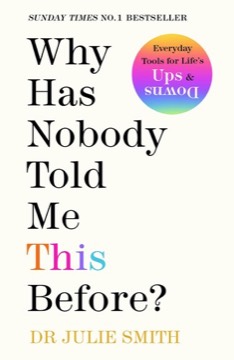
Why Has Nobody Told Me This Before?
Julie Smith's practical toolkit of clinical psychology techniques, organised by the problem you are having rather than by theory. Short, direct, and built for use during a bad week.
- First published
- 2022
- Publisher
- HarperCollins Publishers
- Pages
- 368
- Shelf
- Mind
- Level
- Entry
- ISBN-13
- 9780241529737
Record checked against
Catalogue note
- Reads as
- PracticalWritten to be applied, not only understood.
- Level
- Accessible / FoundationalNo prior reading assumed.
- Approach
- Practical
- Written for
- Curious general readers, Newcomers to the subject
- Ideas
Saved in this browser only — no account, nothing sent anywhere. My library
Read this if
- You want evidence about why people behave as they do, not folklore.
- You want something to apply, not only something to think about.
- You are starting from scratch here and want a way in that assumes no prior reading.
What it is
Smith is a clinical psychologist who built a large audience explaining techniques in short videos. The book collects them: sections on low mood, motivation, emotional pain, grief, self-doubt, fear and stress.
Each is a few pages, with the mechanism explained briefly and then the technique given plainly. It is designed to be opened at the relevant chapter rather than read through.
Organised by what is wrong tonight rather than by school of therapy.
Devmark’s reading — not a quotation from the book
What is in it
Most of the content is cognitive behavioural and acceptance-based: noticing thoughts as thoughts, behavioural activation, tolerating discomfort rather than escaping it, and the standard observation that motivation usually follows action rather than preceding it.
None of it is new to the field, and Smith does not claim it is. The value is compression and availability.
Nothing here is novel. The point is that it is in one place and phrased usably.
Devmark’s reading — not a quotation from the book
Why the format matters
Most self-help assumes a reader with the capacity to work through a book. Smith's premise is the opposite: that the moment you need a technique is precisely the moment you have least ability to find one, so the book is built to be opened at a page and used immediately.
That constraint explains choices that would otherwise look like thinness — the short sections, the repetition of core moves across chapters, the absence of extended theory. It is designed for the worst evening rather than for a good one.
Limits
It is explicitly not treatment, and Smith says so. For anything persistent or severe it is a supplement to care rather than a replacement for it.
The format also means depth is sacrificed: each technique is given enough to try and not enough to understand thoroughly.
Action before motivation
The technique with the most evidence behind it is behavioural activation: scheduling and doing small activities regardless of desire, on the finding that mood follows action rather than preceding it. Smith puts it early because it is the one that works when nothing else is accessible, and because it directly contradicts what low mood tells the person to do.
Thoughts as events
Much of the book teaches noticing a thought as something the mind produced rather than as a report on reality — the shared move behind cognitive therapy and acceptance-based approaches. Smith supplies both versions, disputing content where that helps and simply defusing where it does not, without requiring the reader to adopt either school.
The grief section
The chapters on loss are among the most useful because they mostly decline to offer techniques. Smith's position is that grief is not a problem to be solved, that stage models are descriptive rather than prescriptive, and that the practical work is tolerating a process rather than accelerating it.
Most of the chapter is an argument that there is nothing here to fix.
Devmark’s reading — not a quotation from the book
Starting with the body
A consistent thread routes through physiology before cognition: breathing patterns, grounding, sleep, movement and the effect of a physical state on what thoughts seem plausible. It reflects clinical order of operations — someone in acute distress cannot use a thought record, and something has to lower the arousal first.
Values, not goals
The final section on meaning follows the acceptance-based distinction between a target that can be completed and a direction that can be moved in today. Smith uses it to reframe the question people usually arrive with — how do I feel better — into one that can be acted on when feeling better is not currently available.
The format is the argument
Short chapters, diagrams, and an index organised by presenting problem rather than by theory. This is a deliberate design response to the fact that the people most in need of these techniques have the least capacity to read a book linearly, and it is the clearest reason this one gets used where denser and better-sourced books do not.
What to take from it
Treat it as a reference rather than a read-through: locate the state you are actually in, use the two or three techniques in that chapter, and return when something else is happening. Smith is explicit that it is not treatment, and for anything persistent or severe it is a supplement to care rather than an alternative.
What to take away
- 01Indexed by problemYou open it at low mood or self-doubt, not at a chapter on a theory.
- 02Action before motivationBehavioural activation: doing usually precedes wanting to.
- 03Thoughts as eventsNoticing a thought rather than obeying it is the recurring move.
- 04Compression is the valueStandard clinical technique, made findable.
- 05Not treatmentSmith is explicit that this supplements care rather than replacing it.