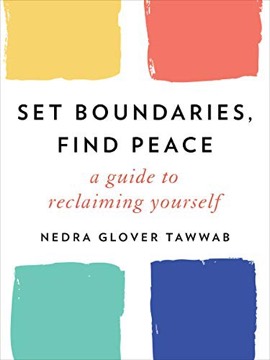
Set Boundaries, Find Peace
Nedra Glover Tawwab's practical guide to setting boundaries, from a therapist who works largely on relationships. Short chapters, scripts, and a clear definition of what a boundary is and is not.
- First published
- 2021
- Publisher
- Tarcherperigee
- Pages
- 304
- Shelf
- Mind
- Level
- Entry
- ISBN-13
- 9780593192092
Record checked against
Only one source carried a publication date for this work, so the year is uncorroborated.
Catalogue note
- Reads as
- PracticalWritten to be applied, not only understood.
- Level
- Accessible / FoundationalNo prior reading assumed.
- Approach
- Practical
- Written for
- Curious general readers, Newcomers to the subject
Saved in this browser only — no account, nothing sent anywhere. My library
Read this if
- You want evidence about why people behave as they do, not folklore.
- You want to get to an agreement without treating the other side as an obstacle.
- You want something to apply, not only something to think about.
- You are starting from scratch here and want a way in that assumes no prior reading.
The core idea
Tawwab's definition is narrow and useful: a boundary is a statement about what you will do, not a demand about what someone else must do. "I will leave if the shouting starts" is a boundary. "You must stop shouting" is a request.
That distinction does most of the work in the book, because it relocates control to the only person who has any.
A boundary describes your own next action. Anything that describes theirs is a request.
Devmark’s reading — not a quotation from the book
What it covers
The chapters move through family, romantic partners, work, friendship and social media, with the same structure each time: what the violation looks like, what to say, and what to expect when you say it.
Tawwab is realistic about the reaction. She is explicit that boundaries often provoke anger, especially from people who benefited from their absence, and that the discomfort is not evidence you were wrong.
How to use it
This is a workbook more than an argument — scripts, prompts and examples rather than a developed theory. Read for the language rather than the psychology.
It is most useful for people whose difficulty is not knowing that a boundary is needed but not knowing what sentence to say out loud.
The contribution is the wording, not the theory.
Devmark’s reading — not a quotation from the book
Porous, rigid, healthy
Tawwab's basic typology separates boundaries that let everything through, boundaries that let nothing through, and boundaries that are stated and maintained. The rigid category matters because it is routinely mistaken for strength: cutting people off entirely is usually the same avoidance as never saying anything, arriving from the other side.
Six domains
She works across physical space, sexual consent, emotional labour, material resources, time, and what she calls intellectual boundaries — the right to hold a view without being required to defend it on demand. Separating them is practically useful, because most people are competent in some domains and almost entirely porous in one.
Say it once, plainly
The scripts are deliberately short and free of justification. Her argument is that explanation invites negotiation: a reason can be argued with and bargained down, while a stated limit offers nothing to grip. The instinct to soften a refusal with an excuse is what converts a boundary into an opening position, and she treats the urge to explain as the point where most people lose the exchange before it starts.
A reason can be argued with. A limit cannot. That is why the explanation is the weak point.
Devmark’s reading — not a quotation from the book
What the pushback means
She is direct that the people most inconvenienced by a new boundary will protest, and that this is evidence about the previous arrangement rather than about the boundary. The prediction is specific — guilt-trips, accusations of selfishness, temporary escalation — and knowing it is coming is most of what makes it survivable.
Guilt is not a verdict
A recurring correction is that the discomfort following a reasonable limit is a learned response, not information about whether the limit was right. Tawwab treats it as a sensation to be expected and tolerated rather than resolved, which is a small reframe that does a lot of work.
Where it is thin
It is a workbook and does not pretend to be more: there is little theory, the therapeutic background is implied rather than explained, and the advice assumes a reader with enough safety and independence to absorb the consequences. For someone financially or physically dependent on the person concerned, the scripts are not the hard part and the book has less to offer.
What to take from it
Use it as intended rather than reading it through — pick the relationship that is actually costing you something, find the matching chapter, and use the script close to verbatim rather than improvising a kinder version. Its value is concentrated in the specificity of the wording, which is precisely what nobody can generate in the moment, under pressure, with the other person waiting for an answer.
What to take away
- 01You, not themA boundary states your action; anything else is a request in disguise.
- 02Expect the pushbackAnger is a predictable reaction from people the old arrangement suited.
- 03Domain by domainFamily, work, romance and friendship each get their own scripts.
- 04Guilt is not evidenceFeeling bad about a boundary does not mean it was wrong.
- 05A script bookIts value is the phrasing, not a theory of relationships.