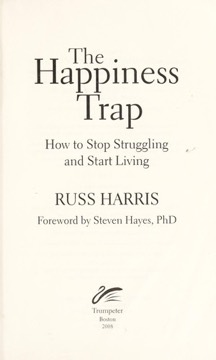
The Happiness Trap
Russ Harris's introduction to Acceptance and Commitment Therapy: the argument that trying to eliminate difficult feelings is the mechanism that keeps them, and that the alternative is valued action alongside them.
- First published
- 2007
- Publisher
- Trumpeter
- Pages
- 288
- Shelf
- Mind
- Level
- Entry
- ISBN-13
- 9781645471165
Record checked against
Catalogue note
- Reads as
- PracticalWritten to be applied, not only understood.
- Level
- Accessible / FoundationalNo prior reading assumed.
- Approach
- Practical
- Written for
- Curious general readers, Newcomers to the subject
- Ideas
Saved in this browser only — no account, nothing sent anywhere. My library
Read this if
- You want evidence about why people behave as they do, not folklore.
- You want something to apply, not only something to think about.
- You are starting from scratch here and want a way in that assumes no prior reading.
The trap
Harris's title names the mechanism. The cultural assumption is that happiness is a normal state and negative feelings are malfunctions to be fixed. Acting on that assumption produces control strategies — avoidance, distraction, suppression, reassurance-seeking — which work briefly and narrow a life permanently.
ACT's claim is that the struggle is the disorder, and that the exit is to stop struggling rather than to win.
The attempt to control difficult feelings is what converts them into a problem.
Devmark’s reading — not a quotation from the book
The six processes
Cognitive defusion — seeing a thought as a thought rather than as an instruction. Acceptance — allowing a feeling without endorsement. Contact with the present moment. Self-as-context, the observing self distinct from its contents. Values, clarified explicitly. Committed action in their direction.
Harris teaches these through metaphor and exercise rather than explanation, which is how ACT is generally delivered.
The aim is not to feel better. It is to act well while feeling whatever you feel.
Devmark’s reading — not a quotation from the book
Evidence and use
ACT has a substantial trial base across anxiety, depression, chronic pain and workplace stress, and this book is its most widely used popular introduction.
It is genuinely different from CBT rather than a variant: it does not dispute the content of thoughts. Readers who found thought-challenging unconvincing often find this approach fits better, and vice versa.
The struggle switch
Harris's most reusable image is a switch that decides whether a difficult feeling is simply present or is a problem to be fought. With it off, anxiety arrives, is unpleasant, and passes. With it on, anxiety generates anxiety about anxiety, and the second layer is both larger and self-sustaining. The claim is not that the feeling is pleasant, only that the struggle is the part that makes it persist.
The feeling is the weather. The struggle with it is the thing that lasts.
Devmark’s reading — not a quotation from the book
Defusion in practice
The techniques for loosening a thought's grip are deliberately slightly absurd: repeating a word until it stops sounding like language, prefacing a thought with "I'm having the thought that", giving a recurring worry a name, imagining it in a silly voice. None of them argue with the content. The aim is to change the relationship to the thought rather than its truth value, which is the clearest break from classical cognitive therapy.
The observing self
Self-as-context is the hardest of the six processes to convey and Harris spends the most effort on it. The distinction is between the contents of awareness — thoughts, feelings, sensations, roles, the story about who you are — and the awareness itself, which has been continuous while all of those changed. The practical payoff is that a distressing self-description becomes something observed rather than something you are.
Values are not goals
A goal can be completed and ticked off; a value is a direction you can act on today and still be acting on in ten years. Harris is insistent on the difference because goals used as values produce the pattern where achieving the thing changes nothing. The question the book keeps asking is not what you want to have but what you want to stand for, and then what the smallest available action in that direction is.
Workability instead of truth
The criterion ACT applies to a thought is not whether it is accurate but whether acting on it moves you toward what you care about. This is a genuine philosophical departure: a thought can be entirely true and still be worth holding lightly if obeying it costs you the life you want. It also removes the argument, since there is nothing to win against your own mind.
Where it is limited
The book is an introduction and says so; it is not a substitute for therapy in acute illness, and Harris is explicit about that. The metaphor-heavy style that makes it accessible also irritates some readers, and acceptance is easily misread as resignation or as permission to tolerate situations that ought to be changed. ACT's evidence base is real but is generally comparable to CBT rather than clearly superior to it.
What to take from it
The transferable core is three questions asked in sequence: what am I struggling against, is the struggle working, and what would I do next if the feeling were simply allowed to be here. That sequence survives without the therapeutic apparatus, and it is the part readers report still using years later.
What to take away
- 01Control is the problemAvoidance and suppression work briefly and shrink a life.
- 02DefusionSeeing a thought as an event rather than as an instruction.
- 03Values before goalsDirection is clarified explicitly and action follows it.
- 04Not CBTACT does not dispute the content of thoughts, which is the key difference.
- 05Trial-supportedA real evidence base across anxiety, depression and chronic pain.