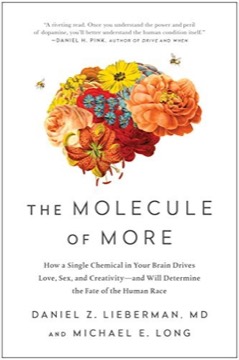
The Molecule of More
Daniel Lieberman and Michael Long's account of dopamine as the chemistry of anticipation rather than of pleasure — and their argument that much of human behaviour is explained by a conflict between wanting the future and inhabiting the present.
- First published
- 2018
- Publisher
- Brilliance Audio
- Pages
- 257
- Shelf
- Mind
- Level
- Entry
- ISBN-13
- 9781978643741
Record checked against
Only one source carried a publication date for this work, so the year is uncorroborated.
Catalogue note
- Reads as
- ConceptualExplains how something works before what to do about it.
- Level
- Accessible / FoundationalNo prior reading assumed.
- Approach
- Theoretical
- Written for
- Curious general readers, Newcomers to the subject
Saved in this browser only — no account, nothing sent anywhere. My library
Read this if
- You are curious what is actually happening in the brain.
- You want evidence about why people behave as they do, not folklore.
- You want to understand how it works before deciding what to do about it.
- You are starting from scratch here and want a way in that assumes no prior reading.
Dopamine is about wanting, not liking
The book's foundational correction, and the one piece of neuroscience most worth knowing. Dopamine is not the pleasure chemical of popular description; it is centrally involved in anticipation, prediction error and the pursuit of reward.
The dissociation is well established: animals with dopamine disrupted still show pleasure responses to a reward but stop working to obtain it. Wanting and liking are separable systems.
Dopamine is not what pleasure feels like. It is what wanting feels like, and the two are separable.
Devmark’s reading — not a quotation from the book
Down here and up there
Their organising metaphor: dopamine handles what is distant in space or time — the future, the possible, the not-yet-possessed. A separate set of here-and-now neurotransmitters handles present experience.
The framework explains the common experience of achieving something and feeling flat immediately afterwards. The circuit that produced the pursuit has nothing to do once the thing is obtained, and it is the louder circuit.
Prediction error
The mechanism underneath: dopamine responds most strongly not to reward but to reward that was better than expected, and drops below baseline when reward is worse than expected.
This explains habituation, why the second time is never like the first, and why variable rewards are so much more compelling than reliable ones — the prediction error is what the system is actually tracking.
Addiction, reframed
Their account follows directly: addiction is a disorder of wanting rather than of liking, which is why people continue pursuing substances and behaviours they no longer enjoy.
This reframing has genuine clinical support and is the book's most practically consequential section — it makes the common observation that an addicted person "doesn't even seem to enjoy it" a prediction of the model rather than a puzzle.
Love, in two phases
Their application to relationships: early passionate attachment is dopamine territory — anticipation, idealisation, pursuit — and the transition to companionate love is a handover to here-and-now chemistry.
The framework is plausible and the treatment is more speculative than the addiction material. It reads as a reasonable extension rather than an established finding, and the book does not always mark the difference.
The end of the pursuit phase is not the end of love. It is a handover to a different system.
Devmark’s reading — not a quotation from the book
Creativity and its costs
Their argument that the same future-oriented circuitry that produces imagination, planning and abstraction also underlies dissatisfaction, restlessness and, at the extreme, disconnection from present reality.
They extend this to associations between creativity and certain mental illnesses, which is the most contested material in the book and is presented with more confidence than the epidemiological evidence supports.
Politics, and where it goes wrong
The later chapters attempt to map political orientation onto dopaminergic versus here-and-now dominance, associating progressive politics with abstraction and future-orientation.
This is the weakest section by a substantial margin: speculative, under-evidenced, and resting on personality-politics correlations that are weak and contested. It should be read as opinion, and a reader would lose nothing by skipping it.
The balance argument
Their constructive conclusion: neither system alone produces a good life. Pure dopaminergic living is endless pursuit without satisfaction; pure present-focus lacks direction and achievement.
Their practical recommendations — deliberate present-focused activity, attention to sensory experience, savouring — are conventional and sound, and follow reasonably from the framework.
How to read it
The first half is a genuinely good popular account of a well-supported and widely misunderstood piece of neuroscience. The second half extends the framework well past what it can carry.
Read the dopamine chapters carefully and the cultural and political chapters sceptically, noticing where a mechanism stops being explained and starts being applied.
What to take from it
The wanting/liking distinction alone justifies the book. Noticing that the intensity of wanting something predicts almost nothing about how much you will enjoy having it is genuinely useful, and it explains a large amount of ordinary disappointment.
And the prediction-error insight, which explains why variable rewards — in gambling, in notifications, in intermittent approval — are so much more compelling than reliable ones.
What to take away
- 01Wanting and liking are separate systemsDopamine drives pursuit; it is not what enjoyment feels like, and the two can come apart entirely.
- 02The circuit goes quiet on arrivalWhich is why achieving something often feels flat — the system that produced the pursuit has no further job.
- 03It tracks prediction errorReward better than expected is what fires, which is why variable rewards compel more than reliable ones.
- 04Addiction is disordered wantingThis is why continued pursuit of something no longer enjoyed is a prediction of the model, not a puzzle.
- 05Skip the politics chapterSpeculative, under-evidenced, and resting on weak contested correlations.