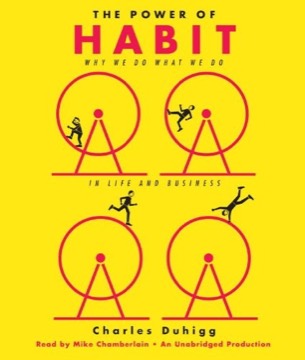
The Power of Habit
Charles Duhigg's account of how habits form and change, structured around the cue–routine–reward loop and extended from individuals to organisations and to whole societies.
- First published
- 2012
- Publisher
- Random House Trade Paperbacks
- Pages
- 400
- Shelf
- Habits
- Level
- Entry
- ISBN-13
- 9780812981605
Record checked against
Catalogue note
- Reads as
- PracticalWritten to be applied, not only understood.
- Level
- Accessible / FoundationalNo prior reading assumed.
- Approach
- Practical
- Written for
- Anyone changing how they work, Newcomers to the subject
Saved in this browser only — no account, nothing sent anywhere. My library
Read this if
- You want to change what you do repeatedly, not just what you intend.
- You are curious what is actually happening in the brain.
- You read for the writing as much as for the argument.
- You want something to apply, not only something to think about.
- You are starting from scratch here and want a way in that assumes no prior reading.
The core idea
Duhigg's organising mechanism is the habit loop: a cue triggers a routine which delivers a reward, and repetition makes the sequence automatic. Once automatic, the behaviour is initiated by the cue rather than by a decision.
The consequential part is his claim about craving: what drives the loop is anticipation of the reward, not the reward itself. This is why a habit persists after the reward has stopped being satisfying.
Once a loop is automatic, the cue starts it. You are no longer deciding, you are being triggered.
Devmark’s reading — not a quotation from the book
The golden rule of habit change
Duhigg's central practical claim is that habits are not broken, they are replaced. The cue and the reward stay; the routine between them is substituted.
This reframes what often looks like failure. Someone who removes a habit without supplying a substitute has left an unanswered cue and an unmet craving, which is a good description of why elimination-based attempts collapse under stress.
Diagnosing your own loop
The book's most usable method is an experiment for identifying what a habit is actually delivering. Cues fall into a small number of categories — location, time, emotional state, other people, and the immediately preceding action — so a few days of noting those five isolates the trigger.
The reward is found by substitution: try a different routine and observe whether the craving is satisfied. Duhigg's point is that people are usually wrong about what they are getting from a habit, and that guessing is the step that fails.
Keystone habits
The idea that some habits reorganise others. Duhigg's examples — regular exercise, family meals, making a bed — are presented as changes that create small wins and shift a person's sense of what they are capable of.
The mechanism is plausible and the evidence is looser than the confident telling suggests. Treat it as a heuristic for choosing where to start rather than an established finding.
Willpower as a habit
Duhigg treats self-control as trainable rather than fixed, and reports the finding that it behaves like a depletable resource.
This is the part of the book that has aged worst. Ego depletion, the research programme underlying it, has failed to replicate reliably in large pre-registered studies, and its status is now seriously contested. The practical residue — that decisions made under fatigue are worse, and that pre-committing removes the need to decide — survives on other grounds.
Organisational habits
The middle section applies the loop to institutions, arguing that organisations run on routines nobody chose and that crises expose them.
His account of how a safety-focused keystone habit can reorganise a whole company is the strongest case study, and his treatment of institutional routines as truces between competing internal interests is a genuinely useful idea that deserves more attention than it gets.
Most organisational routines are not decisions. They are truces, and nobody remembers negotiating them.
Devmark’s reading — not a quotation from the book
The habits of societies
The final section extends the argument to social movements, arguing they spread through strong ties among friends, weak ties across acquaintance networks, and then new habits that let participants keep going without continuous leadership.
This is the book's most speculative reach and the place where the loop framework is stretched furthest from the evidence behind it. It reads as well-told history with a theory laid over it.
Where it should be read carefully
Two cautions. First, the ego-depletion material should be treated as contested rather than settled. Second, the book's structure — a mechanism illustrated by dramatic narrative — makes the evidence feel stronger than it is, because a vivid story is more persuasive than the study it stands in for.
Duhigg is a journalist rather than a researcher, and the book is best read as reporting on a field rather than as a summary of its state.
How it compares with Atomic Habits
The two are usually recommended together and do different jobs. Duhigg explains the mechanism and is stronger on organisations and on why habits persist. Clear is more practical and more specific about what to do tomorrow morning.
If you want to understand why a habit is holding, this is the better book. If you want a procedure for installing one, Clear's is.
What to take from it
The loop itself is a genuinely useful diagnostic, and the discipline of finding the real cue and the real reward before attempting a change is the book's most valuable instruction.
Also worth keeping is the organisational observation: that a great deal of what a company does is routine rather than decision, and that asking when anyone last chose it is often the fastest way to unstick something.
What to take away
- 01Craving drives the loopAnticipation of the reward, not the reward itself, is what keeps a habit running after it stops satisfying.
- 02Replace the routine, keep the cueRemoving a habit without a substitute leaves an unanswered trigger and an unmet craving.
- 03Diagnose before you interveneCues fall into five categories, and people are usually wrong about what a habit is actually delivering.
- 04Organisational routines are trucesMuch of what a company does was negotiated between interests long ago and never revisited.
- 05Hold the willpower chapter looselyEgo depletion has not replicated reliably; the practical advice survives on other grounds.