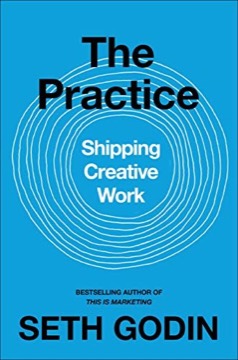
The Practice
Seth Godin's short entries on creative work, arguing that shipping consistently is the practice, that results are not yours to control, and that waiting to feel ready is a form of hiding.
- First published
- 2020
- Publisher
- Portfolio
- Pages
- 264
- Shelf
- Habits
- Level
- Entry
- ISBN-13
- 9780593328972
Record checked against
Only one source carried a publication date for this work, so the year is uncorroborated.
Catalogue note
- Reads as
- PracticalWritten to be applied, not only understood.
- Level
- Accessible / FoundationalNo prior reading assumed.
- Approach
- Practical
- Written for
- Anyone changing how they work, Newcomers to the subject
Saved in this browser only — no account, nothing sent anywhere. My library
Read this if
- You make things, and want to understand the work rather than wait for inspiration.
- You are building something new and want to know why most new things fail.
- You want something to apply, not only something to think about.
- You are starting from scratch here and want a way in that assumes no prior reading.
Process over outcome
Godin's central argument is that a creative professional commits to a process and releases attachment to how any individual piece lands, because reception depends on timing, audience and chance that the maker does not control.
His conclusion is that judging yourself by outcomes trains you to make safer work, since safe work has a more predictable reception — which is exactly the wrong adaptation.
Judging yourself by reception trains you toward safe work, because safe work lands predictably.
Devmark’s reading — not a quotation from the book
Shipping is the discipline
His recurring instruction: the practice is delivering on a schedule, publicly, whether or not the current piece feels good enough.
He is explicit that this is not a claim about quality. It is a claim that the feedback required to improve only exists after release, so withholding work withholds the mechanism by which it would have become better.
Creative work is not a talent
His position that creativity is a decision and a habit rather than a trait — that professionals produce on schedule, and that waiting for inspiration is amateur behaviour dressed as sensitivity.
This overlaps substantially with Pressfield, whom Godin acknowledges, and the two books are best read as the same argument in different registers.
Generosity as the frame
His distinctive contribution: reframing creative work as something made for a specific someone rather than as self-expression.
His test — who is it for, and what is it for — is more demanding than it sounds, because it forbids the comfortable answer of everyone, and because naming the change you intend to make is harder than describing what you made.
The smallest viable audience
His argument against scale as an objective: aiming at everyone produces work so generalised that it moves nobody, while making something specific enough to matter to a small group is what eventually travels.
The reasoning is about specificity rather than modesty — work that is precise about who it serves is the only work that gets recommended.
Aim at everybody and the work is too general to move anyone. Specificity is what gets recommended.
Devmark’s reading — not a quotation from the book
Reassurance is futile
One of his sharpest repeated lines. Seeking assurance that the work will be received well before releasing it is both impossible to satisfy and a mechanism for delay.
His alternative is deciding to trust the process instead — a weaker comfort, and the only one available.
The form
Two hundred and nineteen short entries, most under a page, with no developed argument across them. It is closer to a devotional than to a book of instruction.
This is either the right form for the content or an evasion of the harder job of making an argument, depending on the reader, and opinion divides fairly sharply.
Where it is thin
There is no evidence, no method and no engagement with material conditions — the assumption throughout is that the barrier is internal.
For someone whose obstacle is time, money or access rather than self-doubt, the book offers very little and its framing can read as dismissive of circumstances it does not consider.
The repetition
Godin circles the same handful of ideas — ship, generosity, process, smallest viable audience — across two hundred entries, and a reader will have the argument within thirty pages.
Whether the remaining pages are reinforcement or padding depends largely on whether you are reading it while stuck or while comfortable.
What to take from it
The smallest-viable-audience discipline and the who-is-it-for test, both of which are concrete and both of which change what gets made.
And the reframing of reception as outside your control, which is genuinely useful for anyone whose output has become cautious because the last thing landed badly.
What to take away
- 01Outcomes are not yoursReception depends on timing, audience and chance; judging yourself by it selects for caution.
- 02Feedback only exists after releaseWithholding work withholds the mechanism by which it would have improved.
- 03Name who it is forThe comfortable answer is everyone, and it is forbidden, because it produces work that moves nobody.
- 04Smallest viable audienceWork precise enough to matter to a few is the only work that gets recommended onward.
- 05Reassurance cannot be obtainedSeeking it before shipping is a delay mechanism, because the condition can never be satisfied.