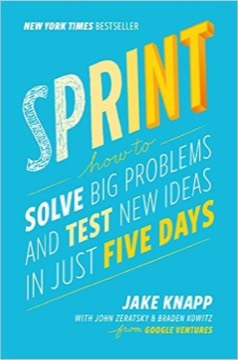
Sprint
How to Solve Big Problems and Test New Ideas in Just Five Days
Jake Knapp's five-day process for answering a big product question — a structured week that goes from mapping a problem to testing a realistic prototype with real users.
- First published
- 2016
- Publisher
- Penguin Random House Grupo Editorial
- Pages
- 288
- Shelf
- Design
- Level
- Entry
- ISBN-13
- 9781501121777
Record checked against
Catalogue note
- Reads as
- PracticalWritten to be applied, not only understood.
- Level
- Accessible / FoundationalNo prior reading assumed.
- Approach
- Practical
- Written for
- Designers and makers, Newcomers to the subject
Saved in this browser only — no account, nothing sent anywhere. My library
Read this if
- You care why some things are obvious to use and others are not.
- You are building something new and want to know why most new things fail.
- You want something to apply, not only something to think about.
- You are starting from scratch here and want a way in that assumes no prior reading.
What it is
A prescriptive schedule developed at Google Ventures and run with startups: five days, a small cross-functional group, a cleared calendar, and a specific set of activities each day.
Its purpose is narrow and worth stating precisely — it is for answering a significant question quickly, not for building a product, running a team, or replacing ongoing discovery.
It answers one large question in a week. It is not a way to build products or to run a team.
Devmark’s reading — not a quotation from the book
Monday: map and target
The day for building a shared understanding: set a long-term goal, list the assumptions that could sink it, map the customer's path through the problem, interview internal experts, and choose a single target on the map.
The choice of target by the decider is the day's real output, because a sprint that tries to address the whole map produces nothing testable.
Tuesday: sketch
The day for generating solutions individually rather than in a group. Each person reviews existing solutions, then works through a structured sketching sequence ending in a detailed, self-explanatory solution sketch.
The rejection of group brainstorming is deliberate and grounded — the evidence that groups generate fewer and less varied ideas than the same people working alone is one of the better-supported findings in the book.
Wednesday: decide
The day for choosing without discussion-by-committee: a silent review of all sketches, a heat map of interesting parts, short critiques, a straw poll, and a final binding decision by the designated decider.
The structure exists to prevent the two standard failures — the loudest voice winning, and a consensus that blends everything into nothing.
Thursday: prototype
The day for building a realistic facade — enough to produce a genuine reaction, with no working system behind it.
Their prototype mindset is the transferable idea: it is temporary, it needs to be only as real as the test requires, and building it in a day forces decisions that would otherwise be deferred for weeks.
Build only as much reality as the test requires. The one-day limit forces decisions that would otherwise drift.
Devmark’s reading — not a quotation from the book
Friday: test
Five customer interviews with the prototype, watched live by the team, with notes taken in a structured grid and patterns identified at the end of the day.
The five-participant number comes from usability research suggesting most major problems surface within that many sessions. It is a reasonable working heuristic, though the original claim has been qualified considerably since it was made.
The decider
Their insistence on a single person with authority who is present for the week, and their contingency advice if that person cannot attend throughout.
This is the requirement most often ignored and most responsible for failed sprints, because a week of work that ends in a decision nobody can make produces nothing.
Where it works and where it does not
It works for open questions with several plausible answers and real stakes — a new product direction, a redesign, a service concept.
It works poorly for incremental improvements, for problems requiring technical investigation, and for questions where the uncertainty is about feasibility rather than desirability. Teams that run sprints on a schedule rather than on a question tend to discover this.
The cost
Five days of several senior people is expensive, and the book underplays that. The subsequent shortened variants — including the authors' own four-day revision — exist because the original commitment proved hard to obtain repeatedly.
A team can only justify the format for questions large enough to warrant it, which is a constraint on frequency rather than a flaw.
What to take from it
Work alone, then decide together, which is the sequence that fixes most of what is wrong with idea meetings and transfers to any group decision.
And the discipline of putting a realistic artefact in front of real users before committing, which is the whole point and is skipped far more often than it is done badly.
What to take away
- 01Work alone, then decide togetherIndividual generation followed by structured group selection, which is better supported than group brainstorming.
- 02Name a decider and keep them in the roomA week ending in a decision nobody has authority to make produces nothing.
- 03A prototype needs only the reality the test requiresThe one-day limit is a forcing function, not a compromise.
- 04Pick one target on the mapA sprint addressing the whole problem produces nothing testable by Thursday.
- 05It suits open questions with real stakesRun on a schedule rather than on a question, it is an expensive way to reach an obvious answer.