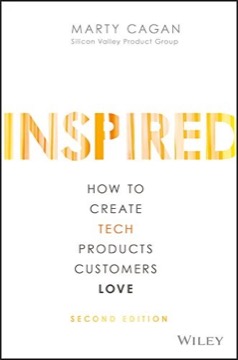
Inspired
How To Create Products Customers Love
Marty Cagan's book on how strong product organisations work — the structure of empowered product teams, the role of the product manager, and the discovery practices that separate products people love from projects that shipped.
- First published
- 2008
- Publisher
- SVPG Press
- Pages
- 368
- Shelf
- Design
- Level
- Core
- ISBN-13
- 9789352131501
Record checked against
Only one source carried a publication date for this work, so the year is uncorroborated.
Catalogue note
- Reads as
- PracticalWritten to be applied, not only understood.
- Level
- Core / BuildingAssumes general familiarity with the subject.
- Approach
- Practical
- Written for
- Designers and makers, Readers with some grounding
- Ideas
Saved in this browser only — no account, nothing sent anywhere. My library
Read this if
- You are building something new and want to know why most new things fail.
- You want something to apply, not only something to think about.
- You know roughly how the subject works and want the fuller account.
The distinction it rests on
Cagan's core contrast is between feature teams, which are handed roadmaps and asked to deliver, and empowered product teams, which are given problems and held accountable for outcomes.
His claim is that almost everything else — process, technique, role definition — follows from which of these a company has, and that most companies believe they have the second while operating the first.
Most companies believe they have empowered teams and are in fact running feature teams with nicer language.
Devmark’s reading — not a quotation from the book
The product team
His unit of organisation: a durable, cross-functional group of a product manager, a product designer and engineers, together long enough to accumulate knowledge of the problem.
His insistence on durability is a specific claim — that teams reassembled per project never develop the domain understanding that good product decisions require.
What the product manager actually does
His definition is demanding: deep knowledge of the users, the data, the business and the market, and personal responsibility for whether the product is valuable and viable.
His rejection of the product manager as backlog administrator or requirements courier is the book's most direct challenge to how the role is commonly practised.
The four risks
His framework for what discovery must answer before building: value risk (will anyone want it), usability risk (can they use it), feasibility risk (can we build it), and business viability risk (does it work for our business).
The framework's value is that it names four distinct questions with four distinct owners, which stops teams from validating one and assuming the others.
Discovery and delivery in parallel
His model: discovery work — prototypes, tests, interviews — runs continuously alongside delivery rather than as a phase preceding it.
His argument against discovery as a stage is that a completed discovery phase produces a requirements document, which recreates the feature-team dynamic the book is arguing against.
Discovery techniques
A substantial catalogue: opportunity assessment, customer letters, story maps, prototypes of several fidelities, usability testing, demand testing, live-data prototypes and qualitative interviews.
His distinction between prototypes built to learn and prototypes built to persuade is the most useful piece, because confusing them produces work that does neither.
A prototype built to learn and one built to persuade are different artefacts. Confusing them produces neither.
Devmark’s reading — not a quotation from the book
Product vision and strategy
His treatment of the longer horizon: a vision that is inspiring and persistent, a strategy that sequences a small number of target markets or problems, and objectives that cascade without becoming a roadmap by another name.
His warning that objectives assigned to teams by executives reproduce the roadmap problem is the connection back to the book's central argument.
Where it is limited
Its evidence is Cagan's own consulting experience and a set of case examples from companies that succeeded, which is a selection problem he acknowledges only in passing.
Its prescriptions also assume conditions many readers lack — engineering capacity, executive tolerance for uncertainty, direct customer access — and the book has more to say about what good looks like than about how to get there from a bad situation.
Its relation to Transformed
Cagan's later book takes up exactly that gap: how an organisation that operates as feature teams moves to the empowered model.
A reader in a functioning product organisation should read this one; a reader trying to change one should read both and treat this as the description of the destination.
What to take from it
The four risks, because they are a fast diagnostic for what a team has actually validated and what it has assumed.
And the empowered-versus-feature-team distinction, which explains a large proportion of product frustration more accurately than complaints about process usually do, because it identifies the structural cause rather than the ceremonies that are its most visible symptom.
What to take away
- 01Problems, not roadmapsAn empowered team is given outcomes to achieve; a feature team is given a list to deliver.
- 02Four risks with four ownersValue, usability, feasibility and viability are distinct questions, and validating one proves nothing about the rest.
- 03Discovery runs alongside deliveryDiscovery as a completed phase produces a requirements document, which is the failure mode it was meant to avoid.
- 04Durable teams accumulate domain knowledgeTeams reassembled per project never develop the understanding good decisions require.
- 05Learning prototypes and selling prototypes differThey have different fidelities, audiences and success criteria, and merging them wastes both.