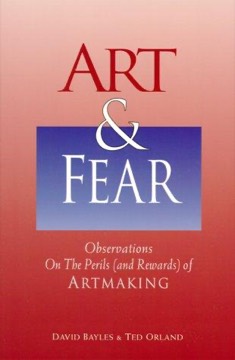
Art & Fear
David Bayles and Ted Orland's short book on why people stop making art, written by two working artists for other working artists. Concerned with the ordinary obstacles rather than with talent.
- First published
- 1993
- Publisher
- Capra Pr
- Pages
- 122
- Shelf
- Design
- Level
- Entry
- ISBN-13
- 9781452637518
Record checked against
Only one source carried a publication date for this work, so the year is uncorroborated.
Catalogue note
- Reads as
- PracticalWritten to be applied, not only understood.
- Level
- Accessible / FoundationalNo prior reading assumed.
- Approach
- Practical
- Written for
- Designers and makers, Newcomers to the subject
Saved in this browser only — no account, nothing sent anywhere. My library
Read this if
- You make things, and want to understand the work rather than wait for inspiration.
- You want evidence about why people behave as they do, not folklore.
- You want something to apply, not only something to think about.
- You are starting from scratch here and want a way in that assumes no prior reading.
The argument
The book's premise is that almost nobody quits because they lack ability. They quit because of fear — of being found out, of the gap between the work they make and the work they imagined, of what quitting would mean if they did not.
Bayles and Orland's response is to reframe art-making as a practice with ordinary problems rather than as a sign of an inner condition.
Almost nobody stops because of talent. They stop because of the distance between the work and the intention.
Devmark’s reading — not a quotation from the book
The ceramics story
The book contains its most-repeated anecdote: a class divided so that half was graded on the quantity of pots produced and half on a single perfect pot. The quantity group produced the better work, having learned from repetition while the other group theorised.
Whether the study is literally documented is debated; as an argument about where quality comes from, it has been enormously influential.
Quantity produced quality, because the people making many pots were learning while the others were planning.
Devmark’s reading — not a quotation from the book
What it is useful for
The chapters on the gap between vision and execution, and on the difference between problems that are yours and problems that belong to the wider art world, are the most practically useful.
It is under a hundred pages, written plainly, and addressed to someone who is already making things. It is not an introduction to art and does not pretend to be.
Vision runs ahead of execution
The book's diagnosis of despair is structural rather than psychological. Your taste develops faster than your capacity, so the work in front of you is always worse than the work you can imagine, and this gap is permanent rather than a stage to be passed through. Understanding it as a condition of the activity is what stops it being read as evidence of unfitness.
The gap between what you can see and what you can make never closes. It is the working condition.
Devmark’s reading — not a quotation from the book
Quantity teaches
Their claim is that most of what anyone makes exists to teach them how to make the small proportion that is good, and that this cannot be shortcut by planning. It follows that the useful metric early on is volume of completed work rather than quality of any individual piece, because the learning is distributed across attempts.
Two kinds of fear
The structure separates fears about yourself — that you have no talent, no originality, nothing to say — from fears about others: how the work will be received, judged, misunderstood or ignored. They require different responses, and the authors are clear that the second category is the one that most often ends a practice, because it is socially reinforced.
Talent as a distraction
The book is unusually direct that talent is largely irrelevant to whether someone keeps working, and may be actively harmful: early facility produces praise, praise produces an identity to protect, and an identity to protect produces avoidance of the difficult work. The people who continue are generally not the ones who found it easy.
About that ceramics story
The famous anecdote about a class split into a group graded on quantity and a group graded on a single perfect piece is the most quoted thing in the book, and its provenance has been questioned — it is presented as a story rather than as a study, with no cited source. The underlying point about volume is well supported by practice; the specific experiment should not be repeated as a finding.
Why people actually stop
Their answer is almost never ability. It is the accumulation of ordinary attrition: the absence of an audience, the disappearance of external structure after education ends, the social difficulty of protecting the time, and the moment when continuing requires believing in the work without anyone else doing so.
What to take from it
It is short, unsentimental, and has no exercises, which is part of its appeal. Its function is to normalise the experience of finding the work difficult and disappointing, and to reframe that as the ordinary texture of making rather than a signal to stop. Read it when you have stopped, or are about to.
What to take away
- 01Fear, not talentThe reasons people stop are almost never about ability.
- 02Quantity teachesThe ceramics anecdote: repetition beats planning for a perfect result.
- 03The vision gapThe distance between imagined and actual work is normal, not diagnostic.
- 04Your problems versus the art world'sSeparating the two removes a lot of paralysis.
- 05For people already workingNot an introduction; addressed to someone mid-practice.