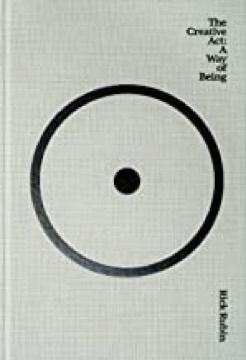
The Creative Act
A Way of Being
Rick Rubin's book on making things, written as a sequence of short meditations rather than a method — concerned almost entirely with the conditions and attention that precede work, and barely at all with technique.
- First published
- 2023
- Publisher
- Penguin Press
- Pages
- 432
- Shelf
- Design
- Level
- Entry
- ISBN-13
- 9781838858636
Record checked against
Catalogue note
- Reads as
- PracticalWritten to be applied, not only understood.
- Level
- Accessible / FoundationalNo prior reading assumed.
- Approach
- Practical
- Written for
- Designers and makers, Newcomers to the subject
- Ideas
Saved in this browser only — no account, nothing sent anywhere. My library
Read this if
- You make things, and want to understand the work rather than wait for inspiration.
- You want something to apply, not only something to think about.
- You are starting from scratch here and want a way in that assumes no prior reading.
What kind of book this is
Seventy-eight short chapters, most two or three pages, on awareness, attention, doubt, completion and the relationship between an artist and their material. There are no exercises, no steps and almost no anecdotes from the author's own career.
That last absence is deliberate and notable. Rubin has produced records across an unusual range of genres over four decades, and the book declines almost entirely to trade on it.
A producer with four decades of famous records declines, almost entirely, to mention any of them.
Devmark’s reading — not a quotation from the book
Everyone is an artist
Rubin's opening position is that creativity is not a rare aptitude but a basic way of being in the world, available to anyone paying attention.
This is either the book's generous foundation or its first act of vagueness, depending on the reader. The argument underneath is more specific than it sounds: he is claiming that the scarce resource is attention rather than talent, and most of the book follows from that.
Attention as the raw material
The most substantive thread. Rubin treats the artist's job as noticing — building a practice of awareness so that material presents itself, rather than sitting down to generate something on demand.
He describes this as living in a state of collection, where the world is constantly being sampled. The practical consequence is that the work of making does not begin at the desk, which is a genuinely useful correction for anyone who treats creative output as a scheduling problem.
The producer's actual role
Where Rubin is most concrete is on what a producer does, and it is almost entirely about conditions rather than craft: removing self-consciousness, protecting a state in which someone can be bad in front of another person, and knowing when to say nothing.
This is the closest the book comes to describing a method, and it is transferable well beyond music — most of it is a description of how to hold space for someone else's judgement rather than substitute your own.
Experimentation and non-attachment
A recurring argument is for holding ideas loosely: try the version you think is wrong, keep the accident, and avoid deciding what a piece is too early.
Rubin's most useful specific instruction concerns finishing. He argues that work is never finished, only abandoned at a chosen point, and that treating completion as a decision rather than an arrival is what allows anything to ship at all.
Nothing is finished. It is abandoned at a chosen moment, and choosing is the skill.
Devmark’s reading — not a quotation from the book
Against the audience
One of the book's firmest positions: make the work for yourself, and decide what it is before considering how it will land. Rubin argues that anticipating an audience during the making corrupts the judgement that makes the work worth anything.
This is contestable and he does not much defend it. For commercial or client work the position is close to unusable, and the book does not acknowledge that most people making things are doing so under constraints.
Where it is vulnerable
The main criticism is vagueness. The chapters are aphoristic, occasionally tautological, and several state a sentiment without an argument. A reader looking for anything testable will find very little.
There is also a spiritual register — references to universal sources and to the artist as a vessel — that some readers find clarifying and others find evasive. It is not incidental; it is the book's frame, and it is worth knowing that before starting.
What it is not
It is not a memoir, not a how-to, and not a book about the music industry. Readers arriving for stories about famous sessions will be disappointed, and that disappointment is the most common complaint about it.
It is also not a productivity book. The argument runs the other way — that output is a by-product of attention, and that optimising output directly is how people end up making things nobody needed.
Who it is for
Most useful to someone already making things who has become stuck in self-consciousness or in the expectations of an audience. Read in that state, several chapters do real work.
Least useful to someone looking for a way to start, or for technique. The book assumes a practice already exists and addresses the conditions around it rather than its establishment.
How to read it
Not straight through. It is designed to be opened at a page, and reading it as a continuous argument exposes the repetition without delivering the accumulation.
Its best use is as something kept nearby and returned to — which is a low bar to clear for a book about work, and a bar most books about work do not clear.
What to take away
- 01The scarce resource is attentionNot talent. The work of noticing happens before anyone sits down to make anything.
- 02Hold ideas looselyTry the version you think is wrong, keep the accident, and decide what it is as late as possible.
- 03Completion is a decisionWork is abandoned at a chosen point rather than finished, and choosing the point is the skill.
- 04Protect the conditions, not the outputThe producer's job is making it safe to be bad in front of someone, which transfers well beyond music.
- 05Read it in fragmentsRead continuously it repeats; read a page at a time it accumulates.