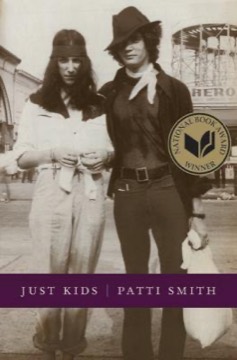
Just Kids
Patti Smith's memoir of her relationship with Robert Mapplethorpe in New York from 1967 onward, written as the promise she made him before he died. Winner of the National Book Award.
- First published
- 2010
- Publisher
- Ecco
- Pages
- 320
- Shelf
- History
- Level
- Core
- ISBN-13
- 9780062109385
Record checked against
Two sources agreed on 2010; a third reported differently (openlibrary 2006, wikidata 2010, wikipedia 2010).
Catalogue note
- Reads as
- ReflectiveChanges how you see rather than what you do.
- Level
- Core / BuildingAssumes general familiarity with the subject.
- Approach
- Theoretical
- Written for
- Readers of history, Readers with some grounding
Saved in this browser only — no account, nothing sent anywhere. My library
Read this if
- You want a life told honestly, at full length.
- You make things, and want to understand the work rather than wait for inspiration.
- You want a book that changes how you see things rather than what you do tomorrow.
- You know roughly how the subject works and want the fuller account.
What it covers
Smith arrives in New York at twenty with no money and no plan, and meets Mapplethorpe almost immediately. They are lovers, then not, then something that has no accurate name for the rest of his life.
The book runs from the Brooklyn years through the Chelsea Hotel to the points where each of them became an artist — she in music, he in photography — and stops before the worst of the 1980s.
He asked her to write their story. The book is the discharge of that promise.
Devmark’s reading — not a quotation from the book
How it is written
The register is deliberately unsensational. Smith was present for a great deal of celebrated New York history and declines to write it as anecdote; famous people appear and are not explained.
The prose is plain and slightly formal, closer to devotional writing than to rock memoir, and it treats poverty as a condition rather than as colour.
Why it matters
It is the best available account of what it cost to be an unknown artist in that city — the specific arithmetic of rent, food and materials — and it is unsentimental about how close they came to failing.
It is also a portrait of a relationship that does not fit the available categories, written by someone unwilling to simplify it for a reader's convenience.
The relationship has no correct name, and Smith refuses to supply one.
Devmark’s reading — not a quotation from the book
The Chelsea
A substantial section is set in the Hotel Chelsea, where the two of them lived among a shifting population of writers, musicians and figures at various stages of collapse. Smith's account is specific about the economics — what a room cost, what was traded, who paid for whom — which is the part most romanticised accounts of the period leave out.
The work before the work
Both are years away from what they became, and the book's interest is in that interval: drawing, making necklaces, stealing books, working in a bookshop, and taking each other's ambitions entirely seriously before anyone else did. Smith presents their mutual belief as the practical resource that made the later work possible.
Long before anyone else believed either of them, they had agreed to believe in each other.
Devmark’s reading — not a quotation from the book
Mapplethorpe's turn
She traces his development toward photography and toward the sexual subject matter that would make him famous and, later, the centre of a national argument about public funding of art. She writes about his work and his life without apology or explanation, which is itself a position given how contested his reputation became.
What the relationship was
It moves from lovers to something without a standard name — collaborators, family, each other's first audience — and continues after he comes out and after they both have other partners. The book's title comes from an overheard remark and captures its central claim: that this was the formative relationship for both, whatever category it belonged to.
The promise
The memoir exists because he asked her to write it as he was dying of an AIDS-related illness. That framing governs the whole book: it is written to a commission from the person it is about, which explains both its tenderness and the things it declines to examine too closely.
The register
Smith writes without sensationalism about a period and a cast that invite it, and largely resists hindsight — people appear at the scale they had at the time rather than at the scale they later acquired. Some readers find the tone mannered and the lyricism heavy; it is a deliberate choice rather than a failure of control.
What to take from it
It is the best available account of the material conditions of being an unknown artist in a city: the poverty, the improvisation, and the necessity of one other person who takes the work seriously. Read it for that rather than for the famous names, who are mostly passing through.
What to take away
- 01A promiseMapplethorpe asked for the book; it exists because he did.
- 02UnsensationalFamous figures appear without explanation or anecdote.
- 03The arithmetic of being brokeRent, food and art materials, counted precisely.
- 04An uncategorised bondLovers, then family, then something with no name.
- 05Stops earlyThe book largely closes before the illness, which is a deliberate mercy.