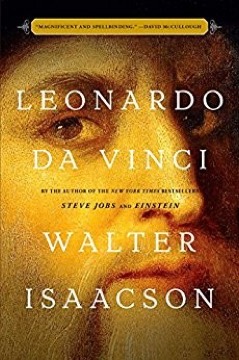
Leonardo da Vinci
Walter Isaacson's biography built from the notebooks — an account of a man whose curiosity ranged across anatomy, engineering, optics, geology and art, and who finished almost nothing.
- First published
- 2017
- Publisher
- Simon & Schuster
- Pages
- 599
- Shelf
- History
- Level
- Core
- ISBN-13
- 9788466347761
Record checked against
Catalogue note
- Reads as
- ReflectiveChanges how you see rather than what you do.
- Level
- Core / BuildingAssumes general familiarity with the subject.
- Approach
- Theoretical
- Written for
- Readers of history, Readers with some grounding
Saved in this browser only — no account, nothing sent anywhere. My library
Read this if
- You want a life told honestly, at full length.
- You make things, and want to understand the work rather than wait for inspiration.
- You want to know how we know things, and how that goes wrong.
- You want a book that changes how you see things rather than what you do tomorrow.
- You know roughly how the subject works and want the fuller account.
The source
Isaacson works primarily from the surviving notebooks, thousands of pages of drawings and notes in mirror writing covering anatomy, hydraulics, optics, flight, geology, mathematics and design.
Working from them rather than from the paintings changes the portrait. What emerges is less a supreme artist who also dabbled than a relentless observer for whom painting was one output among many.
Working from the notebooks rather than the paintings produces an observer for whom painting was one output among several.
Devmark’s reading — not a quotation from the book
Curiosity as a method
Isaacson's central argument: Leonardo's distinguishing quality was not innate genius but a refusal to stop asking, applied to questions nobody considered worth investigating.
His to-do lists are the evidence — describe the tongue of the woodpecker, find out why the sky is blue, measure how the sun warms water — and they record a person systematically pursuing things for no purpose beyond wanting to know.
Observation
His treatment of Leonardo's visual attention: the study of how water moves around obstacles, of dragonfly wings beating in pairs, of facial muscles dissected to understand a smile.
The argument connecting the science to the art is the book's best: the anatomical dissection of the human face is directly responsible for what happens in the paintings, and the observation was not in service of the art but the art benefited from it.
The anatomy
His chapters on the dissections, including the heart valve studies in which Leonardo correctly described the movement of blood through the aortic valve using a glass model and grass seeds.
That finding was not confirmed until the twentieth century. It sat in an unpublished notebook for four hundred years, which is the book's clearest illustration of the cost of not finishing.
Not finishing
The recurring theme. The Sforza horse never cast, the Battle of Anghiari lost to an experimental technique, the Adoration abandoned, the treatises never assembled, the Mona Lisa carried for sixteen years and never delivered.
Isaacson's reading is that Leonardo declined to declare things finished because he kept seeing more, and that the incompletion was a consequence of the same quality that produced the work. That is generous, and it is also supported by the pattern.
The paintings
His treatment of the small surviving body of work: the Last Supper's psychological composition and its technical failure, the Mona Lisa's sfumato and the connection to his optical studies, the Salvator Mundi and its contested attribution.
His analysis of sfumato as a deliberate response to how vision actually works — edges are not sharp, and a painting that renders them sharply is less true than one that does not — is the strongest art-historical material in the book.
Edges are not sharp in vision, so a painting that renders them sharply is less true. That is what sfumato is for.
Devmark’s reading — not a quotation from the book
The life
Isaacson handles the biography directly: illegitimate birth, which excluded him from university and from his father's profession and left him to teach himself; his homosexuality, treated as ordinary fact; his court employment and the flattery required by it.
His argument that being an outsider by birth was an advantage — no classical education to constrain him, no guild orthodoxy to obey — is plausible and is made carefully rather than romantically.
The engineering
His chapters on the machines: flying devices, water systems, weapons designs, theatrical mechanisms and civil engineering proposals.
Isaacson is honest that most were never built and that some would not have worked. Their value is as records of a mind working out mechanisms from first principles, and several of the theatrical designs were built and did work, which is less well known.
Where the book is criticised
Art historians have noted that Isaacson's specialist knowledge is secondary, that the book relies heavily on existing scholarship, and that its lesson-drawing — the chapters that extract habits for the reader — sits awkwardly with the historical material.
The Salvator Mundi material has also aged awkwardly given subsequent doubts about attribution and the painting's disappearance from public view.
What to take from it
The notebooks as an argument for keeping a record of one's own questions, which is the book's most practical suggestion and the one Isaacson presses hardest.
And the observation that Leonardo's science and art were the same activity, which reframes the common description of him as a person of many talents. He had one talent, applied without regard to category.
What to take away
- 01One activity, not many talentsThe dissections and the paintings were the same practice of looking, not separate careers.
- 02The questions were their own purposeHis lists record things pursued for no reason beyond wanting to know, which is the method he is arguing for.
- 03Sfumato is optical honestyVision has no sharp edges, so a painting with them is less accurate, not more.
- 04Not finishing cost four centuriesThe heart valve finding sat in an unpublished notebook until the twentieth century confirmed it.
- 05Outsider status was an advantageNo university, no guild orthodoxy, and therefore nothing he was obliged to accept.