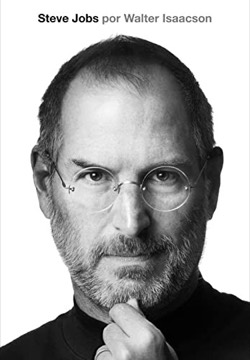
Steve Jobs
Lecciones de liderazgo
Walter Isaacson's authorised biography, written with Jobs's cooperation and his instruction not to show him the manuscript — an account of a career built on taste, cruelty and an unusual insistence on controlling the whole product.
- First published
- 2011
- Publisher
- Simon & Schuster (U.S.)
- Pages
- 665
- Shelf
- History
- Level
- Entry
- ISBN-13
- 9781982130428
Record checked against
Catalogue note
- Reads as
- ReflectiveChanges how you see rather than what you do.
- Level
- Accessible / FoundationalNo prior reading assumed.
- Approach
- Theoretical
- Written for
- Readers of history, Newcomers to the subject
Saved in this browser only — no account, nothing sent anywhere. My library
Read this if
- You want a life told honestly, at full length.
- You want to understand what technology is doing to how we live.
- You care why some things are obvious to use and others are not.
- You want a book that changes how you see things rather than what you do tomorrow.
- You are starting from scratch here and want a way in that assumes no prior reading.
The terms it was written on
Jobs asked Isaacson to write it, gave more than forty interviews, encouraged people who disliked him to speak freely, and declined to read it before publication.
That arrangement is the book's foundation and its main claim to reliability. It also means the frame is Jobs's own — he chose the biographer and the moment — and the selection of what mattered in his life is partly his.
He chose the biographer and the moment, which makes the frame partly his even though the text was not.
Devmark’s reading — not a quotation from the book
Adoption and the early years
Isaacson treats the adoption as formative, and Jobs's own comments about feeling both abandoned and specially chosen recur throughout.
The counter-cultural context matters as much: the fruit farm, the experimentation, the trip to India, and the Zen practice he maintained for decades, which Isaacson connects directly to the aesthetic of simplicity that later defined the products.
The Wozniak partnership
His account of the founding: one person who could build an elegant machine and another who understood that it had to be a product someone could buy.
His handling of the Atari payment dispute — where Jobs told Wozniak a smaller figure than he had received — is presented plainly and without resolution, and it establishes early a pattern the book returns to repeatedly.
The reality distortion field
The term colleagues coined for Jobs's capacity to convince people that impossible schedules were achievable, and the book's most useful psychological observation.
Isaacson's treatment is balanced: it produced work people did not believe they could do, and it also produced burnout, dishonesty about what was possible, and decisions that were simply wrong and were held anyway.
The exile and NeXT and Pixar
His account of the removal from Apple and the years following, which he argues were necessary rather than merely painful.
The Pixar chapters are the most underrated part of the book. Jobs's role was largely as a funder and negotiator rather than a creative force, and the discipline he learned about how a creative organisation actually works shows up in his second period at Apple.
The return and the method
His account of the restructuring: cutting the product line to a few machines, the Think Different campaign, and the sequence of products that followed.
The method Isaacson identifies is consistent: control the entire experience end to end, refuse the customer's stated preference in favour of what they would want once they saw it, and treat design as the primary rather than the final consideration.
The cruelty
The book does not minimise it. Jobs humiliated employees publicly, claimed others' ideas, denied paternity of his daughter for years, and parked in disabled spaces.
Isaacson's position is that the harshness and the results were connected, which he states without endorsing. Readers divide on whether the book ultimately excuses the behaviour by presenting it as inseparable from the achievement, and that is a fair thing to argue about.
Whether presenting the cruelty as inseparable from the achievement amounts to excusing it is a fair argument.
Devmark’s reading — not a quotation from the book
The illness
His account of the cancer diagnosis and of the nine months Jobs spent pursuing alternative treatments before agreeing to surgery.
Jobs himself later expressed regret about the delay. Isaacson reports it directly and does not speculate about the counterfactual, which is the responsible handling of a question that invites speculation.
As a biography
Its strengths are access and candour. Its weakness, identified by many reviewers, is that Isaacson is stronger on narrative than on analysis — the book reports what happened extensively and explains why less often.
There is comparatively little about how Apple actually worked as an organisation, about the contributions of people other than Jobs, and about the technology itself.
What to take from it
The insistence on controlling the whole experience rather than one layer of it, which is the single most transferable idea in the book and explains most of the specific decisions.
And a clear-eyed view of the cost. The book is frequently read as a manual for how to behave, which is not what it shows: the behaviour damaged people and the results happened anyway, and the two facts are separate.
What to take away
- 01Control the whole experienceHardware, software, retail and packaging as one product, which explains most of the individual decisions.
- 02Refuse the stated preferenceHis method was building what people would want once they saw it, which only works if you are right.
- 03The distortion field cut both waysIt produced work people thought impossible and it also produced wrong decisions held past their evidence.
- 04Pixar taught him creative organisationsThe exile years are underrated, and the second Apple period is visibly different because of them.
- 05It is not a manual for behaviourThe cruelty damaged people and the results happened as well, and the two are separate facts.