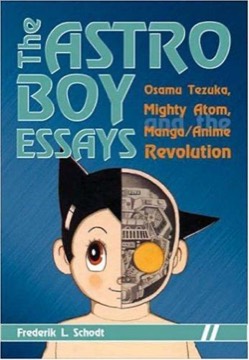
The Astro Boy Essays
Frederik L. Schodt's 2007 study of Osamu Tezuka through the single character he is best known for, combining biography, criticism and the author's own recollections.
- First published
- 2007
- Publisher
- Stone Bridge Press
- Pages
- 215
- Shelf
- Anime
- Level
- Core
- ISBN-13
- 9781933330549
Record checked against
Only one source carried a publication date for this work, so the year is uncorroborated.
Catalogue note
- Reads as
- ReflectiveChanges how you see rather than what you do.
- Level
- Core / BuildingAssumes general familiarity with the subject.
- Approach
- Theoretical
- Written for
- Readers of comics, and anyone curious how the form works, Readers with some grounding
Saved in this browser only — no account, nothing sent anywhere. My library
Read this if
- You want a life told honestly, at full length.
- You want to know how we got here.
- You care why some things are obvious to use and others are not.
- You want a book that changes how you see things rather than what you do tomorrow.
- You know roughly how the subject works and want the fuller account.
What it is
A book about Tezuka organised around Astro Boy: the character's creation, his development across decades, the 1963 television series, the merchandising, the American adaptation, and the robot's afterlife in Japanese culture.
Schodt knew Tezuka personally and interpreted for him, and the book combines scholarship with first-hand recollection.
One character, used as the route into the career of the person who invented modern manga.
Devmark’s reading — not a quotation from the book
The personal material
Schodt worked as Tezuka's English interpreter on several trips, and the passages describing him at work — his schedule, his temper, his competitiveness — are the book's most distinctive content.
Almost nothing comparable exists in English, and the portrait is affectionate without being uncritical. Schodt also travelled with him internationally, and the account of Tezuka working through jet lag and unfamiliar countries is among the book's funniest material.
Tezuka's competitiveness
The book is frank about his difficulty with younger rivals, his inability to delegate, and the professional insecurity that persisted despite his standing.
The gekiga generation's challenge to him in the 1960s is covered in particular detail, and Schodt does not pretend Tezuka responded to it gracefully.
The robot as subject
Astro Boy's status — a machine with a child's face, built to replace a dead son, denied full legal personhood — is analysed as a sustained argument rather than as an adventure premise.
Schodt connects it to Japanese attitudes toward robotics and to the industry's later enthusiasm for humanoid machines.
Technology and Japan
A substantial thread concerns why robots are received differently in Japan than in the West, taking in Shinto animism, post-war industrial policy and the absence of a Frankenstein tradition.
The argument is handled carefully and Schodt is sceptical of the simpler versions of it that circulate widely.
The 1963 series
The account of the television adaptation covers the production constraints, the low sale price, and the merchandising arrangements that followed, which Steinberg later analysed at length.
Schodt's version is shorter and is based partly on conversations with people involved, which gives it a different kind of authority.
American reception
The adaptation for American television, with changed names, altered episodes and removed content, is documented in detail.
The material is a useful case study in how Japanese animation was initially handled abroad, and several of the alterations are genuinely extraordinary. Names were anglicised, episodes dealing with racial themes were dropped entirely, and the broadcaster commissioned additional material to fill the resulting gaps.
Tezuka's politics
The book takes seriously his pacifism, his ambivalence about technology and his preoccupation with discrimination, and connects them to his wartime experience in Osaka.
Schodt argues these were consistent commitments rather than themes he happened to return to. He witnessed the Osaka air raids as a teenager and has described the experience directly, and Schodt treats it as the origin of nearly everything that followed.
Structure
It is organised as linked essays rather than as a continuous narrative, which means some material recurs and the chronology is not strict.
The looseness suits the mixture of scholarship and memoir, and individual chapters can be read independently. Readers looking for a straightforward account of Tezuka's life will find it distributed across the chapters rather than presented in sequence, which takes some adjustment.
Illustrations
The book includes a substantial amount of visual material, including photographs and reproduced pages, and the design is careful.
The images are genuinely necessary rather than decorative, particularly in the sections about character design and the American alterations. Several of the photographs are Schodt's own, taken during the trips he describes, and they give the book a documentary quality the text alone would lack.
Its position
It is the best English-language book on Tezuka and among the most useful on the early industry, and it won an Eisner award.
Readers wanting a full biography will find it partial by design, since the Astro Boy frame excludes a great deal of his output.
Who it is for
Readers who have read some Tezuka and want to understand the person and the period, and readers interested in how Japanese animation first reached American audiences.
It requires no scholarly background and reads quickly, and its first-hand material makes it valuable even for readers who know the history from elsewhere.
What to take away
- 01First-hand accessSchodt interpreted for Tezuka and the portrait of him working — schedule, temper, insecurity — exists nowhere else in English.
- 02A career through one characterAstro Boy's development across decades serves as the route into Tezuka's whole output and its preoccupations.
- 03Not handled gracefullyThe gekiga generation's challenge in the 1960s is covered frankly, including Tezuka's poor response to it.
- 04Robots received differentlyShinto animism, industrial policy and the absence of a Frankenstein tradition are examined, and the simpler versions are treated sceptically.
- 05The American alterations documentedChanged names, altered episodes and removed content make a useful case study in early handling of Japanese animation abroad.
- 06Consistent commitmentsPacifism, ambivalence about technology and a preoccupation with discrimination are traced to wartime Osaka rather than treated as recurring motifs.