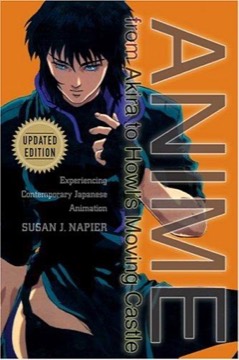
Anime from Akira to Howl's Moving Castle
Susan J. Napier's study, first published in 2001 and revised in 2005, which reads anime as a body of work expressing Japanese cultural anxieties.
- First published
- 2005
- Publisher
- St. Martin's Griffin
- Pages
- 400
- Shelf
- Anime
- Level
- Core
- ISBN-13
- 9781403970510
Record checked against
Only one source carried a publication date for this work, so the year is uncorroborated.
Catalogue note
- Reads as
- ReflectiveChanges how you see rather than what you do.
- Level
- Core / BuildingAssumes general familiarity with the subject.
- Approach
- Theoretical
- Written for
- Readers of comics, and anyone curious how the form works, Readers with some grounding
- Ideas
Saved in this browser only — no account, nothing sent anywhere. My library
Read this if
- You care why some things are obvious to use and others are not.
- You want a book that changes how you see things rather than what you do tomorrow.
- You know roughly how the subject works and want the fuller account.
What it is
An academic study organised around modes rather than chronology: the apocalyptic, the elegiac and the festival, each illustrated through close readings of specific films and series.
Napier treats anime as a form worth serious critical attention and builds arguments about what its recurring preoccupations reveal.
Anime read as a literature, organised by mode rather than by studio or decade.
Devmark’s reading — not a quotation from the book
The three modes
Napier's framework proposes that anime works predominantly in one of three registers: apocalyptic destruction, elegiac loss, and carnivalesque inversion.
The scheme is productive rather than exhaustive, and she applies it flexibly. Its value is in making comparison possible across works that otherwise appear to have nothing in common.
Close reading
The method is literary: sustained attention to individual works, with particular emphasis on Akira, Grave of the Fireflies, Ghost in the Shell, Princess Mononoke and Miyazaki's later films.
The readings are the book's substance, and they are careful and frequently illuminating about material that had not previously received this kind of attention in English.
Gender
A substantial portion concerns the representation of women, including the shōjo figure, the armoured female body and the ambivalence of magical-girl transformation.
This is among the book's strongest material, and it established a set of questions that subsequent scholarship has continued to work on. Napier is also careful to distinguish between representation that empowers and representation that merely displays, and she does not assume that a capable female figure is automatically progressive.
Post-war anxiety
Napier reads the recurrence of destroyed cities, contaminated landscapes and technological catastrophe as connected to the atomic bombings and to post-war Japanese identity.
The argument is well made and is also the book's most contested claim, since it risks explaining a very large and varied industry through a single national trauma.
The first of its kind
When it appeared, there was almost no serious English-language academic writing on anime, and the book did a great deal to establish the field.
Its influence is visible in most subsequent scholarship, including the work that disagrees with it. It also arrived as anime was reaching Western audiences in volume, which meant it shaped how a generation of English-speaking viewers understood what they were watching.
The critique
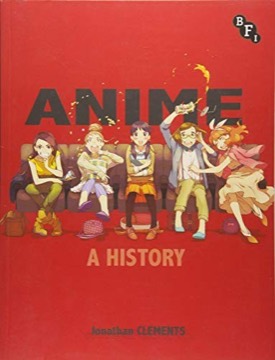
Clements and others have argued that Napier's approach is too textual and too willing to treat commercial products as expressions of national psychology without evidence from production.
The objection has force. Napier's readings are frequently persuasive as criticism and are not grounded in how the works were actually commissioned.
Accessibility
The prose is academic but not obscure, and the book was clearly written with an audience beyond specialists in mind.
Readers without a background in film or cultural theory will follow it without difficulty, which is not true of all the criticism in this section.
Scope
The revised edition extends coverage to Howl's Moving Castle and adds material on the international reception of anime.
The coverage stops well short of the present, which limits its usefulness as a survey while leaving its arguments intact. Readers approaching it now should treat it as a study of a particular period rather than as a guide to the medium as it currently stands.
Napier's other work
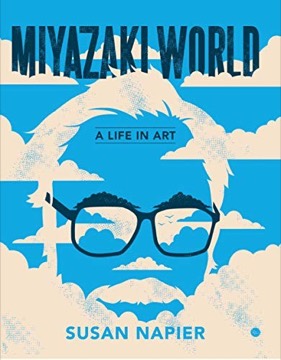
Miyazakiworld is her later single-director study, and she has also written on Japanese literature more broadly.
The progression from this book to the Miyazaki study shows her moving from survey toward biography, and readers interested in the director should go to the later book. Her academic background is in Japanese literature rather than film, which accounts for the literary method and for the confidence with which she reads visual material as text.
As an introduction
For a reader who wants to think about anime rather than to learn how it is produced, this remains the most useful starting point in English.
It supplies a vocabulary and a set of questions, and it treats the material with a seriousness that was genuinely new when it appeared.
Who it is for
Readers who want criticism rather than history, and who are comfortable with an approach that reads popular work for cultural meaning.
It pairs naturally with Clements's history, and reading both is the fastest way to understand the main disagreement in the field. Readers who came to anime through the Ghibli films in particular will find a great deal here, since Miyazaki receives sustained attention throughout.
What to take away
- 01Three modes as a comparative toolApocalyptic, elegiac and carnivalesque registers make comparison possible across works with nothing else in common.
- 02A literary method appliedSustained close reading of individual films treated anime with a seriousness that was new in English scholarship.
- 03Gender as a central questionThe shōjo figure and the armoured female body established questions subsequent scholarship still works on.
- 04National trauma as explanationReading destroyed cities as connected to the atomic bombings is persuasive and is the book's most contested move.
- 05The counter-argumentCritics object that the approach is too textual and treats commercial products as national psychology without production evidence.
- 06Field-foundingAlmost no serious English-language academic writing on anime existed beforehand, and most since responds to this book.