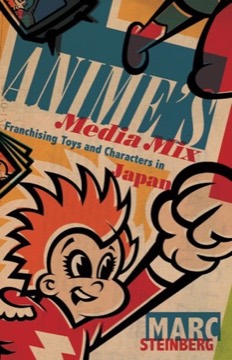
Anime's Media Mix
Marc Steinberg's 2012 study of how character franchises spread across television, toys, publishing and advertising, using Astro Boy as its founding case.
- First published
- 2012
- Publisher
- University of Minnesota Press
- Pages
- not established
- Shelf
- Anime
- Level
- Deep
- ISBN-13
- 9781452938677
Record checked against
Only one source carried a publication date for this work, so the year is uncorroborated. No page count is recorded, so no reading estimate is shown for the book itself.
Catalogue note
- Reads as
- ReflectiveChanges how you see rather than what you do.
- Level
- Advanced / AdvancedAssumes you have read around the subject already.
- Approach
- Theoretical
- Written for
- Readers of comics, and anyone curious how the form works, Specialists and serious readers
- Ideas
Saved in this browser only — no account, nothing sent anywhere. My library
Read this if
- You care why some things are obvious to use and others are not.
- You want a book that changes how you see things rather than what you do tomorrow.
- You have read around this already and want a book that assumes it.
What it is
A history and theory of the media mix — the Japanese practice of distributing a single property across animation, manga, toys, stickers, advertising and games simultaneously rather than sequentially.
Steinberg traces the model to the 1963 Astro Boy television series and the marketing arrangements that financed it.
How one character became a television series, a sticker, a chocolate promotion and a business model.
Devmark’s reading — not a quotation from the book
The founding case
The Astro Boy series was sold to broadcasters below cost, with the shortfall covered by merchandising and by a sponsorship arrangement with a confectionery company.
Steinberg argues this was not merely a funding expedient but the invention of a distribution logic that reshaped the entire Japanese content industry.
Stickers
An extended analysis of the Astro Boy stickers included with sweets treats them as a serious object: cheap, portable, endlessly recombinable, and attaching the character to the child's own environment.
The sticker chapter is the book's most original material and its most frequently cited. Steinberg tracks how many were produced, how children used them and where they ended up, and the archival specificity is what makes the theoretical claim convincing.
The character as platform
Steinberg's central concept is that the character, not the story, is the unit that travels: detachable from narrative, recognisable in any medium, and capable of carrying attachment across formats.
This explains a great deal about Japanese franchise behaviour that a story-centred account cannot. It also explains why a property can survive the failure of any individual work built on it, since the attachment is to the figure rather than to any particular story.
Against Western franchise models
The book distinguishes the Japanese media mix from Hollywood licensing, where a film is primary and other products derive from it.
In the media mix no medium is primary, and Steinberg argues that this horizontal arrangement produces different creative and commercial consequences. The distinction matters practically as well as theoretically, since it accounts for why Japanese properties are frequently developed simultaneously across formats rather than sequentially.
Limited animation, again
Steinberg connects limited animation's stillness to the character's detachability: a figure that holds still is a figure that can become an image on a sticker.
The argument links production technique to marketing form in a way that is genuinely illuminating and is not obvious before it is stated.
Later developments
The final chapters extend the analysis to later franchises and to the database-driven consumption that Azuma describes, tracing continuity across several decades.
The historical argument is that contemporary franchise behaviour is not new and follows a template established in 1963. He also connects the model to the emergence of character-led mobile games and to franchises that have no single originating text at all.
Method
It is a media studies monograph, drawing on advertising records, trade sources and Japanese theory, with the usual scholarly apparatus.
The writing is clear and the theoretical content is manageable, making it considerably more accessible than Lamarre while remaining rigorous. The advertising and confectionery records in particular are material that had not previously been used for this purpose, and they are the source of the book's most original chapter.
Relevance beyond anime
The book is frequently cited in discussions of transmedia and franchise strategy generally, including by people with no particular interest in Japanese animation.
Its account of character-led distribution anticipates a great deal of what has since become standard practice internationally. Readers working in marketing or in media strategy frequently encounter it for that reason rather than through any interest in the works it describes.
Limitations
The focus on a single founding case is both the book's strength and its constraint, and readers may reasonably ask how much of the model was genuinely invented there.
The later chapters are also thinner than the Astro Boy material, which is where the archival work is concentrated.
Pairing
It reads naturally alongside Clements's industrial history and Azuma's work on otaku consumption, and the three together give a reasonably complete account of the industry's economics.
Steinberg supplies the mechanism that connects the other two. Clements explains the money, Azuma explains the consumption, and Steinberg explains how the property physically moves between them.
Who it is for
Readers interested in how franchises work, in media economics, or in why Japanese properties behave differently from American ones.
It is scholarly and readable, and it is the most useful book in this section for someone whose interest is commercial rather than aesthetic. It is also considerably shorter and more focused than most media studies monographs, which makes it an unusually efficient read for the amount of argument it contains.
What to take away
- 01A model invented in 1963Selling Astro Boy below cost and covering the shortfall with merchandising created a distribution logic, not just a funding fix.
- 02The character travels, not the storyDetachable from narrative and recognisable anywhere, the character is the unit that carries attachment across formats.
- 03Stickers as serious objectsCheap, portable and recombinable, they attached the character to a child's own environment, and the analysis is the book's most original.
- 04No medium is primaryThe horizontal media mix differs from Hollywood licensing, where a film is central and everything else derives from it.
- 05Stillness enabling circulationLimited animation's held figures are what make a character reproducible as a sticker, linking technique to marketing.
- 06Anticipating transmediaThe account of character-led distribution describes practice that became standard internationally decades later.