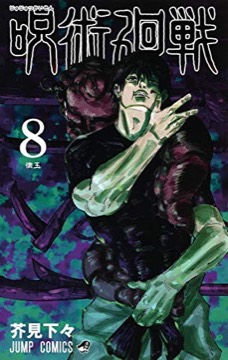
Jujutsu Kaisen
Gege Akutami's series, begun in 2018, in which a student swallows a cursed object and becomes host to a powerful spirit. Modern shōnen with unusually strict combat logic.
- First published
- 2018
- Publisher
- Viz Media
- Pages
- 192
- Shelf
- Anime
- Level
- Entry
- ISBN-13
- 9781974718719
Record checked against
Catalogue note
- Reads as
- ReflectiveChanges how you see rather than what you do.
- Level
- Accessible / FoundationalNo prior reading assumed.
- Approach
- Theoretical
- Written for
- Readers of comics, and anyone curious how the form works, Newcomers to the subject
Saved in this browser only — no account, nothing sent anywhere. My library
Read this if
- You read for the writing as much as for the argument.
- You care why some things are obvious to use and others are not.
- You want a book that changes how you see things rather than what you do tomorrow.
- You are starting from scratch here and want a way in that assumes no prior reading.
What it is
Yuji Itadori swallows a preserved finger belonging to Ryomen Sukuna, a legendary cursed spirit, and becomes his vessel. Rather than being executed, he is enrolled at a school for sorcerers and given a stay of execution until the remaining fingers are collected.
The series follows the students, the institution that trains them, and the curses produced by accumulated human negative emotion.
Sentenced to death, with the sentence deferred until he has finished being useful.
Devmark’s reading — not a quotation from the book
Cursed energy and its rules
Combat is governed by a detailed system: cursed techniques with binding conditions, domain expansions that guarantee outcomes within a bounded space, and binding vows that trade freedom for power.
The system is rigorous in the Hunter x Hunter tradition. Fights are frequently decided by a character accepting a permanent restriction in exchange for a temporary advantage.
Binding vows
The mechanic by which a sorcerer gains power by imposing a genuine cost on themselves is the series' best idea, and it is used for strategy rather than for escalation.
It also produces genuine tension, since the costs are real and not subsequently reversed. A sorcerer who swears never to use a technique again can borrow enormous strength for one exchange, and the series honours the debt afterwards.
Mortality
The series kills significant characters abruptly and often, including at moments a reader would expect to be protected.
Akutami has been explicit that the deaths are intended to be pointless rather than meaningful, which is a distinctive and frequently distressing editorial position. The effect is that no confrontation can be assumed survivable, which sustains tension that a more protective series would have lost.
Gojo
The most powerful sorcerer is charismatic, flippant and genuinely overwhelming, and the series spends considerable effort constructing situations that remove him.
He is both the work's best-loved creation and its central structural problem, since a character this strong makes most threats trivial unless he is absent.
Horror design
The curses are genuinely unpleasant: asymmetric, improvised-looking, frequently made of mouths and misplaced limbs.
The horror register is stronger than in most action series, and several sequences are closer to body horror than to conventional combat. Akutami has cited horror manga and film as direct influences, and the curses owe considerably more to that tradition than to the action genre the series otherwise inhabits.
Institutions
Jujutsu society is governed by conservative elders, an execution-happy bureaucracy and inherited clan politics, and the series is consistently hostile to all three.
The argument that the institution protecting people is the same institution producing the conditions for curses is present throughout, though it is developed unevenly.
The art
Akutami's drawing is loose and expressive, and the action becomes noticeably harder to parse as the series proceeds and the schedule tightens.
Character designs are strong and the horror imagery is consistently effective. The fight choreography is where the pressure of weekly serialisation shows most.
The Shibuya arc
The extended incident in a Tokyo district is the series' peak: a large cast, simultaneous confrontations, and consequences that permanently reshape the premise.
It is also where the series' willingness to destroy its own setup becomes fully apparent, and nothing afterwards returns to the previous arrangement.
Pacing problems
The final arcs are widely criticised for a sequence of tournament-style confrontations that slow the narrative considerably, and for explanations delivered in dense expository blocks.
Akutami's health and schedule have been publicly discussed, and the strain is visible in the later volumes. Several arcs that were plainly planned at length are resolved in a handful of chapters, and the compression is visible on the page.
Its position
It was among the defining commercial successes of its period and its animated adaptation brought a very large international audience to the property.
Its reputation among readers is strong for the first half and contested for the second, which is a common shape for weekly series of this scale.
Who it is for
Readers who want strict combat logic and genuine stakes, and who can accept horror imagery and the deaths of characters they have invested in.
It is complete, and readers who value the systemic rigour of Hunter x Hunter but want something finished will find this the closest available substitute.
What to take away
- 01Power bought with permanent costBinding vows let a sorcerer trade genuine, irreversible restrictions for strength, and the costs are never quietly undone.
- 02Deliberately pointless deathsAkutami has stated the deaths are meant to be meaningless rather than redemptive, which is unusual and frequently distressing.
- 03Guaranteed outcomes in bounded spaceDomain expansions make a fight's result certain within a defined area, which forces opponents to solve the space rather than the person.
- 04A character too strong to keepGojo is the series' best-loved creation and its central structural problem, requiring constant contrivance to remove him.
- 05Hostile to its own institutionConservative elders and an execution-ready bureaucracy are presented as producing the conditions they claim to police.
- 06Body horror in an action frameThe curse designs are asymmetric and improvised-looking, pushing several sequences closer to horror than to combat.