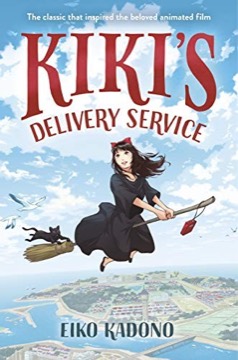
Kiki's Delivery Service
Eiko Kadono's 1985 children's novel about a thirteen-year-old witch who must leave home for a year and establish herself in a town of her choosing.
- First published
- 1985
- Publisher
- Estação Liberdade
- Pages
- 208
- Shelf
- Anime
- Level
- Entry
- ISBN-13
- 9780241449486
Record checked against
Two sources agreed on 1985; a third reported differently (openlibrary 2020, wikidata 1985, wikipedia 1985).
Catalogue note
- Reads as
- ReflectiveChanges how you see rather than what you do.
- Level
- Accessible / FoundationalNo prior reading assumed.
- Approach
- Theoretical
- Written for
- Readers of comics, and anyone curious how the form works, Newcomers to the subject
Saved in this browser only — no account, nothing sent anywhere. My library
Read this if
- You read for the writing as much as for the argument.
- You want a book that changes how you see things rather than what you do tomorrow.
- You are starting from scratch here and want a way in that assumes no prior reading.
What it is
Kiki is thirteen, which by witch custom means she must leave home for a year, find a town without a witch, and support herself using whatever magic she has.
Her only reliable skill is flying, so she starts a delivery service. The novel follows her first year through a sequence of episodic deliveries and the relationships they produce.
A thirteen-year-old with one marketable skill, setting up a business in a town she has never seen.
Devmark’s reading — not a quotation from the book
Work
The book's actual subject is starting a small business: finding premises, setting prices, dealing with difficult customers, and the loneliness of working alone in a place where nobody knows you.
It treats a child's enterprise with complete seriousness, and the practical problems are the plot.
Episodic structure
Each chapter is a delivery that goes wrong in a different way, and the customers' circumstances supply the variation.
The design makes it readable in small portions, which suits its intended audience, and the accumulation of Kiki's competence across the episodes is the real progression.
Independence
The custom requiring a year away is presented as ordinary rather than as hardship, and Kiki's homesickness is handled without either minimising it or dramatising it.
The novel's confidence that a thirteen-year-old can manage this is its defining quality and is what distinguishes it from most children's fiction about leaving home.
Magic
Witchcraft here is a diminishing family trade: Kiki's mother makes medicine, Kiki can only fly, and the book notes that each generation has less.
The framing is matter-of-fact and slightly melancholy, and magic is treated as a skill with limits rather than as a source of wonder.
Jiji
Her black cat talks, which in the novel is presented without explanation and without significance beyond companionship.
Their conversations are the book's main source of humour, and the relationship is written as an ordinary friendship rather than as a familiar-and-witch arrangement. Kadono also uses him to externalise Kiki's own doubts, so the conversations function as internal monologue with a second speaker, which is a neat solution for a children's book.
Tone
It is gentle, unhurried and almost entirely without threat, and nothing genuinely dangerous happens across its length.
The absence of jeopardy is deliberate. The book's tension comes from uncertainty about whether Kiki is managing, which is sufficient. Kadono has said she wrote it after her daughter drew a picture of a witch flying with a radio, which is an origin entirely consistent with the book's register.
The sequels
Kadono wrote several continuations following Kiki into adulthood, marriage and parenthood, which are less well known outside Japan.
The series covers a considerable span, and the later volumes address questions the first leaves open about what a witch's life becomes. The final volumes in particular take the character somewhere the first book gives no indication of, and they change what the original looks like in retrospect.
The film
Miyazaki's 1989 adaptation is far better known and differs substantially: it compresses the timeline, adds a crisis involving Kiki losing her magic, and gives the story a dramatic climax the novel does not have.
Kadono was reportedly unhappy with the changes, and the two works have genuinely different shapes.
Novel against film
The film is about an artist's loss of confidence; the novel is about a teenager establishing a business.
Both are good and they are not the same story. Readers who know the film will find the book quieter, longer and considerably less dramatic. Readers who want the film's emotional arc will not find it, and readers who want a practical book about becoming self-sufficient will find rather more of it.
The translation
An English edition became widely available only after the film's international success, and the prose is plain and clear in translation.
It is genuinely a children's book, and adults reading it should not expect the additional layer that the Ghibli films often supply. The English edition also restores Kadono's chapter structure, which the film necessarily discarded, and the episodic shape is considerably clearer on the page.
Who it is for
Children, and adults who want to know what the film was made from.
It is short, kind and unexpectedly practical, and its treatment of self-sufficiency is more useful than most fiction aimed at the same age manages. It is also a reasonable book to give a child who is about to face something unfamiliar on their own, which is more or less what it was written for.
What to take away
- 01A book about a small businessPremises, pricing, difficult customers and working alone are the plot, treated with complete seriousness.
- 02Independence assumed, not provedThe year away is presented as ordinary custom, and the novel's confidence in a thirteen-year-old is its defining quality.
- 03Magic as a diminishing tradeEach generation has less, and Kiki can only fly, which makes witchcraft a limited skill rather than a source of wonder.
- 04No jeopardy at allNothing dangerous happens, and the tension comes entirely from uncertainty about whether she is coping.
- 05A different story from the filmMiyazaki added a crisis of confidence the novel does not contain, and the author was reportedly unhappy about it.
- 06Competence accumulated episodicallyEach delivery goes wrong differently, and the real progression is how much better Kiki gets at handling it.