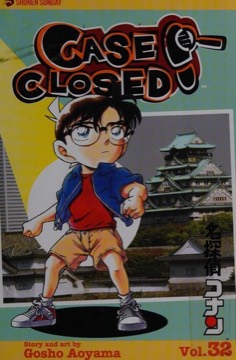
Case Closed
Gosho Aoyama's series, begun in 1994 and published in English as Case Closed, about a teenage detective chemically reduced to a child. One of the longest-running manga in publication.
- First published
- 1994
- Publisher
- VIZ Media
- Pages
- 142
- Shelf
- Anime
- Level
- Entry
- ISBN-13
- 9781421522005
Record checked against
Catalogue note
- Reads as
- ReflectiveChanges how you see rather than what you do.
- Level
- Accessible / FoundationalNo prior reading assumed.
- Approach
- Theoretical
- Written for
- Readers of comics, and anyone curious how the form works, Newcomers to the subject
Saved in this browser only — no account, nothing sent anywhere. My library
Read this if
- You read for the writing as much as for the argument.
- You want to be kept up late, and made uneasy about who to believe.
- You want a book that changes how you see things rather than what you do tomorrow.
- You are starting from scratch here and want a way in that assumes no prior reading.
What it is
Shinichi Kudo, a high-school detective, is poisoned by a criminal organisation and wakes in the body of a six-year-old. He adopts an alias, moves in with a private investigator, and continues solving cases while hiding his identity.
The series proceeds as largely self-contained mysteries with an overarching plot about the organisation.
A teenage detective in a six-year-old's body, solving murders that nobody will let him take credit for.
Devmark’s reading — not a quotation from the book
The mystery structure
Cases follow a fair-play model: the clues are shown, the solution is derivable, and the reveal is staged as a formal explanation.
Aoyama plays reasonably fair, and the puzzles are constructed rather than merely asserted, which distinguishes the series from a great deal of detective fiction in the medium.
The central problem
Conan cannot be seen to solve cases, so each resolution requires him to manufacture a way for an adult to deliver the explanation.
The device is a genuinely good structural constraint that generates comedy and complication, and the series has used it for thousands of chapters without exhausting it.
Length
It has run continuously since 1994 and is among the longest-running series in the medium, with well over a hundred volumes.
The length is a serious commitment and the series is deliberately designed to be entered anywhere, with the overarching plot advancing extremely slowly. New readers are frequently advised to start with a recent volume rather than the first, since the early cases are shorter and the drawing is considerably less assured.
The overarching plot
The organisation that poisoned him appears intermittently, and the main narrative advances at a pace that has frustrated readers for decades.
Aoyama has said he knows how it ends. Whether the series will reach that ending is an open question given its publication history. The organisation's members are introduced slowly and several long-running questions about their identities have remained open for decades, which is a substantial test of reader patience.
Tone
The murders are frequent and often elaborate, and the register is light despite a body count that accumulates to absurdity.
The gap between the content and the tone is part of the series' character, and readers who find comic treatments of homicide uncomfortable should be aware.
The cast
Ran, Kogoro, the child detectives and a rotating set of police officers supply the recurring framework, and several have their own long-running arcs.
The supporting characters are broad and reliable rather than developed, which suits a series designed for indefinite continuation. The child detectives in particular function as a reliable comic unit, and their presence lets the series place a competent investigator in situations no adult could enter.
The art
Clean, clear and consistent, with strong emphasis on legibility since the puzzles require the reader to be able to see the relevant details.
Aoyama's visual clarity is a functional necessity rather than an aesthetic choice, and the series is better drawn than its unassuming style suggests.
Its position
It is enormously successful in Japan, with an annual film series and a television run of extraordinary length, and it is a genuine cultural institution.
Its international profile is smaller than its domestic one, partly because the length makes it difficult to market to new readers.
The English publication
Viz published a substantial number of volumes under the Case Closed title with several character names changed, and the release has lagged far behind the Japanese run.
Readers should expect an incomplete English catalogue and inconsistent availability. The name changes in particular cause confusion for readers who encounter the series through the animation, where different conventions were used.
Reading strategy
Because the cases are self-contained, the series supports dipping in at almost any point, and many readers treat it as a mystery anthology rather than as a continuing narrative.
Readers wanting the organisation plot will need to seek out which volumes advance it, since most do not.
Who it is for
Readers who want fair-play detective puzzles in quantity and are content with an unfinished overarching story.
It is the most purely functional series in this section: consistent, reliable, and designed to be consumed indefinitely rather than completed. Readers who want closure of any kind should be aware that the series has been running for over thirty years and shows no sign of concluding.
What to take away
- 01Fair-play puzzlesClues are shown and solutions are derivable, which distinguishes it from detective fiction that merely asserts its reveals.
- 02A constraint that generates plotConan cannot be seen solving anything, so every resolution requires engineering an adult to deliver it.
- 03Designed for indefinite continuationSelf-contained cases and broad reliable supporting characters make the series enterable at almost any point.
- 04A main plot that barely movesThe organisation appears intermittently and the overarching narrative has advanced very little in three decades.
- 05Light tone, enormous body countThe register remains comic across thousands of murders, and the gap is part of the series' character.
- 06Clarity as a functional requirementThe drawing prioritises legibility because the puzzles depend on the reader seeing the relevant detail.