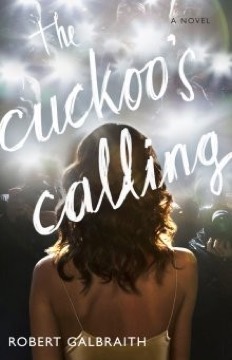
The Cuckoo's Calling
Robert Galbraith's 2013 novel, the first Cormoran Strike book, in which a private detective is hired to investigate the death of a model that the police ruled a suicide.
- First published
- 2013
- Publisher
- Espasa Libros
- Pages
- 480
- Shelf
- Thriller
- Level
- Entry
- ISBN-13
- 9785389067356
Record checked against
Catalogue note
- Reads as
- ReflectiveChanges how you see rather than what you do.
- Level
- Accessible / FoundationalNo prior reading assumed.
- Approach
- Theoretical
- Written for
- Readers who mean to stop at one more chapter, Newcomers to the subject
Saved in this browser only — no account, nothing sent anywhere. My library
Read this if
- You want to be kept up late, and made uneasy about who to believe.
- You read for the writing as much as for the argument.
- You want a book that changes how you see things rather than what you do tomorrow.
- You are starting from scratch here and want a way in that assumes no prior reading.
The premise
Cormoran Strike is a private investigator with one client, enormous debts, a military prosthetic leg and a camp bed in his office. His temporary secretary Robin Ellacott arrives on the day he has decided he cannot afford one.
John Bristow, whose adopted sister Lula Landry fell from a balcony three months earlier, does not accept the suicide verdict and can pay.
A detective sleeping in his office, a temp he cannot afford, and a client with money and a theory.
Devmark’s reading — not a quotation from the book
The pen name
The book was published pseudonymously and sold modestly until Galbraith was identified as J. K. Rowling, after which sales increased enormously.
The episode is part of the book's record and is genuinely interesting as a case study: the novel was well reviewed before anyone knew who had written it.
Traditional construction
It is an old-fashioned detective novel: a closed set of suspects, a sequence of interviews, physical clues, and a final explanatory confrontation.
The form is handled competently and without irony, and the solution is fairly clued, which is rarer in contemporary crime fiction than it should be.
Strike
He is large, damaged, recently separated from a long and destructive relationship, and stubborn in a way that is presented as both his virtue and his problem.
The character is well constructed, and the military background supplies both his investigative method and his physical limitations, which the novel uses practically.
Robin
The temporary secretary is competent, interested, engaged to a man who disapproves, and quickly more useful than her role permits.
The partnership is the series' actual draw, and its development across subsequent books is what has sustained the sequence. Galbraith also gives her a specific reason for wanting the work, and her ambition is established early rather than developing as a surprise.
Celebrity
The novel is substantially about fame: the industries around a famous young woman, the people who profit from her, and the press's treatment of her death.
The material is clearly informed by the author's own experience, and the depiction of tabloid behaviour is specific and angry.
London
The geography is exact and class-conscious, moving between Mayfair, a homeless hostel, a record producer's house and Strike's office above a guitar shop.
The city is used properly rather than as backdrop, and the distances people travel are part of the investigation. The contrast between Strike's circumstances and his clients' is maintained physically, with the novel noting what each journey costs him.
Length
It is long for a detective novel, with extended interviews and a great deal of domestic material about both leads.
The pace is deliberate and the book takes its time. Readers who want velocity will find the middle section slow. The interviews in particular are given full space rather than summarised, which is unusual and is where most of the clueing is distributed.
Class
Strike's own background — the illegitimate son of a rock musician, raised partly in squats — positions him precisely against the wealth he is investigating.
The observation is consistent and is among the novel's better-handled elements. His relationship with his half-siblings, and their embarrassment about him, is handled economically and supplies most of his backstory.
Prose
Plain and functional, with the characterisation carried by dialogue and by accumulated detail rather than by style.
It is efficient rather than distinguished, and the writing is noticeably better in the interview scenes than in the descriptive passages. The dialogue in particular is strong, and each suspect is distinguished by speech pattern in a way that makes the large cast manageable.
The series
Several longer novels follow, and the books have become substantially longer over time while the central relationship develops slowly.
The later volumes have attracted criticism for length and for content unrelated to the mysteries, and readers should approach the series with that in mind. The first three books are the tightest, and readers who want the detective novel without the later expansion should consider stopping after Career of Evil.
Who it is for
Readers who want a traditional, fairly clued detective novel with a good central partnership.
It is the most conventional book in this section and is well made. Readers who want the form done without contemporary trappings will find it satisfying. It also works entirely as a standalone, and readers uninterested in continuing the series lose nothing by reading only this one.
What to take away
- 01A fairly clued solutionThe physical evidence is shown and the answer is deducible, which contemporary crime fiction frequently declines to do.
- 02Damage used practicallyStrike's prosthetic leg imposes real constraints on what he can do, which the plot works around rather than ignoring.
- 03A partnership as the actual drawRobin's competence exceeding her role is what has sustained the series across subsequent books.
- 04Fame examined from experienceThe depiction of tabloid behaviour and of the industries around a famous young woman is specific and angry.
- 05Geography that costs somethingDistances and neighbourhoods are part of the investigation rather than scenery.
- 06A pseudonym that became the storyThe novel was well reviewed before the author was identified, which makes the episode a genuine case study in reception.