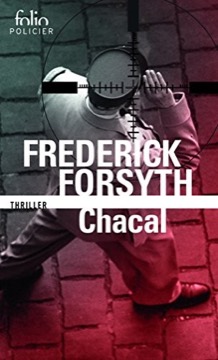
The Day of the Jackal
Frederick Forsyth's 1971 thriller about a professional assassin hired to kill Charles de Gaulle, and the French detective trying to identify him. The template for the procedural thriller.
- First published
- 1971
- Publisher
- Gallimard
- Pages
- 416
- Shelf
- Thriller
- Level
- Entry
- ISBN-13
- 9782070467914
Record checked against
Catalogue note
- Reads as
- ReflectiveChanges how you see rather than what you do.
- Level
- Accessible / FoundationalNo prior reading assumed.
- Approach
- Theoretical
- Written for
- Readers who mean to stop at one more chapter, Newcomers to the subject
Saved in this browser only — no account, nothing sent anywhere. My library
Read this if
- You want to be kept up late, and made uneasy about who to believe.
- You want to understand how power is taken, kept and lost.
- You want a book that changes how you see things rather than what you do tomorrow.
- You are starting from scratch here and want a way in that assumes no prior reading.
The premise
After the loss of Algeria, a French paramilitary group that has repeatedly failed to assassinate President de Gaulle concludes that it must hire an outsider unknown to the security services.
They engage an English professional, identified only by a codename, who sets a very large fee and one condition: absolute operational control.
The problem it solves
De Gaulle was not assassinated, and every reader knows it. The novel therefore cannot generate suspense from the outcome and does not try.
What it substitutes is process. The question is never whether the attempt succeeds but how close a sufficiently methodical stranger can get, and how an investigator with nothing to work from might find him.
You know how it ends. The book is built so that this does not matter.
Devmark’s reading — not a quotation from the book
The procedural method
Forsyth had been a Reuters correspondent in Paris, and the book reads like reporting: documents obtained, forgers commissioned, a rifle specified and built, a route surveyed.
The detail is specific, sequential and technically confident, and it is delivered in a flat declarative register that presents invention and fact in exactly the same tone.
The Jackal as a character
He is given almost no interiority: no politics, no history that can be confirmed, no relationships that are not instrumental. He is defined entirely by competence and preparation.
This is a deliberate construction rather than a failure of characterisation. The absence of motive is what makes him unfindable, and the investigation's central difficulty is that there is no pattern of belief to search for.
Claude Lebel
The detective assigned to find him is unglamorous, middle-aged, politically unprotected and good at his job. He is given a nightly meeting with ministers who want results he cannot yet produce.
The pairing is the book's engine: two professionals, each working methodically, neither aware of the other's progress, converging along a timetable the reader can see and they cannot.
The forged-identity sequence
The best-known passage has the Jackal acquiring a false British passport by finding a child who died in infancy and applying for documents in that name.
The technique was real, was widely reported after the novel, and prompted changes in how several countries cross-check birth and death records. It is the clearest case of the book's research having consequences outside it.
Structure and pace
The novel is built in three parts — the commission, the preparation, and the convergence — and the middle section is much the longest.
Forsyth keeps two clocks running: the assassin's schedule and the investigation's, cutting between them at increasingly short intervals. The acceleration is mechanical and extremely effective.
The political background
The OAS, the Algerian war and the attempt at Petit-Clamart are real, and the opening chapter narrates the historical facts before the fiction begins.
That grounding does specific work: it establishes that the organisation is serious and has already tried, so the reader accepts the premise without the novel having to argue for it.
What it invented
The modern procedural thriller — technical, researched, multi-viewpoint, narrated in journalistic prose — is substantially this book. Forsyth demonstrated that method could carry a narrative without a strong central personality.
Its descendants are everywhere in the genre, and the specific device of following hunter and hunted in parallel is now close to standard.
A whole genre learned that research can do the work interiority usually does.
Devmark’s reading — not a quotation from the book
The prose
Plain, fast, and heavy with nouns. Forsyth explains mechanisms, prices and procedures at length and emotional states hardly at all.
The style has limits. Dialogue is functional, the women in the book exist almost entirely to be used by the plot, and any passage requiring psychological nuance is the weakest thing on the page.
How it has aged
The procedure has aged best. The manhunt now depends on telephone calls, card indexes and physical documents, which makes it a period piece in a way that is more interesting than dated.
The attitudes have aged worst, particularly in the treatment of the few female characters and in a casual coarseness that the flat style does nothing to soften.
Reading it now
It remains one of the most efficient thrillers in the language, and it is short enough to be read in two sittings. No prior knowledge of French politics is required.
Readers who want character will find little. Readers who want to watch two competent people work a problem to its end will find the form close to its purest expression.
What to take away
- 01Suspense without uncertaintyThe historical outcome is known, so tension is generated entirely from method and timing.
- 02Research as characterisationForsyth's reporting background supplies technical density that stands in for interiority.
- 03A blank antagonist by designThe Jackal has no politics and no past, which is exactly why the investigation has nothing to search for.
- 04Two clocksCutting between the assassin's preparation and the detective's search at shortening intervals is the book's engine.
- 05Fiction with consequencesThe passport method was real enough that several countries changed how they cross-check birth and death records.
- 06The procedural templateTechnical, multi-viewpoint, journalistic thrillers descend largely from this one book.