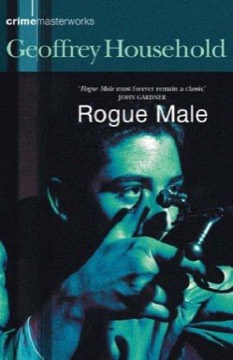
Rogue Male
Geoffrey Household's 1939 novel about an English sportsman who stalks a European dictator, is caught, and escapes to be hunted across England. A chase narrowed almost to nothing.
- First published
- 1939
- Publisher
- Chatto & Windus
- Pages
- 192
- Shelf
- Thriller
- Level
- Core
- ISBN-13
- 9781872672861
Record checked against
Catalogue note
- Reads as
- ReflectiveChanges how you see rather than what you do.
- Level
- Core / BuildingAssumes general familiarity with the subject.
- Approach
- Theoretical
- Written for
- Readers who mean to stop at one more chapter, Readers with some grounding
- Ideas
Saved in this browser only — no account, nothing sent anywhere. My library
Read this if
- You want to be kept up late, and made uneasy about who to believe.
- You want a book that changes how you see things rather than what you do tomorrow.
- You know roughly how the subject works and want the fuller account.
The premise
An unnamed English narrator is captured on a wooded hillside with a rifle trained on the residence of an unnamed dictator. He insists he was engaged in a sporting stalk with no intention of firing.
He is tortured, thrown off a cliff and left for dead. He survives, makes his way back to England, and discovers that the pursuit has followed him home.
He claims he was only seeing whether it could be done. The book spends its length testing that claim.
Devmark’s reading — not a quotation from the book
The unnamed everything
The narrator, the dictator and the country are all left unnamed, though the book was published in 1939 and the identifications are not difficult.
The refusal to name does real work. It keeps the novel from being a political thriller about a specific regime and turns it into something closer to a fable about hunting.
The burrow
The central section has the narrator living underground in a Dorset lane, having dug himself a concealed den, subsisting on what he can reach and emerging only at night.
It is the most famous sustained passage in the book and among the most claustrophobic in English fiction: a hero reduced to earth, damp and a narrow exit, described with practical precision.
Hunter and hunted collapsed
The title is a game-keeping term for an animal that has separated from its kind and become dangerous. The narrator applies it to himself without flinching.
The novel's argument is that the distinction between stalking and being stalked is procedural rather than moral, and that the same skills serve on either side of it.
The unreliable frame
The whole book is a written account produced by the narrator, and he is evasive about his motive from the first page — insisting on the sporting explanation while the reader accumulates reasons to doubt it.
The disclosure, when it comes, is handled quietly and recontextualises the opening rather than reversing it.
Class, and its uses
The narrator's advantages are entirely those of his position: the ability to pass unremarked in clubs and countryside, credit at a bank, and a set of outdoor skills acquired as leisure.
Household is more knowing about this than he is usually credited for. The same class assurance that makes the escape possible is what allowed the original expedition to be undertaken as a whim.
Craft and improvisation
Much of the pleasure is procedural: how to make a tool from a bicycle, how to disguise a scent trail, how to buy food without being remembered.
The competence is lower-tech and more physical than the espionage tradition that followed, and the detail is convincing enough that the book has been read as a manual.
Prose and length
The style is compressed and slightly formal, with long descriptive passages about terrain and very little dialogue. The novel is short and does not waste a page.
Household's sentences are the main reason it has survived while most 1939 thrillers have not; the writing about landscape and physical sensation is genuinely fine.
Violence
The book is more brutal than its date suggests. The torture is described matter-of-factly, and the narrator's own acts are neither dwelt on nor excused.
The refusal to dramatise is the point. Cruelty is presented as something that happens at a particular speed and leaves specific damage, rather than as an occasion for feeling.
Its admirers and its influence
It has been championed repeatedly — by Robert Macfarlane among others, and as a model by writers of pursuit narratives — and has never entirely left print.
Its clearest descendants are the survival-and-pursuit novels, and its underground sequence has been borrowed more often than it has been acknowledged.
How it differs from Buchan
Buchan's chase is social: Hannay keeps meeting people, and each encounter opens an option. Household's narrows steadily until the protagonist is alone in a hole.
Where The Thirty-Nine Steps is an adventure with a hero, Rogue Male is closer to a study of an animal being reduced to instinct.
One chase widens with every chapter. This one closes.
Devmark’s reading — not a quotation from the book
Who it is for
Readers who want plot will find relatively little; the events could be summarised in a paragraph. Readers who want interiority, landscape and physical process will find it exceptional.
It is a short book that leaves a disproportionately long impression, and it is the one 1930s thriller most worth reading for the writing alone.
What to take away
- 01The chase that narrowsUnlike Buchan's widening adventure, this pursuit closes steadily until the hero is alone underground.
- 02Deliberate anonymityLeaving the narrator, the dictator and the country unnamed converts a 1939 political thriller into a fable about hunting.
- 03Hunter and quarry are the same skill setThe title's game-keeping term is applied by the narrator to himself, collapsing the distinction.
- 04An account, not a reportThe narrator is evasive about motive from the first page, and the book is built on that evasion.
- 05Class as equipmentHis escape depends on credit, accent and leisure-acquired fieldcraft — the same assets that licensed the original stalk.
- 06Undramatised violenceTorture and killing are described at their real speed and left unexcused, which is why they land.