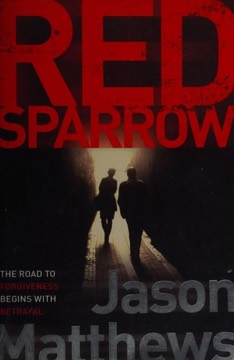
Red Sparrow
Jason Matthews's 2013 novel about a Russian intelligence officer trained in sexual manipulation and the CIA officer she is assigned to compromise.
- First published
- 2013
- Publisher
- Simon & Schuster
- Pages
- 226
- Shelf
- Thriller
- Level
- Core
- ISBN-13
- 9781471112584
Record checked against
Catalogue note
- Reads as
- ReflectiveChanges how you see rather than what you do.
- Level
- Core / BuildingAssumes general familiarity with the subject.
- Approach
- Theoretical
- Written for
- Readers who mean to stop at one more chapter, Readers with some grounding
Saved in this browser only — no account, nothing sent anywhere. My library
Read this if
- You want to be kept up late, and made uneasy about who to believe.
- You read for the writing as much as for the argument.
- You want a book that changes how you see things rather than what you do tomorrow.
- You know roughly how the subject works and want the fuller account.
The premise
Dominika Egorova, a ballerina whose career ends in injury, is recruited by her uncle into Russian intelligence and sent to a school that trains officers in sexual technique as an operational tool.
She is assigned to Nathaniel Nash, a young CIA officer who is handling a senior Russian asset, and the operation becomes a long mutual approach.
A trained seductress and the officer she is sent to compromise, each aware of what the other is.
Devmark’s reading — not a quotation from the book
Authenticity
Matthews served thirty-three years in the CIA's operations directorate, and the tradecraft is the novel's principal claim: surveillance detection routes, dead drops, agent handling, polygraph technique, internal vetting.
The procedural material is more detailed and more credible than in almost anything else in this section.
Agent handling
The novel's best material concerns the relationship between a case officer and a source: the management of risk, the psychology of someone betraying their own service, and the specific obligations that accumulate.
Matthews is writing about something he did, and the difference from researched fiction is noticeable.
The Sparrow School
The training in sexual manipulation is depicted in detail and the novel treats it as a documented historical practice.
The material is explicit and is the book's most criticised element, both for its accuracy and for the amount of attention it receives relative to its plot function.
Dominika
She has synaesthesia, perceiving people's intentions as colours, which is an odd choice that functions as an externalised instinct.
She is given genuine agency and her eventual decisions are her own rather than the plot's, which is more than the setup promises. Matthews also gives her a mother to protect and a service that has used her family badly, which supplies motive independent of the romance.
Contemporary Russia
The novel depicts the intelligence service as an instrument of personal power rather than of state policy, with Putin appearing as a character.
The political portrait is specific and unflattering and has aged into something more obviously accurate than it appeared at publication. The novel also depicts the internal culture of the service — the vetting, the denunciations, the careerism — with the same specificity as the tradecraft.
The recipes
Each chapter ends with a recipe for a dish mentioned in it, which is an extremely unusual device for a spy novel.
It is either charming or baffling depending on the reader, and Matthews maintained it across the trilogy. They also tend to appear after chapters containing violence, which produces a tonal collision that readers have described as both jarring and oddly effective.
Prose
Functional and occasionally clumsy, particularly in the sexual material, which several reviewers have identified as the book's weakest writing.
Matthews's strengths are procedural rather than stylistic, and the novel is worth reading for what he knows rather than for how he writes it. The interior monologue in particular is frequently clumsy, and Matthews is considerably better at describing an operation than at describing a feeling.
Violence
There is torture, described clinically and at length, and the treatment of captured officers is graphic.
The material is consistent with the book's realism and is genuinely unpleasant, and readers should expect it rather than be surprised. Matthews also declines to make the torturers exceptional, presenting them as officers carrying out a procedure, which is consistent with the book's general realism.
The trilogy
Two sequels follow and complete the arc, and the tradecraft remains the principal attraction throughout.
The later books are somewhat better written and less reliant on the sexual material, and readers who get through the first generally continue. Matthews died in 2021, so the trilogy is complete and there will be no further books, which at least means readers can commit to it safely.
The film
A 2018 adaptation follows the plot loosely and foregrounds the training sequences.
The tradecraft that justifies the novel is largely absent from the film, which leaves it with the elements most open to objection and few of the compensations. The adaptation also removes the recipes entirely, which is understandable and removes one of the few genuinely distinctive things about the source.
Who it is for
Readers who want genuine operational detail from someone who did the work, and who can tolerate explicit content and uneven prose.
It is the most technically authoritative spy novel in this section and is not the best written. Readers who want both should read le Carré and accept less procedural specificity.
What to take away
- 01Tradecraft from a practitionerThirty-three years in the operations directorate produce surveillance and handling detail more credible than anything researched.
- 02The handler-source relationshipThe obligations accumulating between a case officer and someone betraying their own service is the novel's best material.
- 03Intelligence as personal powerThe service is depicted as an instrument of individual authority rather than of state policy, which has aged accurately.
- 04Agency beyond the premiseDominika's decisions are genuinely her own, which the setup gives no reason to expect.
- 05Procedural strength, stylistic weaknessThe book is worth reading for what its author knows rather than for how he writes it.
- 06A recipe at every chapter's endAn unusual device maintained across the whole trilogy, which readers find either charming or inexplicable.