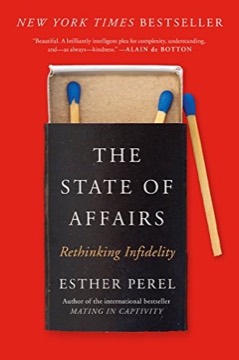
The State of Affairs
Esther Perel's examination of infidelity: why it happens in good relationships, what it means, and why the contemporary response to it is unusually punitive by historical standards.
- First published
- 2017
- Publisher
- Editorial Planeta, S. A.
- Pages
- 319
- Shelf
- Love
- Level
- Core
- ISBN-13
- 9780062322609
Record checked against
Only one source carried a publication date for this work, so the year is uncorroborated.
Catalogue note
- Reads as
- ReflectiveChanges how you see rather than what you do.
- Level
- Core / BuildingAssumes general familiarity with the subject.
- Approach
- Theoretical
- Written for
- Anyone thinking about how people attach, Readers with some grounding
Saved in this browser only — no account, nothing sent anywhere. My library
Read this if
- You want evidence about why people behave as they do, not folklore.
- You want to understand why people attach to each other the way they do.
- You want to think harder about what is actually right.
- You want a book that changes how you see things rather than what you do tomorrow.
- You know roughly how the subject works and want the fuller account.
The argument
Perel's starting claim is that affairs are not reliably symptoms of a bad relationship, and that treating them as such misdescribes many of the cases she sees. People in satisfying marriages have affairs, and the reasons are frequently about the self rather than the partner.
She frames many affairs as attempts to recover a lost version of oneself rather than to replace a spouse.
Her most contested claim is that a good marriage does not make you immune, and that this needs explaining.
Devmark’s reading — not a quotation from the book
The historical frame
She sets the modern reaction in context: as marriage moved from an economic arrangement to the source of identity, meaning and self-actualisation, the betrayal became correspondingly total.
Affairs have been common across most societies and periods; what has changed is the expectation and therefore the scale of the injury.
What she offers
Perel is careful to say she neither condones nor recommends, and much of the book is about aftermath: what disclosure does, what questions to ask and avoid, and the observation that some couples emerge with a stronger relationship than before, which she reports rather than prescribes.
The chapters on the betrayed partner's intrusive imagining are the most practically useful.
She reports that some couples end up stronger. She is careful not to recommend the route.
Devmark’s reading — not a quotation from the book
The objection
The book has been criticised for giving too much sympathetic attention to the unfaithful partner's interior life relative to the harm done, and for a framing that can read as sophistication about something straightforwardly damaging.
That criticism is worth holding. Perel's defence is that understanding is not absolution and that therapy requires the former, which is a reasonable position rather than a settled one.
Not why they stray
Perel's opening move is to refuse the usual explanatory frame, in which an affair is caused by a deficient marriage or a deficient partner. She argues that many affairs occur in relationships the person describes as good, and that the more interesting question is what the person was looking for in themselves.
Many affairs happen inside marriages nobody wanted to leave. That is the fact the usual explanation cannot hold.
Devmark’s reading — not a quotation from the book
Infidelity as self-seeking
Her central reframe is that an affair is frequently less about the third person than about a version of oneself that has become inaccessible — youth, possibility, being desired, a life not chosen. This makes the betrayal no less real and changes what the couple is actually negotiating.
The aftermath in three forms
She sorts couples who stay into those who never recover, those who return to a functional version of what they had, and those who build something deliberately different. The third category is the one she is most interested in, and she is honest that it is the smallest.
The discovery
A substantial section covers the specific trauma of finding out, including the compulsive investigation, the demand for details, and the particular injury of discovering by phone. Perel's practical guidance on what to ask and what not to is the most concretely useful material in the book.
What has changed
Her historical chapters note that marriage was for most of its existence an economic and dynastic arrangement, with infidelity by men widely tolerated and sometimes assumed, and that the contemporary expectation of lifelong exclusivity combined with passion, friendship, co-parenting and personal self-realisation from one person is both historically unusual and unusually demanding. The rise in expectation, she argues, is part of why discovery now feels so catastrophic.
The criticism it attracts
Critics argue that the framing risks sophistication about something with a clearly injured party, and that placing meaning-making above harm can shade into excusing the person who caused it. Perel's position is that understanding is not absolution, and that condemnation on its own has never once helped a couple sitting in her office. Readers divide sharply on whether that distinction actually holds in practice.
What to take away
- 01Not always a symptomAffairs occur in relationships the participants describe as good.
- 02A historical shiftMarriage as the source of identity made betrayal total.
- 03Recovering a lost selfMany affairs framed as about the self rather than the spouse.
- 04Aftermath, in detailDisclosure, intrusive imagining, and what questions to avoid.
- 05A fair objectionCriticised for the sympathy it extends relative to the harm.