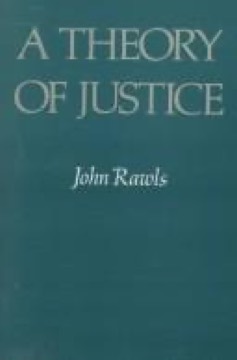
A Theory of Justice
John Rawls's reconstruction of the social contract — an argument that the principles of a just society are those that would be chosen by people who did not know what position they would occupy in it.
- First published
- 1971
- Publisher
- Belknap Press
- Pages
- 607
- Shelf
- Philosophy
- Level
- Deep
- ISBN-13
- 9780198250548
Record checked against
Catalogue note
- Reads as
- ReflectiveChanges how you see rather than what you do.
- Level
- Advanced / AdvancedAssumes you have read around the subject already.
- Approach
- Theoretical
- Written for
- Reflective readers, Specialists and serious readers
Saved in this browser only — no account, nothing sent anywhere. My library
Read this if
- You want to understand how power is taken, kept and lost.
- You want to think harder about what is actually right.
- You want a book that changes how you see things rather than what you do tomorrow.
- You have read around this already and want a book that assumes it.
What it revived
When it was published, normative political philosophy in the English-speaking world had been largely dormant for decades, displaced by linguistic analysis and by the claim that value judgements were not philosophical matters.
This book restored the subject almost single-handedly by offering a systematic, rigorous alternative to utilitarianism, which had held the field by default for a century. Nearly all subsequent Anglophone political philosophy is a response to it.
It revived a subject that had gone dormant, and nearly everything written since responds to it.
Devmark’s reading — not a quotation from the book
The original position and the veil of ignorance
His central device. Imagine people choosing the basic principles of their society while ignorant of their own place in it — their class, talents, race, sex, conception of the good, even their generation.
The veil is not a historical claim or a psychological one. It is a procedure for modelling fairness: principles chosen without knowing who you will be are principles no one could reasonably reject on grounds of partiality.
The two principles
What he argues would be chosen. First, each person has an equal claim to the most extensive scheme of basic liberties compatible with the same for all. Second, social and economic inequalities are permissible only if they attach to positions open to all under fair equality of opportunity, and if they work to the greatest benefit of the least advantaged.
The first has strict priority over the second: liberty cannot be traded for economic gain, however large.
The difference principle
The second half of his second principle, and the most argued-about claim in the book. Inequality is justified only when it improves the position of those worst off.
It is neither strict equality nor unconstrained market outcome. It permits substantial inequality where incentives genuinely raise the floor, and forbids inequality that does not. The argument for it runs through maximin reasoning under uncertainty, which is the step most often challenged.
Against utilitarianism
His central negative argument: utilitarianism permits imposing serious losses on some people for larger aggregate gains, because it treats society as a single system of desires to be maximised.
His charge is that this does not take seriously the distinction between persons. It is the most effective criticism of utilitarianism made in the twentieth century and it changed how the position is defended.
Utilitarianism, he charges, does not take seriously the distinction between persons. The charge stuck.
Devmark’s reading — not a quotation from the book
Reflective equilibrium
His methodological contribution: adjust principles and considered judgements against each other until they cohere, revising either where necessary.
This is now the standard method in moral and political philosophy, and its influence extends well beyond his own conclusions. It is also the part critics identify as insufficiently constraining, since coherence alone does not guarantee correctness.
Primary goods and the basic structure
His account of what the parties are choosing over: rights, liberties, opportunities, income, wealth and the social bases of self-respect — the things anyone needs whatever else they want.
His restriction of justice to the basic structure of society, rather than to individual conduct, is a significant limitation that later critics including feminist philosophers argued leaves the family and the division of domestic labour largely unexamined.
The major criticisms
Nozick argued that any patterned principle of distribution requires continuous interference with liberty, and that a just holding depends on how it was acquired rather than on its shape. Communitarians including Sandel argued that the unencumbered self behind the veil is not a coherent person. Sen argued that primary goods ignore differences in what people can actually do with them.
Each of these launched a major research programme, which is a measure of the book's position more than of its weaknesses.
His own revisions
Rawls substantially reworked the argument in *Political Liberalism*, retreating from the claim that his theory rests on a comprehensive moral doctrine and recasting it as a political conception that people with different worldviews could endorse.
A reader should know this exists, because several standard objections to the original are addressed there rather than in the book being objected to.
Reading it
It is long, dense and technically demanding, and few readers work through the whole. The essential material is the original position, the two principles and the argument against utilitarianism.
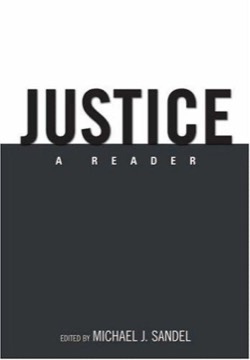
Sandel's *Justice* is a serviceable entry point, since it presents Rawls alongside his critics and shows what is at stake before the machinery arrives.
What to take away
- 01Choose the rules without knowing your placeThe veil is a procedure for modelling fairness, not a historical or psychological claim.
- 02Liberty has strict priorityBasic liberties cannot be traded for economic gain, however large the gain.
- 03Inequality must benefit the worst offNot strict equality and not free outcome: inequality is permitted exactly where it raises the floor.
- 04Persons are distinctThe charge that utilitarianism ignores this is the most effective criticism of it in the last century.
- 05Reflective equilibrium became the methodAdjusting principles and judgements against each other is now standard practice well beyond his conclusions.