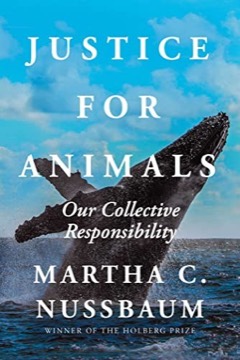
Justice for Animals
Martha Nussbaum's argument that animals are entitled to justice rather than compassion, and that the capabilities approach she developed for human welfare extends to them more coherently than utilitarian or rights-based alternatives.
- First published
- 2022
- Publisher
- Simon & Schuster
- Pages
- 400
- Shelf
- Philosophy
- Level
- Core
- ISBN-13
- 9781982102500
Record checked against
Only one source carried a publication date for this work, so the year is uncorroborated.
Catalogue note
- Reads as
- ReflectiveChanges how you see rather than what you do.
- Level
- Core / BuildingAssumes general familiarity with the subject.
- Approach
- Theoretical
- Written for
- Reflective readers, Readers with some grounding
- Ideas
Saved in this browser only — no account, nothing sent anywhere. My library
Read this if
- You want to think harder about what is actually right.
- You want to examine an assumption you have never examined.
- You want a book that changes how you see things rather than what you do tomorrow.
- You know roughly how the subject works and want the fuller account.
The argument
Nussbaum rejects the two dominant positions. The utilitarian account, from Singer, reduces the question to aggregate suffering and cannot explain why a life prevented is different from a life impaired. The rights account, from Regan, depends on a notion of the subject-of-a-life that excludes too much.
Her alternative is the capabilities approach: each creature has a characteristic form of life with capabilities that can flourish or be blocked, and justice consists in not blocking them.
Her claim is that animals are owed justice, not kindness, and the distinction is legal as well as moral.
Devmark’s reading — not a quotation from the book
What follows
The approach is species-specific rather than uniform: what a whale needs to flourish is not what an elephant or a crow needs, and a single metric across species misses this.
She works through wild animals, farmed animals, companion animals and research animals separately, and is willing to reach uncomfortable conclusions — including about intervention in wild suffering.
The legal turn
A substantial section addresses standing: the practical problem that animals cannot sue, and the mechanisms by which their interests could be represented in law.
Nussbaum draws on her earlier work on constitutional theory here, and this is the part that is least available elsewhere.
She is also candid that the legal apparatus does not yet exist and that constructing it would require decisions courts have so far declined to make, which keeps the chapter from reading as a programme ready to implement.
The hardest practical chapter is about who can bring a case on behalf of a creature that cannot.
Devmark’s reading — not a quotation from the book
How to read it
Written by a philosopher for a general reader but retaining the argumentative structure of philosophy: positions stated, objections considered, conclusions qualified.
It is more demanding than Singer's Animal Liberation and considerably more recent. It engages with the science of animal cognition as it now stands rather than as it stood in 1975.
Against the three existing theories
Nussbaum builds by clearing ground, arguing that the dominant frameworks each fail. The utilitarian account reduces animals to vessels of pleasure and pain and permits trade-offs she finds unacceptable; the so-called kinship approach grants standing by resemblance to humans; and Kantian ethics struggles to give animals direct moral status at all.
The capabilities approach
Her alternative asks what a creature of this kind needs in order to flourish according to its own form of life — movement, social relationship, play, sensory engagement, autonomy of a kind appropriate to the species. Justice on this account means not obstructing those capabilities, and the standard is species-specific rather than measured against human experience.
The question is not how like us it is. It is what this kind of creature needs in order to live well as that creature.
Devmark’s reading — not a quotation from the book
Wonder as the starting point
Unlike accounts grounded in sympathy or in the avoidance of suffering, hers begins with wonder at a creature's complexity and its striving. The consequence is that the moral claim does not depend on the animal's capacity to suffer in ways legible to us, which widens the circle considerably.
The wild animal problem
She confronts the hardest question directly: if suffering in nature is enormous and mostly caused by other animals, does her framework demand intervention. Her answer involves a form of stewardship that resists both total non-interference and wholesale management, and she is candid that this is the least settled part of her position.
Making it law
The final movement is legal rather than philosophical: standing for animals in courts, the inadequacy of welfare legislation that regulates treatment without recognising interests, and the mechanisms by which a representative might bring a case. Nussbaum has worked on this with legal scholars and the chapters are concrete about procedure.
The hard cases
She does not dodge the practical implications for food production, research, zoos and companion animals, and her conclusions are demanding without being absolutist. Readers looking for permission to continue as they are will not find it; readers expecting an abolitionist manifesto will find something more qualified.
How to approach it
It is philosophy written accessibly but it is still philosophy, with an argumentative structure that rewards reading in order. Nussbaum writes about her daughter, who worked on animal protection and died during the writing, which gives the book a personal register unusual in her work.
What to take away
- 01Justice, not compassionThe entitlement framing rather than the charitable one.
- 02Against Singer and ReganBoth dominant positions rejected, with reasons.
- 03Species-specific flourishingNo single metric across creatures with different forms of life.
- 04Standing in lawThe practical question of who represents an animal's interests.
- 05Current cognition scienceEngages with what is now known rather than with 1975.