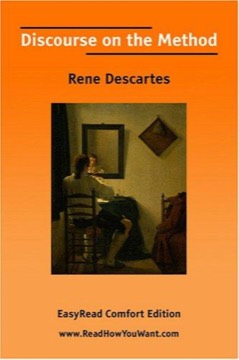
Discourse on Method
Descartes's short account of how he arrived at his method — a first-person narrative of dismantling everything he believed and rebuilding from a single certainty, and the text that opens modern philosophy.
- First published
- 1637
- Publisher
- publisher2 =
- Pages
- not established
- Shelf
- Philosophy
- Level
- Core
- ISBN-13
- 9780141906287
Record checked against
Two sources agreed on 1637; a third reported differently (openlibrary 1999, wikidata 1637, wikipedia 1637). No page count is recorded, so no reading estimate is shown for the book itself.
Catalogue note
- Reads as
- PracticalWritten to be applied, not only understood.
- Level
- Core / BuildingAssumes general familiarity with the subject.
- Approach
- Practical
- Written for
- Reflective readers, Readers with some grounding
- Ideas
Saved in this browser only — no account, nothing sent anywhere. My library
Read this if
- You want to examine an assumption you have never examined.
- You want something to apply, not only something to think about.
- You know roughly how the subject works and want the fuller account.
The form and the language
It is written in the first person as an intellectual autobiography rather than a treatise, and it was published in French rather than Latin so that it could be read by anyone with common sense rather than by scholars alone.
Both choices were deliberate and both were consequential. Philosophy conducted as a personal narrative, in a vernacular, addressed to an ordinary reader, was a break with the entire scholastic tradition before it.
Written in French, in the first person, for ordinary readers. Each of those was a break with scholasticism.
Devmark’s reading — not a quotation from the book
The four rules
His method, stated compactly: accept nothing as true that is not clearly and distinctly known to be so; divide each difficulty into as many parts as possible; proceed from the simplest to the most complex; and review completely enough to be sure nothing is omitted.
They read as unremarkable now, which is a measure of how thoroughly they were absorbed. The second and third are the ancestors of decomposition and of building from primitives, which is why the text appears on engineering reading lists.
Methodical doubt
His procedure for finding a foundation: treat as false anything that admits the least doubt. The senses deceive, so sensory evidence goes. Reasoning contains errors, so demonstrations go. Dreams are indistinguishable from waking, so ordinary experience goes.
His method is often confused with scepticism and is its opposite. He doubts in order to find something that survives doubting, and the doubt is a tool rather than a position.
I think, therefore I am
What survives: the one thing that cannot be doubted is that something is doing the doubting. Even a comprehensive deception requires someone being deceived.
The formulation is the single best-known sentence in philosophy and it is routinely misread as an argument for the importance of thinking. It is not an argument about value; it is the identification of the one proposition whose denial is self-defeating.
Rebuilding, and the weak part
From that foundation he attempts to reconstruct: proofs of God's existence, the reliability of clear and distinct perception, and the existence of the external world.
This is by common agreement the weakest section. The proofs of God are unconvincing to most readers, and the charge of circularity — that clear and distinct perception is guaranteed by God, whose existence is established by clear and distinct perception — was raised immediately by his contemporaries and has never been satisfactorily answered.
Mind and body
His conclusion that mind and body are distinct substances, one thinking and unextended, the other extended and unthinking.
The dualism created the problem it is named for: if they are genuinely distinct, how does either affect the other? His own answer, locating the interaction in the pineal gland, satisfied nobody, and the mind-body problem he opened remains open.
His dualism created the problem it is named for, and his own answer to it satisfied no one, including his correspondents.
Devmark’s reading — not a quotation from the book
The animal machine
His view that animals are automata without minds, which follows from his dualism and which he held with considerable consequences for how his followers treated them.
It is worth stating plainly rather than skipping. The position was disputed in his own time, and the practices it licensed are among the reasons his system attracted moral as well as philosophical objection.
The provisional morality
An easily overlooked and genuinely practical section: while rebuilding his beliefs, he adopted a temporary code — follow the laws and customs of his country, be decisive once a course is chosen, change himself rather than the world, and continue examining.
The recognition that a person cannot suspend living while suspending belief is a practical insight that the rest of the method needed and rarely gets credit for.
What it started
The turn to epistemology: the question of what we can know, and how, becoming prior to questions about what exists. Nearly all subsequent European philosophy accepted that ordering, including the empiricists who rejected everything else about him.
It also established the first-person standpoint as the starting point for philosophy, which shaped the following three centuries and which twentieth-century philosophy spent considerable effort trying to escape.
How to read it
Short — it can be read in an afternoon — and best read for the method and the doubt rather than for the reconstruction, which is where it fails.
Read it as the opening move of a long argument rather than as a completed system, and read the objections of his contemporaries alongside it, since they identified the weaknesses immediately and he answered them at length.
What to take away
- 01Doubt as a tool, not a positionHe doubts in order to find what survives doubting, which is the opposite of scepticism.
- 02The cogito is not about the value of thinkingIt identifies the one proposition whose denial defeats itself, which is a narrower and stranger claim.
- 03Divide, order, reviewThe decomposition rules were absorbed so completely that they now read as obvious engineering practice.
- 04The reconstruction is the weak halfThe circularity objection was raised by his contemporaries and has never been adequately answered.
- 05A provisional morality while you rebuildYou cannot suspend living while you suspend belief, which the rest of the method quietly depends on.