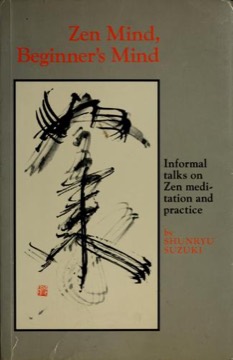
Zen Mind, Beginner's Mind
Shunryu Suzuki's talks to his American students, collected in 1970. The book that introduced Soto Zen to a Western readership, built around the idea that the beginner's mind holds more possibility than the expert's.
- First published
- 1970
- Publisher
- Hakuba Shobō
- Pages
- 146
- Shelf
- Philosophy
- Level
- Entry
- ISBN-13
- 9781590308493
Record checked against
Catalogue note
- Reads as
- PracticalWritten to be applied, not only understood.
- Level
- Accessible / FoundationalNo prior reading assumed.
- Approach
- Practical
- Written for
- Reflective readers, Newcomers to the subject
- Ideas
Saved in this browser only — no account, nothing sent anywhere. My library
Read this if
- You want to examine an assumption you have never examined.
- You want something to apply, not only something to think about.
- You are starting from scratch here and want a way in that assumes no prior reading.
The central idea
Suzuki's opening line is the book's whole argument: in the beginner's mind there are many possibilities, in the expert's there are few. Expertise closes options; the practice is to keep returning to not knowing.
This is not advice about humility. It is a description of the mental state that zazen is meant to cultivate and that accumulating knowledge tends to destroy.
Expertise is treated as something to be worked against rather than accumulated.
Devmark’s reading — not a quotation from the book
On practice
The first section is on posture, breathing and what sitting actually is — specific, physical and unmystical. Suzuki insists repeatedly that practice is not a means to enlightenment but is itself the thing.
The recurring instruction is that there is nothing to attain, which is the hardest idea in the book for a reader who has come looking to attain something.
Practice is not a route to the goal. In his account it is the goal, which is the part readers resist.
Devmark’s reading — not a quotation from the book
How it is written
These are transcribed talks, edited by Trudy Dixon, and they read as speech: repetitive, circling, occasionally ungrammatical, with the same point approached from several directions.
The repetition is not an editing failure. Suzuki was teaching by return rather than by progression, and the book preserves that.
Its position
Suzuki founded the San Francisco Zen Center and this book did more than any other to establish Zen practice in the United States.
It is short, and it is a book about doing something rather than about understanding something. Read without any practice attached, it will seem either profound or empty depending mostly on the reader's mood.
Which Suzuki this is
A recurring confusion worth clearing immediately: this is Shunryu Suzuki, a Soto priest who came to San Francisco in 1959 and stayed, not D. T. Suzuki, the scholar whose Rinzai-inflected books introduced Zen to Western intellectuals a generation earlier. The two are unrelated and their emphases differ sharply — the scholar wrote about sudden insight, the priest about sitting down every day.
The three parts
The book is arranged as practice, attitude and understanding, and the order is the teaching. Posture and breathing come first, before any doctrine, because Suzuki's position is that the physical act is not preparation for understanding but the thing itself. Readers who skip to the later talks looking for the ideas tend to find them thin, which is the intended result.
Nothing to attain
The hardest instruction is that zazen is not a technique for getting somewhere. Practising in order to become enlightened installs exactly the acquisitive attitude that practice is meant to loosen, so the sitting has to be done for its own sake — while the student is fully aware that they are doing it for its own sake in order to benefit, which is the knot Suzuki spends the book patiently refusing to untie.
Practising in order to gain something installs the very habit the practice is meant to loosen.
Devmark’s reading — not a quotation from the book
The weeds
His most-quoted image treats unwanted thoughts and difficulties not as obstacles to be cleared but as material: pulled up and turned back into the soil, they nourish the practice. It is characteristic of his method — no promise that the mind will become quiet, and no suggestion that a noisy one means you are doing it wrong.
Not always so
Suzuki repeatedly undercuts his own formulations immediately after making them. The habit is deliberate rather than vague: any statement firm enough to be held as a position has already become the kind of fixed idea the talks are trying to dislodge. It is also why the book resists summary, including this one.
How the book exists
These were talks, transcribed and shaped into a book by Trudy Dixon, a student who was dying of cancer while she did the editing. That origin explains the texture — the repetition, the circling, the occasional ungrammatical sentence left standing — and it is the reason the prose sounds like a person in a room rather than an author at a desk.
What to take from it
It is not an explanation of Zen and will disappoint anyone reading it as one. Its use is as a companion to actually sitting, a few pages at a time, returned to over years — which is how most of the people who value it report using it, and why it has stayed in print for more than fifty years.
What to take away
- 01Beginner's mindMany possibilities in the beginner's, few in the expert's.
- 02Nothing to attainPractice as the thing itself rather than a route to it.
- 03Physical and unmysticalPosture and breathing described concretely.
- 04Teaching by returnThe repetition is the method, not an editing artefact.
- 05A book about doingIt reads thin without a practice attached to it.