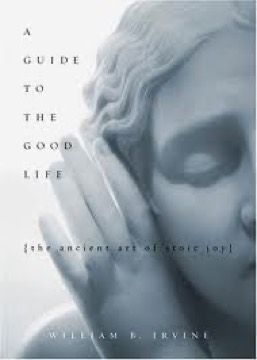
A Guide to the Good Life
William B. Irvine's case for Stoicism as a coherent philosophy of life, written by an academic philosopher who adopted it and reports what happened.
- First published
- 2009
- Publisher
- Ebsco Publishing
- Pages
- 326
- Shelf
- Philosophy
- Level
- Entry
- ISBN-13
- 9780195374612
Record checked against
Only one source carried a publication date for this work, so the year is uncorroborated.
Catalogue note
- Reads as
- PracticalWritten to be applied, not only understood.
- Level
- Accessible / FoundationalNo prior reading assumed.
- Approach
- Practical
- Written for
- Reflective readers, Newcomers to the subject
- Ideas
Saved in this browser only — no account, nothing sent anywhere. My library
Read this if
- You want a practical philosophy for things outside your control.
- You want something to apply, not only something to think about.
- You are starting from scratch here and want a way in that assumes no prior reading.
The argument
Irvine's premise is that most people never choose a philosophy of life and therefore default to whatever their culture supplies, which in his account is the pursuit of status and consumption.
He proposes Stoicism as a tested alternative with an explicit goal — tranquillity, meaning freedom from negative emotion rather than absence of feeling — and a set of techniques for reaching it.
His claim is that not choosing a philosophy of life means inheriting one by default.
Devmark’s reading — not a quotation from the book
Negative visualisation
The technique he emphasises most is premeditatio malorum: deliberately imagining the loss of what you have. His argument is that this inoculates against hedonic adaptation, the process by which everything good becomes invisible once it is normal.
He distinguishes it firmly from worry. The exercise is brief, deliberate and concludes with renewed attention to the thing, not with anxiety about losing it.
Imagining loss is proposed as a cure for taking things for granted, not as rehearsal for disaster.
Devmark’s reading — not a quotation from the book
Where it is contested
Classicists have objected that Irvine reorders Stoic priorities, demoting virtue and promoting tranquillity in a way the ancient sources do not support. That criticism is substantive and worth knowing.
What the book does well is make the practice concrete for a reader with no background, and it is honest that Irvine is reporting an experiment on himself rather than presenting scholarship.
The trichotomy of control
Irvine's own contribution is a revision of Epictetus. Where the ancient dichotomy divides the world into what is up to us and what is not, Irvine adds a third category for things over which we have some but not complete control — the outcome of a match, a promotion, a diagnosis. His recommendation is to internalise the goal in those cases: aim to play as well as you can rather than to win, since only the first is yours to determine.
Play as well as you can is a goal you own; winning is not.
Devmark’s reading — not a quotation from the book
Voluntary discomfort
Alongside imagining loss, Irvine recommends periodically arranging it: eating plainly, underdressing for the cold, choosing the harder option when nothing depends on it. The claimed benefits are threefold — a rehearsal that makes future hardship less frightening, a reset of what counts as comfort, and the confidence that comes from having tested yourself. He is careful to present this as training rather than asceticism for its own sake.
Fatalism about the past
The book asks for fatalism directed backwards and at the present moment only, never forwards. What has already happened is closed, so treating it as anything other than fixed is wasted effort; the present moment is likewise already underway. This is not passivity about the future, which Irvine insists remains open to effort, and the distinction is one readers regularly collapse.
Insults, anger and grief
The practical chapters take the emotions the Stoics wrote about most and translate their responses. On insults, the recommendation is to consider the source and to treat the sting as an assent you supplied rather than an injury received. On anger, Irvine follows Seneca in treating it as briefly pleasurable and reliably costly. On grief he is more careful, distinguishing the Stoic target — prolonged, cultivated distress — from the first natural response to loss.
Stealth Stoicism
One of the book's more practical suggestions is to practise without announcing it. Irvine's reasoning is partly social — a declared philosophy invites argument and invites others to police your consistency — and partly that the techniques work on the practitioner and need no audience. It is also an honest acknowledgement that the word Stoic carries a popular meaning, emotional suppression, that the philosophy does not.
What Stoicism is not here
Irvine spends real effort separating the philosophy from its caricature. The Stoic goal is not the absence of feeling but the absence of a specific set of disturbances arrived at by faulty judgement; joy is explicitly part of the programme, which is why the subtitle uses the word. Nor is it withdrawal — the Roman Stoics he draws on were senators, advisers and teachers with public duties.
What to take from it
It is the most usable modern entry point to Stoicism, and it is honest that it is a practitioner's account rather than a work of scholarship. Read it for the techniques and for Irvine's report of living with them; go to Epictetus and Marcus Aurelius directly for the philosophy, and keep the classicists' objection about tranquillity in mind while you do.
What to take away
- 01Choose or inheritWithout a chosen philosophy you adopt your culture's by default.
- 02Tranquillity as the goalFreedom from negative emotion, not absence of feeling.
- 03Negative visualisationDeliberate imagined loss as a counter to hedonic adaptation.
- 04Not worryThe exercise ends in renewed attention, not anxiety.
- 05Contested by classicistsIrvine promotes tranquillity above virtue; the sources do not.