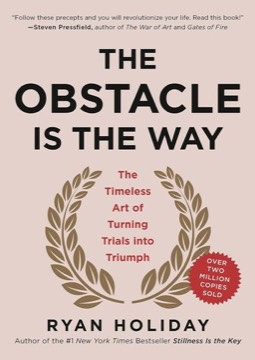
The Obstacle Is the Way
Ryan Holiday's compact modern application of Stoic practice, organised around a single move drawn from Marcus Aurelius — that what stands in the way of action can be made the action — and structured as perception, action, will.
- First published
- 2014
- Publisher
- Portfolio (US)Profile Books (UK)
- Pages
- 224
- Shelf
- Philosophy
- Level
- Entry
- ISBN-13
- 9781781252895
Record checked against
Catalogue note
- Reads as
- PracticalWritten to be applied, not only understood.
- Level
- Accessible / FoundationalNo prior reading assumed.
- Approach
- Practical
- Written for
- Reflective readers, Newcomers to the subject
Saved in this browser only — no account, nothing sent anywhere. My library
Read this if
- You want a practical philosophy for things outside your control.
- You want to know how we got here.
- You want something to apply, not only something to think about.
- You are starting from scratch here and want a way in that assumes no prior reading.
The premise
Holiday builds the book from one passage in Marcus Aurelius: that the impediment to action advances action, and what stands in the way becomes the way.
His three-part structure follows from it. Perception governs how a situation is framed; action governs what is done about it; will governs what is endured when nothing can be done. Every chapter is a short illustration of one of the three.
One passage from Marcus Aurelius, worked out at book length in three parts.
Devmark’s reading — not a quotation from the book
Perception
The first section is the strongest and the most faithful to the source. Its claim is that an obstacle arrives with an interpretation attached, and that the interpretation is separable from the fact.
Holiday's practical material — controlling the reaction, recognising which part of a situation is yours to decide, resisting the urge to editorialise an event into a catastrophe — is a clear restatement of the Stoic discipline of assent, in modern vocabulary.
Action
The second section argues for persistent, deliberate, unglamorous work: starting before conditions are right, iterating, treating failure as information, and using the specific properties of an obstacle rather than fighting it head-on.
This is where the book is furthest from classical Stoicism and closest to ordinary practical advice. It is sensible, and a reader should notice that it is not particularly Stoic.
Will
The third section deals with what cannot be changed, and is the shortest. It covers building resilience in advance, accepting what has already happened, and the Stoic practice of contemplating mortality.
Holiday's treatment of *amor fati* — not merely accepting what happens but willing it — is drawn more from Nietzsche than from the Stoics, which he notes, and it is the most demanding idea in the book.
The method: history as illustration
The book proceeds through short historical vignettes — figures from business, sport, politics and war who faced an obstacle and used it.
The form makes it readable and gives it momentum. It also means the evidence is entirely anecdotal and selected for fit: the people who applied the same attitude and were simply defeated do not appear, and that asymmetry is never acknowledged.
Everyone in the book overcame something. The ones who did the same thing and lost are not in it.
Devmark’s reading — not a quotation from the book
Where it is genuinely useful
As an entry point it works well. It is short, the structure is memorable, and it delivers the core Stoic move — separate the event from your verdict on it — without requiring anyone to read classical philosophy first.
For a reader in the middle of a difficulty, the perception section can do real work, and its central instruction is sound and old.
Where it thins the source
Classical Stoicism is a complete philosophical system with a physics, a logic and an ethics oriented toward virtue and the common good. Holiday extracts the psychological techniques and leaves nearly all of that behind.
The result is Stoicism as performance enhancement, which inverts the original priority: for Marcus and Epictetus, tranquillity was a by-product of pursuing virtue, not the goal. Readers should know that a great deal has been removed.
The repetition problem
The core idea is stated in the introduction and then illustrated approximately forty times. Readers frequently report that the second half adds little, and the book's structure makes that hard to avoid.
It is also quotable to a fault, which shades occasionally into motivational writing — a register the source material does not share.
How it sits against the originals
It is a gateway rather than a substitute. Marcus, Epictetus and Seneca are all shorter than people expect, all available in good translations, and all considerably stranger and more demanding than this.
The honest recommendation is to read this if the originals feel inaccessible, and then read them — Holiday himself points readers toward them, which is to his credit.
What to take from it
One practice, done properly, justifies the book: when something goes wrong, separate what actually happened from the story arriving with it, and ask which part of the response is genuinely yours.
The rest is encouragement. Useful encouragement, competently delivered, but it should not be mistaken for the philosophy it is drawn from.
What to take away
- 01Separate the event from the verdictThe obstacle arrives with an interpretation attached, and the interpretation is the part you can change.
- 02Perception, action, willFrame it, do what can be done, endure what cannot — a memorable structure whatever you make of the rest.
- 03The evidence is selectedEveryone in the book overcame something; the people who applied the same attitude and lost are absent.
- 04It is Stoicism with the ethics removedFor the originals, tranquillity was a by-product of pursuing virtue rather than the objective.
- 05Use it as a doorMarcus, Epictetus and Seneca are shorter than expected and considerably more demanding.