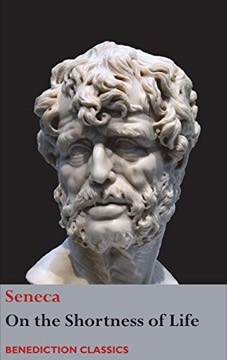
On the Shortness of Life
Seneca's essay to a Roman official, arguing that life is not short but that most of it is spent on things that do not deserve it. Written around AD 49 and still the most useful Stoic text on time.
- Composed
- not established
- Publisher
- not established
- Pages
- 36
- Shelf
- Philosophy
- Level
- Entry
- ISBN-13
- not established
Record checked against
This work predates printing, so it has no publication year. The years the sources report — openlibrary 2016 — are those of later editions or translations, not of the work.
Catalogue note
- Reads as
- ReflectiveChanges how you see rather than what you do.
- Level
- Accessible / FoundationalNo prior reading assumed.
- Approach
- Theoretical
- Written for
- Reflective readers, Newcomers to the subject
- Ideas
Saved in this browser only — no account, nothing sent anywhere. My library
Read this if
- You want a practical philosophy for things outside your control.
- You want to examine an assumption you have never examined.
- You want a book that changes how you see things rather than what you do tomorrow.
- You are starting from scratch here and want a way in that assumes no prior reading.
The argument
Seneca's opening move is a reversal: people complain that nature gave them too little time, when in fact they were given enough and squandered it. The essay is addressed to Paulinus, who administered Rome's grain supply, and it is pointedly about a busy and important man.
The charge is that we guard money and property carefully and give away time — the only genuinely irreplaceable thing — to anyone who asks.
We defend our property and hand out our time, which is the one thing that cannot be recovered.
Devmark’s reading — not a quotation from the book
The targets
Seneca is specific about who is wasting life: the man consumed by business, the one waiting to start living after retirement, the one absorbed in other people's affairs, the one whose leisure is merely a different kind of busyness.
His sharpest section is on preoccupation with the future — living in postponement, which he argues is the surest way to reach the end without having been present for any of it.
What he recommends
Study, and specifically the company of philosophers across history, which Seneca presents as the one way genuinely to extend a life: by reading them you inherit everyone else's, and are no longer confined to the span you were allotted.
He contrasts this with the two other uses of leisure he considers worthless — idleness that is merely unoccupied, and the busy retirement that reproduces the working life it was supposed to end. The essay is short, direct and unusually unsystematic for philosophy, because it is written to be acted on rather than examined.
The one respectable way to lengthen a life, on his account, is to inherit everyone else's thinking.
Devmark’s reading — not a quotation from the book
Reading Seneca
He was among the wealthiest men in Rome and adviser to Nero, which is the standard objection to him, and it is fair. The essays are advice he did not always take.
Read it with that in view rather than around it: the argument stands or falls on its own, and it is not weakened by its author having failed it.
Who it was written to
The essay is addressed to a Roman official responsible for the corn supply — a genuinely demanding public post — and the choice of recipient is part of the argument. Seneca is not writing to an idler about idleness; he is telling a competent, busy, important man that competence, busyness and importance are precisely the respectable forms the waste takes.
The occupied life
His target is a specific type he names repeatedly: the person whose time is entirely committed, mostly to other people's purposes, and who experiences this as a full life. Seneca's claim is that such a person is not living but being used, and that the condition is invisible from inside because it looks identical to diligence.
The busiest life and the most wasted one are frequently the same life.
Devmark’s reading — not a quotation from the book
Time is the property nobody guards
The comparison he returns to is with money and land. People defend a boundary dispute over inches and litigate over small sums, then hand whole days to anyone who asks. His explanation is that time has no visible stock: you cannot see what remains, so you cannot notice it being taken, and the loss is only legible at the end when nothing can be done about it.
Against postponement
The passage on deferral is the essay's most quoted: the plan to begin living properly after the next promotion, the campaign, the retirement. Seneca's objection is arithmetic rather than moral — the arrangement spends the certain part of life buying the uncertain part, and the people who make it most confidently are the ones with the least reason to be confident.
Philosophy as annexed time
His positive recommendation is study, and specifically reading the philosophers, which he describes as adopting other lives into your own: none of the great minds of the past are too busy for you, and their years become available in a way your contemporaries' are not. It is the one form of extension he thinks is actually on offer.
Seneca against Seneca
The obvious objection is his life: enormously wealthy, deeply implicated in imperial politics, tutor and then adviser to Nero, eventually ordered to kill himself by the pupil he had taught. Whether that invalidates the essays or makes them more interesting is an old argument. The essay reads differently, and better, if you hold the biography alongside it rather than setting it aside.
What to take from it
It is about twenty pages and loses nothing to being read in one sitting, then again a year later. The transferable test is Seneca's own: look at where the week actually went, not where it was meant to go, and ask how much of it was spent on purposes you would have chosen. He expects the answer to be uncomfortable.
What to take away
- 01Not short, wastedThe opening reversal: we were given enough time and spent it badly.
- 02Time as unguarded propertyWe protect money and give away the irreplaceable thing.
- 03PostponementLiving in the future is his sharpest target.
- 04Inheriting other mindsStudy extends a life by adding everyone else's.
- 05The author's own recordSeneca was rich and advised Nero; the objection is fair and does not settle the argument.