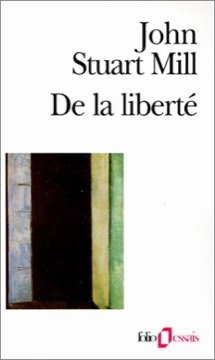
On Liberty
John Stuart Mill's argument for the limits of society's power over the individual — the fullest statement of the harm principle, of the case for free expression, and of why conformity is as dangerous as government.
- First published
- 1859
- Publisher
- language = English
- Pages
- 176
- Shelf
- Philosophy
- Level
- Core
- ISBN-13
- 9781853264641
Record checked against
Catalogue note
- Reads as
- ReflectiveChanges how you see rather than what you do.
- Level
- Core / BuildingAssumes general familiarity with the subject.
- Approach
- Theoretical
- Written for
- Reflective readers, Readers with some grounding
Saved in this browser only — no account, nothing sent anywhere. My library
Read this if
- You want to understand how power is taken, kept and lost.
- You want to think harder about what is actually right.
- You want a book that changes how you see things rather than what you do tomorrow.
- You know roughly how the subject works and want the fuller account.
The subject it addresses
Mill states at the outset that his subject is not free will but civil liberty: the nature and limits of the power society may legitimately exercise over an individual.
His framing move is that the danger has shifted. Where once the threat was a ruler acting against the people, in a democratic society the threat is the majority acting against dissenting individuals, which is harder to resist because it operates through opinion rather than law.
In a democracy the threat is not the ruler but the majority, acting through opinion rather than law.
Devmark’s reading — not a quotation from the book
The harm principle
His single governing proposition: the only purpose for which power can rightfully be exercised over any member of a civilised community against their will is to prevent harm to others. A person's own good is not sufficient warrant.
It is the most influential sentence in modern political philosophy and the foundation of most liberal legal reasoning about paternalism. Its difficulty is entirely in the word harm, which the book does not define with the precision the principle requires.
Tyranny of the majority
His borrowed phrase, developed further than Tocqueville had. Social tyranny is more formidable than political oppression because it penetrates further, leaves fewer means of escape, and enslaves the soul itself.
His concern is with conformity operating through employment, association and reputation rather than through law — which makes the chapter uncomfortably applicable to contemporary conditions he could not have anticipated.
The four arguments for free expression
His second chapter and the strongest sustained defence of free speech ever written. The suppressed opinion may be true. It may contain part of the truth. Even if wholly false, a true belief held without challenge becomes dead dogma. And a belief never contested loses its meaning and its effect on conduct.
The third and fourth arguments are the distinctive ones. He is not only defending the dissenter's right to speak but arguing that the majority needs the dissent to understand its own position.
Dead dogma
His term for a true belief held without any grasp of the reasons for it or of the case against it.
His claim that such a belief provides no protection against error, cannot be applied to a new situation, and will collapse when seriously challenged is an argument about the quality of understanding rather than about rights, and it is the part of his case that applies directly to education.
Individuality as an element of well-being
His third chapter, which he regarded as central and which is less often read. Human nature is not a machine to be built to a model but a tree requiring growth in the direction of its own inward forces.
His argument that experiments in living are necessary — that society learns what modes of life are worth having only by permitting people to try them — is the positive case underlying the negative harm principle.
Society discovers which ways of living are worth having only by permitting people to try them.
Devmark’s reading — not a quotation from the book
The limits, and where he draws them
His fourth and fifth chapters apply the principle: self-regarding conduct is immune, other-regarding conduct is not, and he works through cases including trade, poisons, public indecency, gambling and education.
His treatment shows the difficulty of the distinction. Almost no conduct is purely self-regarding, and his handling of the harder cases is less conclusive than the principle's clarity implies.
Harriet Taylor
Mill attributed the work substantially to his wife Harriet Taylor Mill and described it in his dedication as more hers than his.
Scholars disagree about the extent of her contribution, and the historical tendency was to discount his statement as gallantry. The safest position is that he said it plainly, repeatedly, and had no obvious reason to exaggerate.
Where the criticism is serious
Two objections stand. The harm principle depends on a distinction between self- and other-regarding acts that may not survive examination, since almost every action affects someone.
The second is his exclusion of what he calls barbarians and children from the principle's protection, which licensed a paternalist argument for colonial administration — an institution Mill himself worked for. This is not incidental to the text and should not be read past.
Why it endures
Because it is the clearest available statement of a position that every liberal society claims to hold and constantly relitigates.
Every argument about speech, about paternalistic regulation, about professional and social consequences for unpopular views, is conducted in terms this book established, usually by people who have not read it.
What to take away
- 01Only harm to others justifies coercionA person's own good is explicitly not sufficient warrant, which is the core of anti-paternalist argument.
- 02The majority is the modern threatSocial pressure penetrates further than law and leaves fewer means of escape.
- 03The majority needs the dissentAn unchallenged true belief becomes dead dogma and stops affecting conduct.
- 04Experiments in livingWe learn which ways of life are worth having only by permitting people to attempt them.
- 05The colonial exclusion is in the textHis exemption of those he calls barbarians licensed paternalist rule, and he worked for that administration.