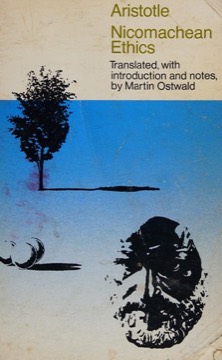
Nicomachean Ethics
Aristotle's inquiry into what the good life for a human being consists of — the founding text of virtue ethics, arguing that the good is an activity rather than a state, achieved through character built by practice.
- Composed
- not established
- Publisher
- not established
- Pages
- 329
- Shelf
- Philosophy
- Level
- Deep
- ISBN-13
- not established
Record checked against
This work predates printing, so it has no publication year. The years the sources report — openlibrary 1558 — are those of later editions or translations, not of the work.
Catalogue note
- Reads as
- ReflectiveChanges how you see rather than what you do.
- Level
- Advanced / AdvancedAssumes you have read around the subject already.
- Approach
- Theoretical
- Written for
- Reflective readers, Specialists and serious readers
- Ideas
Saved in this browser only — no account, nothing sent anywhere. My library
Read this if
- You want to think harder about what is actually right.
- You want a book that changes how you see things rather than what you do tomorrow.
- You have read around this already and want a book that assumes it.
The question and the method
Aristotle begins with the observation that every action aims at some good, and asks whether there is a final good pursued for its own sake and never for the sake of anything else.
His method is worth noting because it differs from Plato's. He starts from what people actually believe and say about happiness, treats common opinion as evidence, and refuses to demand more precision than the subject admits. Ethics, he says, is not mathematics.
He refuses to demand more precision than the subject allows. Ethics, he says, is not mathematics.
Devmark’s reading — not a quotation from the book
Eudaimonia
The word usually translated as happiness, which misleads. It means something closer to flourishing or living well — an activity of a whole life rather than a feeling, and something that can be assessed from outside rather than only reported.
His definition is that it is activity of the soul in accordance with virtue, which makes the good life something you do rather than something you feel or possess. A person asleep is not flourishing, whatever their state of mind.
Virtue as a mean
His best-known doctrine: each virtue lies between an excess and a deficiency. Courage between recklessness and cowardice, generosity between prodigality and meanness, wit between buffoonery and boorishness.
It is routinely misread as a recommendation of moderation. His mean is relative to the person and the situation, not an average, and he is explicit that some actions — he names several — admit no mean and are simply wrong.
Character is built by practice
His central practical claim: we become just by doing just acts and brave by doing brave ones. Virtue is a stable disposition formed by repetition, not a conclusion reached by argument.
The consequence is that moral education is training rather than instruction, and that habituation precedes understanding. This is one of the more empirically robust claims in ancient philosophy and connects directly to modern work on habit formation.
Voluntary action and responsibility
His analysis in Book III of what makes an action voluntary, what constitutes ignorance, and when compulsion excuses.
His treatment is the ancestor of every subsequent legal and moral analysis of culpability, and his distinction between acting in ignorance and acting through ignorance is still the operative one in questions of responsibility.
Practical wisdom
Phronesis: the intellectual virtue of perceiving what a particular situation requires and acting accordingly. It cannot be reduced to rules, because rules cannot specify their own application.
This is his deepest contribution and the reason virtue ethics remains a live position. A person with the right character perceives the situation differently from someone without it, which means good judgement is not a matter of applying a principle correctly.
The two books on friendship
He devotes more space to friendship than to almost anything else, dividing it into friendships of utility, of pleasure and of virtue.
His claim that only the third is complete, that it requires time and shared activity, and that a person cannot have many such friendships, is one of the most humane passages in ancient philosophy. His observation that the first two dissolve when their basis does is simply accurate.
Friendships of use and pleasure dissolve when their basis does. Only the third kind survives its own conditions.
Devmark’s reading — not a quotation from the book
Pleasure, and the final book
His treatment of pleasure as completing an activity rather than being a separate thing pursued, which avoids both the hedonist and the ascetic error.
Book X then argues that the highest happiness is contemplative — a conclusion that sits awkwardly with the rest, since the preceding books made flourishing a matter of active virtue in a community. Scholars have argued about this tension for centuries and it is not resolved.
Where modern readers push back
The work assumes a specific social world: it excludes slaves and women from full flourishing, assumes leisure, and treats the Greek city as the natural setting for a human life.
Its account of virtue also has no clear answer for genuine moral disagreement between people of good character, which is the standard objection from rule-based and consequentialist positions.
Why it is still read
Because it asks a question the other major traditions do not: not what should I do, but what kind of person should I become.
That question survives every criticism of his specific answers, and the revival of virtue ethics in the twentieth century came from philosophers who concluded that rule-based and outcome-based approaches had left it unanswered.
What to take away
- 01Flourishing is an activityEudaimonia is something you do across a whole life, not a feeling you report.
- 02The mean is not an averageIt is relative to person and situation, and some actions admit no mean at all.
- 03Character is built by repetitionWe become brave by doing brave things; habituation precedes understanding rather than following it.
- 04Practical wisdom cannot be reduced to rulesRules cannot specify their own application, which is why judgement is a form of perception.
- 05The question is who to becomeNot what to do, which is why the tradition revived when the alternatives left this unanswered.