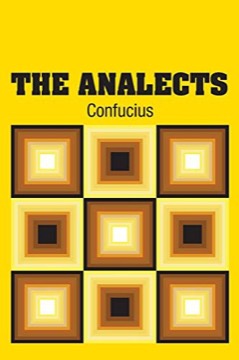
The Analects
The sayings of Confucius, compiled by his students over generations after his death around 479 BC. The foundational text of Chinese ethical and political thought.
- Composed
- not established
- Publisher
- not established
- Pages
- 100
- Shelf
- Philosophy
- Level
- Core
- ISBN-13
- not established
Record checked against
This work predates printing, so it has no publication year. The years the sources report — wikidata 2000, openlibrary 1979 — are those of later editions or translations, not of the work.
Catalogue note
- Reads as
- ReflectiveChanges how you see rather than what you do.
- Level
- Core / BuildingAssumes general familiarity with the subject.
- Approach
- Theoretical
- Written for
- Reflective readers, Readers with some grounding
- Ideas
Saved in this browser only — no account, nothing sent anywhere. My library
Read this if
- You want to examine an assumption you have never examined.
- You want to think harder about what is actually right.
- You want a book that changes how you see things rather than what you do tomorrow.
- You know roughly how the subject works and want the fuller account.
What it is
Not a treatise but a collection of fragments: short exchanges, single remarks, and observations about Confucius's conduct, assembled across several generations. There is no argument running through it and no system presented.
That form is a genuine obstacle for a first reader. The Analects assumes a community that already shares its vocabulary and is recording reminders rather than teaching from the beginning.
It is a set of reminders for people who already had the training, not an introduction for those who did not.
Devmark’s reading — not a quotation from the book
The central terms
Ren, usually rendered as humaneness or benevolence, is the governing virtue and is deliberately never defined the same way twice. Li covers ritual, propriety and the forms of social conduct. Junzi, the exemplary person, replaces an inherited aristocratic term with an ethical one.
The move in that last substitution is the radical part: Confucius took a word meaning noble by birth and made it mean noble by conduct.
He took a word that meant well-born and redefined it to mean well-behaved.
Devmark’s reading — not a quotation from the book
Why it matters
Two and a half thousand years of East Asian political and family life were organised around this text, including the imperial examination system that selected officials by their command of it.
For a modern reader the interest is an ethics grounded entirely in relationship and role rather than in rules or consequences — a third option alongside the Western traditions, and one with an unusually long record of application.
How to read it
Choose the translation deliberately. Versions differ substantially on the central terms — ren alone has been rendered as benevolence, humaneness, goodness and authoritative conduct — and those choices change the ethics considerably. An edition with commentary is close to essential for a first reader, because the text assumes context it does not supply.
It also does not reward reading straight through. The Analects was built to be returned to in small sections, and a passage that seems trivial on first encounter frequently turns out to be doing work that only becomes visible once the surrounding material is familiar.
Ritual as the mechanism
The concept that most readers underestimate is li — the forms, courtesies and ceremonies of social life. Confucius treats these not as empty etiquette but as the training apparatus by which an inner disposition is built: practising the outward form repeatedly is how the corresponding feeling is cultivated. The claim is that character is produced by rehearsal rather than expressed by it.
Perform the form until the feeling follows. The order is deliberate and it is the whole method.
Devmark’s reading — not a quotation from the book
The exemplary person
The recurring figure of the junzi — originally a term for aristocratic birth — is redefined throughout as a moral achievement available regardless of station. It is one of the text's most consequential moves: relocating nobility from inheritance to conduct, which is the seed of a whole tradition of meritocratic argument.
Filial piety and its reach
Family obligation is treated as the root from which wider social virtue grows, on the argument that someone who cannot manage the nearest relationships reliably will not manage distant ones. Modern readers frequently find this the least congenial part, particularly where the text subordinates individual judgement to a parent's authority.
The reluctance to define
Confucius repeatedly declines to give a general definition of his central virtue, answering different students differently according to what each needs to hear. This is not evasion but method: he is teaching discernment in situations rather than issuing rules, which is also why the text resists systematisation.
On government
The political passages argue that rule by moral example is more effective than rule by punishment, since law produces avoidance while shame produces self-correction. It is an empirical claim about incentives as much as an ethical one, and it has been read as both a humane doctrine and a justification for hierarchy.
What it has been made to mean
The text has been state doctrine, examination syllabus, target of revolutionary denunciation, and more recently an instrument of cultural diplomacy. Reading it now means reading through two and a half thousand years of institutional use, and it is worth knowing that most of what "Confucianism" denotes was built long after this book.
How to approach it
It is fragmentary, unsystematic and full of references to people and disputes now lost, so a first reading without a good introduction and notes is frustrating. Read a small number of passages slowly rather than attempting it cover to cover; the text was assembled for return rather than for completion.
What to take away
- 01Fragments, not a treatiseCompiled across generations with no argument running through.
- 02RenThe governing virtue, deliberately never fixed to one definition.
- 03Junzi redefinedA word for the well-born, reassigned to mean the well-conducted.
- 04Ethics of relationshipGrounded in role and obligation rather than rules or outcomes.
- 05Translation mattersVersions differ substantially on the central terms.