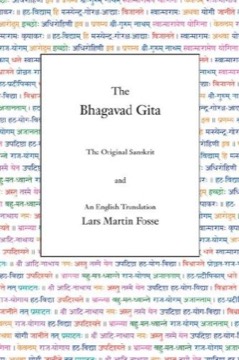
The Bhagavad Gita
The Original Sanskrit and An English Translation
A dialogue of about seven hundred verses set on a battlefield, embedded in the Mahabharata, in which a warrior refuses to fight and his charioteer — who is also a god — answers him.
- Composed
- not established
- Publisher
- not established
- Pages
- 224
- Shelf
- Philosophy
- Level
- Core
- ISBN-13
- not established
Record checked against
This work predates printing, so it has no publication year. The years the sources report — wikipedia 1944, openlibrary 2007 — are those of later editions or translations, not of the work.
Catalogue note
- Reads as
- ReflectiveChanges how you see rather than what you do.
- Level
- Core / BuildingAssumes general familiarity with the subject.
- Approach
- Theoretical
- Written for
- Reflective readers, Readers with some grounding
- Ideas
Saved in this browser only — no account, nothing sent anywhere. My library
Read this if
- You want to examine an assumption you have never examined.
- You want to think harder about what is actually right.
- You want a book that changes how you see things rather than what you do tomorrow.
- You know roughly how the subject works and want the fuller account.
The situation
Arjuna, about to fight a battle in which the opposing army contains his cousins, teachers and kin, puts down his bow and refuses. Krishna, acting as his charioteer, responds, and the response occupies the rest of the text.
The battlefield setting is the crucial formal choice. The philosophy is delivered under time pressure to a man in a concrete crisis, not in a school.
A man refuses to act, and the entire text is the answer to that refusal.
Devmark’s reading — not a quotation from the book
The argument
Krishna's response moves through several paths: karma yoga, action performed without attachment to its fruits; jnana yoga, knowledge of the self as distinct from the body; and bhakti yoga, devotion.
The best-known teaching is that one has a right to action but not to its results. This is not fatalism — Arjuna is told to fight — but a separation of the duty to act from the demand that acting pay off.
You have a claim on the action and none on the outcome, and you must act anyway.
Devmark’s reading — not a quotation from the book
Its reach
The Gita became the most widely read Hindu text partly because it is short and self-contained. Gandhi called it his dictionary of daily reference and read it as an allegory of internal conflict rather than a licence for war.
It has also been read the opposite way, and that tension — a text about detachment set on a battlefield — has never been resolved and is part of what keeps it alive.
How to read it
Translations vary enormously in register, from devotional to scholarly to poetic. A version with the Sanskrit terms retained and glossed is the more useful starting point.
Read it aware that it is one section of an enormous epic, and that Arjuna's refusal is answered rather than validated.
The three paths
The dialogue sets out several routes to the same end: action performed without attachment to its fruits, knowledge and discriminating insight, and devotion to a personal god. Their relationship is the text's central interpretive problem — whether they are alternatives suited to different temperaments or a hierarchy with devotion at the top has been argued for centuries.
Acting without grasping the result
The most widely transmitted teaching is that one is entitled to the action and not to its fruits. The claim is not indifference to outcome but the removal of the anxious identification with it: the work is done fully and the result is released, which the text presents as the only way to act without accumulating further entanglement.
You have a claim on the action. You have never had one on what it produces.
Devmark’s reading — not a quotation from the book
Duty and the battlefield
The setting is a warrior refusing to fight relatives, and the answer he receives — that withdrawal is itself an action with consequences, and that his own role carries obligations he cannot simply decline — is the source of the text's most serious ethical controversy. Readings that treat the battle as allegory and readings that treat it as literal produce very different books.
What it synthesises
Part of the text's historical importance is integrative. It brings the older ritual tradition, the renunciant philosophy of the forest texts, and personal devotion to a god into a single coherent frame, and in doing so offers householders with obligations a path that does not require abandoning the world. That accessibility is a substantial part of why it reached far beyond the specialist and ascetic circles that produced the texts around it.
Its modern political life
The text was central to twentieth-century Indian political thought and was read in incompatible ways — as a charter for non-violent action interpreted allegorically, and by others as a sanction for armed struggle. Its commentarial history is not a scholarly footnote; it is part of what the book now is.
Translation matters more than usual
Key terms have no clean English equivalents, and the choices a translator makes about them determine whether the text reads as philosophy, devotional poetry or scripture. Verse translations that aim for beauty and prose versions that aim for precision produce noticeably different arguments; it is worth comparing two.
How to approach it
It is around seven hundred verses and can be read in an afternoon, which is misleading — it is compressed rather than short. Read it with a commentary, accept that competing interpretations are genuinely unresolved rather than a sign you have missed something, and return to sections rather than pressing through.
What to take away
- 01Philosophy under pressureDelivered to a man in crisis, on a battlefield, not in a school.
- 02Action without attachmentA right to the act, none to its fruits.
- 03Three pathsAction, knowledge and devotion, presented as compatible routes.
- 04Read allegoricallyGandhi treated the war as internal conflict; others have not.
- 05Part of an epicA short section of the Mahabharata, self-contained by accident of fame.