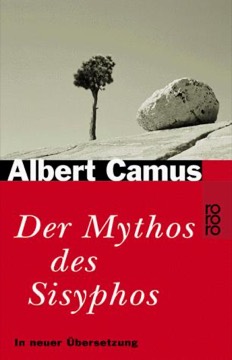
The Myth of Sisyphus
Albert Camus's essay on whether life is worth living given that it has no inherent meaning — the founding statement of the absurd, arguing for revolt, freedom and passion in place of both suicide and false hope.
- First published
- 1941
- Publisher
- Alianza
- Pages
- 169
- Shelf
- Philosophy
- Level
- Deep
- ISBN-13
- 9781983689444
Record checked against
Catalogue note
- Reads as
- ReflectiveChanges how you see rather than what you do.
- Level
- Advanced / AdvancedAssumes you have read around the subject already.
- Approach
- Theoretical
- Written for
- Reflective readers, Specialists and serious readers
- Ideas
Saved in this browser only — no account, nothing sent anywhere. My library
Read this if
- You want to examine an assumption you have never examined.
- You want a book that changes how you see things rather than what you do tomorrow.
- You have read around this already and want a book that assumes it.
The opening question
Camus begins by declaring that there is only one truly serious philosophical problem, and that is suicide — whether life is worth living is the fundamental question, and everything else comes afterward.
The bluntness is deliberate. He is refusing the academic posture that treats such questions as one topic among many, and insisting that a philosophy which cannot address it has not begun.
He refuses to treat this as one topic among many. A philosophy that cannot address it has not begun.
Devmark’s reading — not a quotation from the book
What the absurd is
His precise definition, frequently misstated. The absurd is not a property of the world and not a property of the human mind. It is the relation between them: our demand for meaning meeting a universe that provides none.
The consequence is that the absurd disappears if either term is removed. It exists only in the confrontation, which is why he insists that it must be maintained rather than resolved.
Physical suicide rejected
His first response to examine and reject. Suicide removes one term of the relation and therefore does not answer the absurd but abolishes the question.
His argument is that it is a form of acceptance — a confession that life is too much — and that the absurd demands the opposite: living without appeal.
Philosophical suicide rejected
His second and more interesting rejection, aimed at the religious existentialists — Kierkegaard, Chestov, Jaspers — who confronted the absurd and then made a leap to faith.
His charge is that the leap dissolves the absurd by inventing meaning rather than by finding it, and that this is an evasion however sincere. He respects the honesty of their confrontation and rejects the escape.
The three consequences
What remains if both suicides are refused: revolt, freedom and passion.
Revolt is the constant confrontation, refusing to accept and refusing to be consoled. Freedom follows from the loss of eternal purpose, since a life with no prescribed meaning is not answerable to one. Passion is quantity rather than quality of experience — living as much as possible rather than as well as possible according to some standard.
The absurd figures
His examples of lives lived in full awareness: the seducer who exhausts the present, the actor who lives many lives in a short time, the conqueror who chooses action over eternity, and the artist who creates without believing the creation lasts.
The chapter on absurd creation is the most substantial. His claim that the work of art is valuable precisely because it does not explain, and that a great novel is philosophy embodied rather than illustrated, is his own artistic manifesto.
Sisyphus
The closing pages and the image everyone knows. The gods condemned him to roll a stone up a mountain forever, and Camus's interest is in the moment at the top when the stone rolls down and Sisyphus walks back after it.
That descent is the hour of consciousness. Sisyphus is superior to his fate because he knows the full extent of it, and his scorn is what no punishment can reach.
The interest is in the walk back down. That is the hour of consciousness, and it is where he is free.
Devmark’s reading — not a quotation from the book
One must imagine Sisyphus happy
The final sentence and the most quoted in the book. Its meaning is not that suffering is secretly pleasant.
The claim is that the struggle itself, undertaken lucidly and without appeal to any hope of completion, is enough to fill a life. Happiness and the absurd are children of the same earth, in his phrase, and neither can be had without the other.
Its context and its limits
It was written and published during the German occupation of France, which gives its argument about living without consolation a weight that a peacetime essay would not carry.
Camus rejected the existentialist label throughout, considering his position distinct from Sartre's. He also later regarded this essay as incomplete, and *The Rebel* is where he worked out the ethical consequences — specifically whether the absurd permits anything at all, which this book does not adequately answer.
How to read it
As a literary essay rather than an argument with premises and conclusions. Its reasoning is frequently more assertion than demonstration, and readers looking for rigour will find it lyrical.
Its value is in the precision of the problem rather than the proof of the solution, and in refusing both the comfort of meaning and the exit of despair, which is a harder position to hold than either.
What to take away
- 01The absurd is a relation, not a factIt exists between our demand for meaning and a silent universe, and vanishes if either term is removed.
- 02The leap to faith is an evasionConfronting the absurd and then inventing meaning dissolves the problem instead of answering it.
- 03Revolt, freedom, passionWhat remains once both suicides are refused: confrontation without consolation, and quantity of living.
- 04The descent is the free momentSisyphus is superior to his fate because he knows its full extent, and scorn is beyond punishment.
- 05The Rebel is the sequel it needsThis essay does not settle whether the absurd permits anything at all, and he knew it.