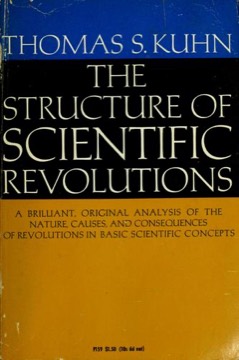
The Structure of Scientific Revolutions
Thomas Kuhn's 1962 account of how science actually changes — not by steady accumulation but by long periods of puzzle-solving inside an accepted framework, punctuated by crises in which the framework itself is replaced.
- First published
- 1962
- Publisher
- University of Chicago Press
- Pages
- 210
- Shelf
- Science
- Level
- Deep
- ISBN-13
- 9780226458113
Record checked against
Two sources agreed on 1962; a third reported differently (openlibrary 1955, wikidata 1962, wikipedia 1962).
Catalogue note
- Reads as
- FoundationThe standard first book on its subject.
- Level
- Advanced / AdvancedAssumes you have read around the subject already.
- Approach
- Balanced
- Written for
- Curious general readers, Specialists and serious readers
- Ideas
Saved in this browser only — no account, nothing sent anywhere. My library
Read this if
- You want to know how we know things, and how that goes wrong.
- You want the book people are sent to first on this subject.
- You have read around this already and want a book that assumes it.
The argument against accumulation
Kuhn's target is the textbook picture of science as a steady approach to truth, with each generation adding to the last. He argues that this picture is produced by textbooks, which are written after the fact and necessarily present the current framework as the destination all previous work was heading toward.
What the historical record shows instead, he claims, is discontinuity: periods of stable work interrupted by episodes in which the fundamental commitments of a field are exchanged rather than extended.
The tidy picture of science comes from textbooks, which are written by the winners after the argument ends.
Devmark’s reading — not a quotation from the book
Normal science
Most science, most of the time, is what Kuhn calls normal science: work conducted within an accepted framework that supplies the questions, the methods and the standards for an acceptable answer.
He describes this as puzzle-solving, and means it precisely rather than dismissively. A puzzle has an assured solution and rules for reaching it, and that assurance is what allows the detailed, cumulative, highly technical work that produces most scientific progress.
Paradigm — the word's two meanings
Kuhn's most famous term is also his most criticised, and he later acknowledged using it in two distinct senses.
The broad sense is the entire constellation of beliefs, values and techniques shared by a community. The narrow sense — which he came to prefer and called the exemplar — is a concrete achievement so successful that it becomes the model for how to do the work. The second is more precise and more useful, and is what students actually learn.
Anomaly and crisis
Normal science generates anomalies: results the framework cannot accommodate. Kuhn's important observation is that these do not immediately falsify anything. They are set aside, attributed to experimental error, or absorbed by adjusting the framework's periphery.
Crisis arrives when anomalies accumulate, resist repeated attempts, and begin to strike at fundamental commitments. Only then does a community become willing to consider an alternative — and Kuhn argues a framework is never abandoned merely because it has problems, only when there is something to replace it with.
Incommensurability
The most contested idea. Kuhn argues that competing paradigms cannot be fully compared because they define their terms differently, ask different questions, and disagree about what would count as a solution.
"Mass" does not mean quite the same thing in Newtonian and relativistic physics, so the two theories are not simply rival answers to one question. This is what forces Kuhn's conclusion that paradigm change cannot be decided by evidence alone — and it is the claim that made the book notorious.
Rival paradigms do not merely disagree. They disagree about what a satisfactory answer would look like.
Devmark’s reading — not a quotation from the book
Revolutions and the invisibility of them
When a shift occurs, Kuhn argues, the field reorganises around the new framework and then rewrites its own history so the change becomes invisible.
Textbooks are the mechanism. Each new one presents the current position as the natural conclusion of everything before it, which is why practising scientists usually have a cumulative picture of a history that was not cumulative.
What Kuhn was not saying
This matters, because the book has been enlisted for arguments he rejected. Kuhn did not claim science is irrational, that paradigms are chosen arbitrarily, or that scientific claims are merely social conventions.
He argued that paradigm choice involves judgement — accuracy, scope, simplicity, fruitfulness — that cannot be reduced to an algorithm. That is a claim about the limits of formal method, not a denial that evidence matters, and he spent much of his later career resisting the relativist reading.
Where philosophers push back
Serious objections exist. Critics argue incommensurability is overstated — that scientists across paradigms communicate and compare more successfully than Kuhn allows. Others note that his model fits physics far better than biology, chemistry or the social sciences, whose histories look considerably less revolutionary.
Lakatos's research programmes and Laudan's problem-solving traditions were both developed as attempts to keep Kuhn's historical insight while recovering a stronger sense of rational progress.
How the vocabulary escaped
"Paradigm shift" is now used for any change of approach in any field, which is a considerable distance from Kuhn's meaning. His paradigms are community-wide commitments in a mature science, replaced only under crisis.
The degraded usage is worth resisting if you want the concept to do any work. A company changing strategy is not experiencing a paradigm shift; it is changing strategy.
Why it still matters
Because it changed the question. Before Kuhn, philosophy of science largely asked how theories should be justified; after, it had to account for how science actually behaves as a human institution with communities, training, authority and inertia.
Its most portable insight is about anomalies: that a framework's defenders are not being irrational when they set aside a contrary result, because frameworks are abandoned for better frameworks rather than for problems. That describes a great deal of human reasoning well beyond science.
What to take away
- 01Most science is puzzle-solvingNormal science works inside a framework that supplies the questions and the standard for an answer.
- 02Anomalies do not falsifyThey are set aside until something better exists. A framework is replaced, not merely refuted.
- 03Rivals define their terms differentlyWhich is why evidence alone cannot settle a paradigm dispute — they disagree about what counts.
- 04Textbooks erase the discontinuityEach generation is taught a cumulative history of a process that was not cumulative.
- 05He was not a relativistKuhn argued judgement cannot be reduced to an algorithm, and spent years resisting the reading that it does not matter.