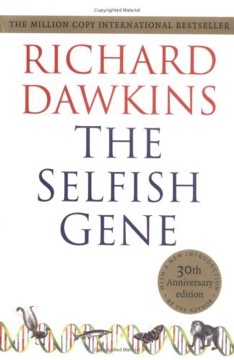
The Selfish Gene
Richard Dawkins's 1976 argument that the unit on which natural selection acts is best understood as the gene rather than the individual or the group — and that organisms are, from the gene's point of view, vehicles built to carry it forward.
- First published
- 1976
- Publisher
- Oxford University Press
- Pages
- 352
- Shelf
- Science
- Level
- Core
- ISBN-13
- 9782738112439
Record checked against
Catalogue note
- Reads as
- FoundationThe standard first book on its subject.
- Level
- Core / BuildingAssumes general familiarity with the subject.
- Approach
- Balanced
- Written for
- Curious general readers, Readers with some grounding
- Ideas
Saved in this browser only — no account, nothing sent anywhere. My library
Read this if
- You want to understand living things by how they came to be.
- You want the book people are sent to first on this subject.
- You know roughly how the subject works and want the fuller account.
The core idea
Dawkins's proposal is a change of viewpoint rather than a new mechanism. Evolution is easier to reason about, he argues, if you take the replicator's perspective: genes that produce effects making copies of themselves more likely become more common, and bodies are the machinery through which that happens.
The book is a work of synthesis and exposition, not original research. Its achievement is making an existing body of thought — Hamilton, Trivers, Maynard Smith, Williams — reasoned about clearly by non-specialists.
Genes are not selfish in intent. They are simply the things that persist, and persistence has no motive.
Devmark’s reading — not a quotation from the book
The title problem
More confusion has come from the title than from any chapter. "Selfish" is not a claim about intention, and it is not a claim that people are selfish. A gene has no aims; the word is shorthand for behaving in ways that, observed from outside, look as though copying itself were the objective.
Dawkins has said repeatedly that a title like *The Immortal Gene* would have saved decades of argument. Readers should treat the word as technical and inert, because much of the book is devoted to explaining how cooperation and altruism arise from exactly this starting point.
Kin selection
The clearest payoff of the gene's-eye view is altruism toward relatives. A gene promoting sacrifice for kin can spread if the benefit to copies of itself in those relatives outweighs the cost — which is why apparent self-sacrifice is commonest among close relatives.
This dissolves a problem that defeated earlier accounts. The behaviour is not self-sacrifice at the level of the gene at all, and once that is seen the puzzle disappears rather than being explained away.
Reciprocal altruism and game theory
Cooperation between unrelated individuals gets its own treatment through reciprocal altruism and the game-theoretic work Dawkins popularised from Maynard Smith. The evolutionarily stable strategy — one that cannot be invaded by an alternative once common — is the central tool.
The extended discussion of iterated prisoner's dilemma tournaments is the part of the book most read outside biology, and the finding that a simple, retaliatory, forgiving strategy performs well has travelled into economics and political science.
Memes
The final chapter of the original edition coins a term that escaped the book entirely. A meme is a unit of cultural transmission subject to variation, selection and retention — proposed by analogy to show that Darwinian logic is substrate-neutral.
Dawkins offered it as an illustration rather than a theory, and it has been criticised precisely for lacking the replication fidelity that makes genetic selection tractable. Its current internet usage has almost nothing to do with the original argument.
The extended phenotype
Later editions include Dawkins's own view that his more important contribution is the extended phenotype: the idea that a gene's effects do not stop at the body's edge. A beaver's dam and a spider's web are phenotypic effects of genes, as much as a limb is.
The idea is genuinely strange and genuinely useful, because it makes parasite manipulation of host behaviour — a parasite's genes expressed through another animal's actions — a natural case rather than an anomaly.
A gene's reach does not stop at the skin. A dam is as much a phenotype as a tooth.
Devmark’s reading — not a quotation from the book
What it does not claim
Worth stating explicitly, because the book is regularly misread as biological determinism or as an endorsement of selfishness.
Dawkins argues that humans are uniquely able to rebel against the tendencies their genes produced, and says so in the closing pages. The book is descriptive about mechanism and explicitly rejects deriving values from it — the naturalistic fallacy is named and dismissed.
Where biologists disagree
The gene's-eye view is a mainstream position but not an uncontested one. Multi-level selection theorists argue that selection genuinely operates at several levels and that reducing everything to genes loses explanatory content. Developmental and epigenetic work argues the gene-centred picture underweights how phenotypes are actually built.
The most common specialist objection is that the disagreement is partly about bookkeeping rather than biology — that the two views often describe the same process in different currencies. A reader should know the argument is live.
How it reads today
The prose is the reason it survived. Dawkins is an exceptionally clear explainer, and the book assumes no biology while refusing to condescend, which is a rare combination in popular science.
Its cultural position has shifted. In 1976 it was a lucid intervention; it is now a canonical text that generations of biologists learned from and some have spent careers arguing with. That history is part of reading it.
What to take from it
The durable gift is the habit of asking what level a selection process is operating on — a question that applies well beyond biology, to institutions, technologies and ideas.
The caution is symmetrical. The gene's-eye view is a lens, and lenses are chosen for what they make visible. Dawkins is clear about this in the book; readers who adopt the framing as a complete account of life are taking something he did not offer.
What to take away
- 01It is a viewpoint, not a mechanismSelection did not change. What changed is which level you do the bookkeeping at.
- 02'Selfish' describes outcome, not intentA gene has no aims. The word is shorthand for what persists, and it has caused fifty years of confusion.
- 03Altruism toward kin is not a puzzleAt the level of the gene it is not sacrifice at all, which is why the problem dissolves.
- 04Stability beats optimalityAn evolutionarily stable strategy is one that cannot be invaded, not one that performs best in isolation.
- 05Phenotypes extend past the bodyA dam, a web, or a manipulated host's behaviour are all effects of genes.