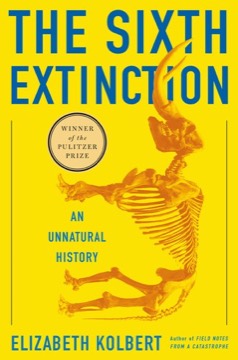
The Sixth Extinction
An Unnatural History
Elizabeth Kolbert's account of the current mass extinction — reported from field sites around the world, and arguing that human activity is producing a biological event comparable to the five great extinctions in the fossil record.
- First published
- 2014
- Publisher
- Guy Saint-Jean éditeur
- Pages
- 352
- Shelf
- Science
- Level
- Core
- ISBN-13
- 9782311100617
Record checked against
Catalogue note
- Reads as
- ConceptualExplains how something works before what to do about it.
- Level
- Core / BuildingAssumes general familiarity with the subject.
- Approach
- Theoretical
- Written for
- Curious general readers, Readers with some grounding
Saved in this browser only — no account, nothing sent anywhere. My library
Read this if
- You want to understand a place, or what we are doing to one.
- You want to understand living things by how they came to be.
- You want to understand how it works before deciding what to do about it.
- You know roughly how the subject works and want the fuller account.
The claim
Kolbert's thesis is that we are living through a mass extinction event of the kind that has occurred five times previously, and that its cause is us — not a single activity but the aggregate of habitat change, chemical alteration, species transport and climate.
Her method is to establish each element through a specific species and a specific place, reported first-hand, rather than through aggregate statistics.
Each element is established through one species in one place, reported in person, rather than through aggregate numbers.
Devmark’s reading — not a quotation from the book
How extinction became thinkable
Her opening historical chapters, on Cuvier establishing that species could disappear entirely — an idea that had no place in the prevailing view of nature — and on the long argument between catastrophism and gradualism.
Her point is that extinction had to be discovered, and that the discovery required accepting that the past contained events unlike anything observed.
The five previous events
Her treatment of the end-Ordovician, late Devonian, end-Permian, end-Triassic and end-Cretaceous extinctions, with particular attention to the asteroid impact and how long it took for that explanation to be accepted.
The Alvarez story is her best illustration of scientific resistance: a correct explanation, with physical evidence, dismissed for years partly because it was catastrophist and partly because it came from outside palaeontology.
Ocean acidification
Her strongest scientific chapter, reported from volcanic seeps off Italy where naturally elevated carbon dioxide has already changed the water chemistry.
The mechanism is direct chemistry rather than modelling: absorbed carbon dioxide lowers pH, which impairs organisms that build calcium carbonate structures. Her observation of what actually grows near the seeps is more persuasive than any projection.
The amphibian collapse
Her account of the chytrid fungus and of frog populations disappearing worldwide, including species that vanished between one field season and the next.
Her framing is that the fungus spread through human transport of animals, which makes this an extinction caused not by habitat destruction but by moving things around — a category of cause with no precedent at this scale.
The New Pangaea
Her term for the effect of global transport: species that were separated for millions of years are now routinely mixed, reversing the isolation that generated much of the world's diversity.
Her argument that this homogenisation is itself an extinction driver, and one that continues regardless of conservation effort elsewhere, is the most under-appreciated point in the book.
Reversing tens of millions of years of isolation is an extinction driver that conservation elsewhere cannot offset.
Devmark’s reading — not a quotation from the book
Forest fragments and habitat
Her reporting from a long-running Amazon fragmentation experiment, where patches of forest of different sizes were isolated and monitored for decades.
The finding — that fragments lose species steadily over time, and that smaller fragments lose more — establishes that preserving a percentage of habitat does not preserve a proportional share of the species.
The Neanderthals
Her late chapters on human expansion and on the disappearance of other hominin species, and on the megafaunal extinctions that followed human arrival on each continent.
Her implication is that the current event is continuous with a much older pattern rather than a recent industrial aberration, which is the book's most uncomfortable argument.
What is established and what is contested
Established: current extinction rates are far above background, and the drivers she describes are real and documented.
Contested: whether the event qualifies as a sixth mass extinction on the geological definition, since that requires a scale of loss not yet reached. Some ecologists regard the framing as ahead of the evidence, and Kolbert's case is that the trajectory rather than the current total is the point.
The tone
She reports rather than exhorts, and the book has no chapter of solutions and no call to action. Several reviewers criticised this.
The choice appears deliberate. The book's effect comes from accumulation rather than argument, and readers who want a programme will need to look elsewhere.
What to take away
- 01Extinction had to be discoveredThe idea that a species could vanish entirely had no place in the prevailing view of nature.
- 02Acidification is chemistry, not projectionAbsorbed carbon dioxide lowers pH and impairs calcium carbonate builders, observable at natural seeps today.
- 03Moving species is itself a driverThe New Pangaea reverses isolation that generated diversity, and conservation elsewhere cannot offset it.
- 04Fragments keep losing speciesPreserving a share of habitat does not preserve a proportional share of what lives in it.
- 05The sixth-extinction label is contestedRates are unambiguously elevated; whether the geological threshold is met is not yet settled.