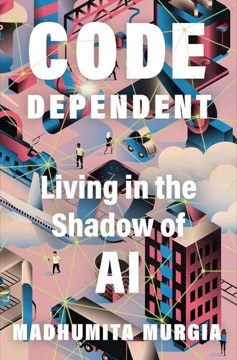
Code Dependent
Madhumita Murgia's reported account of how AI systems are already reshaping specific people's lives — gig workers, doctors, refugees, the wrongly arrested — told through individuals in ten countries.
- First published
- 2024
- Publisher
- Pan Macmillan
- Pages
- 320
- Shelf
- Technology
- Level
- Core
- ISBN-13
- 9781250867391
Record checked against
Only one source carried a publication date for this work, so the year is uncorroborated.
Catalogue note
- Reads as
- TechnicalAssumes and builds craft knowledge.
- Level
- Core / BuildingAssumes general familiarity with the subject.
- Approach
- Applied
- Written for
- Engineers, Readers with some grounding
Saved in this browser only — no account, nothing sent anywhere. My library
Read this if
- You want to think seriously about what these systems can and cannot do.
- You work in this area and want depth rather than an overview.
- You know roughly how the subject works and want the fuller account.
The approach
Murgia, the Financial Times's AI editor, avoids both the existential-risk frame and the productivity frame. Her subject is what these systems are doing now, to named people, in Kenya, India, Argentina, Bulgaria, China, the Netherlands and elsewhere.
Each chapter follows one person: a data annotator in Nairobi, a gig driver in India, a man arrested on a false facial recognition match, a doctor using a diagnostic model.
The book refuses both the doom frame and the productivity frame, and reports what is happening to specific people.
Devmark’s reading — not a quotation from the book
The strongest chapters
The Dutch childcare benefits scandal — in which an algorithm flagged tens of thousands of families for fraud, disproportionately those with dual nationality, and brought down a government — is the clearest documented case of automated administrative harm at scale.
The chapter on content moderators in Nairobi, and what reviewing the worst material on the internet does to people paid very little, is the hardest to read and the most necessary.
What it argues
Murgia's implicit case is that the harms are distributional: these systems transfer risk and cost downward while concentrating benefit, and the people absorbing the cost have the least ability to contest it.
She is a reporter rather than a theorist, and the book is stronger on documentation than on remedy. As a record of the present tense it is among the most useful available.
The method
Murgia builds each chapter around a named person affected by a specific system, and reports outward from them to the technology and the institution. It is a deliberate rejection of both the abstraction of policy writing and the speculation of existential-risk discourse: the harms in this book have already happened, to people with addresses.
The benefits scandal
The strongest chapter concerns a European welfare system that used automated risk scoring to flag childcare benefit claims as fraudulent, wrongly accusing tens of thousands of families, demanding repayment, driving people into debt and removing children into care. It brought down a national government, and it is the clearest documented case of algorithmic administration causing large-scale harm to citizens.
It was not a warning about what could happen. A government fell over what already had.
Devmark’s reading — not a quotation from the book
The people who label the data
Another thread follows workers contracted to annotate and moderate training data, including content involving extreme violence and abuse, for low wages and with minimal psychological support. Murgia's point is structural: the safety of a widely used system was manufactured by outsourcing the exposure to people with the least protection.
Bodies and likenesses
A chapter on synthetic sexual imagery follows a woman who discovered her likeness used without consent, and is careful about what the law does and does not currently provide. It is the clearest illustration of a recurring pattern: a capability becoming cheap and general before any mechanism exists for the people it is used against.
Management by algorithm
Reporting on gig drivers and delivery workers documents allocation, pricing and discipline handled by systems the worker cannot see, question or appeal. The specific complaint is not that decisions are automated but that they are unexplainable by design, which removes the possibility of contesting them.
Where it is limited
It is reportage, and it is stronger at documenting harm than at analysing mechanism or proposing remedy. The technical explanation is kept light for a general audience, and the closing arguments about governance are brief relative to the weight of the cases. It is a book of evidence rather than a book of answers.
What to take from it
Its value is calibration. Anyone whose sense of AI risk has been formed by speculation about future systems will find here a documented account of what present ones are already doing, to whom, and through which institutions — and the distribution of the harm is the thing most worth noticing.
What to take away
- 01Present tenseWhat these systems do now, not what they might become.
- 02One person per chapterTen countries, each chapter following a named individual.
- 03The Dutch benefits scandalAn algorithm that flagged thousands of families and felled a government.
- 04Moderation labourWhat reviewing the worst of the internet costs the people paid least.
- 05Distributional harmRisk pushed down, benefit concentrated, contest made difficult.