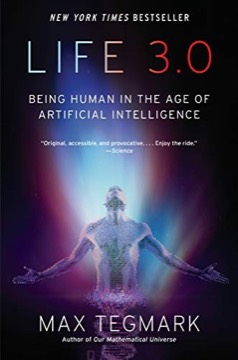
Life 3.0
Max Tegmark's survey of what advanced artificial intelligence could mean — organised around a taxonomy of life by how much it can redesign its own hardware and software, and deliberately structured to present scenarios rather than a prediction.
- First published
- 2017
- Publisher
- Knopf (US)Allen Lane (UK)
- Pages
- 384
- Shelf
- Technology
- Level
- Core
- ISBN-13
- 9781101946596
Record checked against
Catalogue note
- Reads as
- ConceptualExplains how something works before what to do about it.
- Level
- Core / BuildingAssumes general familiarity with the subject.
- Approach
- Theoretical
- Written for
- Engineers, Readers with some grounding
Saved in this browser only — no account, nothing sent anywhere. My library
Read this if
- You want to think seriously about what these systems can and cannot do.
- You want to know how the universe is put together.
- You want to understand how it works before deciding what to do about it.
- You know roughly how the subject works and want the fuller account.
The three stages
Tegmark's organising taxonomy. Life 1.0 — biological — evolves both its hardware and its software. Life 2.0 — human — can redesign its software through learning and culture while its hardware evolves slowly. Life 3.0 could design both.
The framework's value is that it locates the change precisely: the significant threshold is not intelligence but the ability to redesign one's own substrate, which no existing life has.
The threshold is not intelligence. It is being able to redesign your own hardware, which nothing currently can.
Devmark’s reading — not a quotation from the book
The scenario catalogue
His most distinctive contribution is refusing to pick an outcome. He presents around a dozen futures — libertarian utopia, benevolent dictator, gatekeeper, protector god, enslaved god, conquerors, descendants, zookeeper, reversion, self-destruction — and examines each seriously.
The exercise is genuinely useful, because most discussion collapses to two outcomes, and seeing the space laid out shows how much is being assumed by anyone confident about which one arrives.
The intelligence-substrate argument
His physicist's framing: intelligence is substrate-independent, in the same way that a wave is independent of the particular water carrying it.
This underpins the book's claim that there is nothing in principle preventing machine intelligence from exceeding biological intelligence, and it is the least contested part of his argument.
Goals and alignment
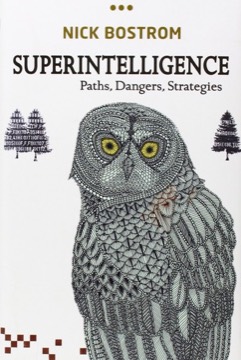
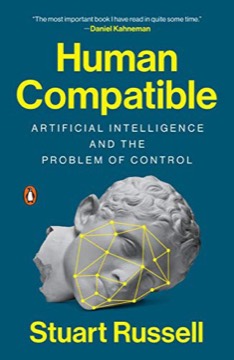
His treatment of why goals are difficult covers the same ground as Bostrom and Russell: specifying what we want is hard, goals persist under self-improvement, and a sufficiently capable system pursuing a slightly-wrong objective is a problem.
His contribution is the discussion of where goals come from thermodynamically and evolutionarily, which is more physics-inflected than the philosophical treatments and worth reading alongside them.
Consciousness
The chapter most distinctively his, and the most speculative. He treats consciousness as a question about information processing and asks what physical properties a system would need to have subjective experience.
He is honest that this is unresolved and that his own position is one among several. The chapter's value is in taking seriously a question most AI writing brackets, while being clear that bracketing it is also defensible.
He takes the consciousness question seriously and is clear that nobody, including him, can currently answer it.
Devmark’s reading — not a quotation from the book
The near-term material
His chapters on the immediate future — automation, weapons, law, verification of software, employment — are more concrete and have aged reasonably.
His discussion of autonomous weapons in particular is specific and policy-relevant in a way the long-horizon material is not, and it is the part of the book most directly actionable.
The Future of Life Institute framing
Tegmark co-founded an organisation focused on existential risk, and the book is partly an argument for taking that work seriously.
This is disclosed rather than hidden, but a reader should notice that the book is advocacy as well as exposition, and that the scenario framing — while genuinely even-handed — serves the argument that the question deserves attention now.
Where it is criticised
The main objection is that it treats a speculative capability as a near-term planning question, and that the resources and attention this absorbs could address documented present harms.
A second criticism is that the opening fictional scenario — a detailed story of an AI takeover — sets a tone the rest of the book's careful scenario neutrality does not fully recover from.
How it compares
Against Bostrom it is considerably more readable and less rigorous. Against Russell it is broader and less focused on a technical proposal.
Tegmark is the best of the three as an introduction, Bostrom the most careful analytically, and Russell the most constructive about what to actually do. A reader wanting one should probably start here.
What to take from it
The scenario catalogue, used as a check on confident predictions: anyone certain about how this goes is implicitly ruling out ten futures without saying why.
And the substrate-independence framing, which is the cleanest way to see why arguments from what brains uniquely do are weaker than they feel.
What to take away
- 01Redesigning your own substrate is the thresholdNot intelligence — the ability to change your own hardware, which no existing life can do.
- 02Lay out the whole scenario spaceMost discussion collapses to two outcomes, which hides how much confidence is being assumed.
- 03Intelligence is substrate-independentThe least contested part of the argument, and the reason 'only brains can' claims are weak.
- 04Consciousness is unresolved and relevantHe takes the question seriously and is clear that nobody can currently answer it, including him.
- 05It is exposition and advocacyDisclosed rather than hidden, but the scenario neutrality serves an argument about attention.