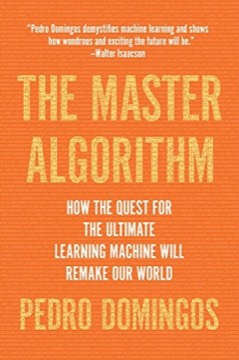
The Master Algorithm
How the Quest for the Ultimate Learning Machine Will Remake Our World
Pedro Domingos's survey of machine learning organised as five competing schools, each with its own founding idea and master algorithm — and his argument that a unification of them is the field's central open problem.
- First published
- 2015
- Publisher
- Basic Books
- Pages
- 352
- Shelf
- Technology
- Level
- Core
- ISBN-13
- 9780141979243
Record checked against
Catalogue note
- Reads as
- TechnicalAssumes and builds craft knowledge.
- Level
- Core / BuildingAssumes general familiarity with the subject.
- Approach
- Applied
- Written for
- Engineers, Readers with some grounding
Saved in this browser only — no account, nothing sent anywhere. My library
Read this if
- You want to think seriously about what these systems can and cannot do.
- You work in this area and want depth rather than an overview.
- You know roughly how the subject works and want the fuller account.
The five tribes
His organising device. Symbolists reason with logic and inverse deduction. Connectionists build neural networks and use backpropagation. Evolutionaries use genetic algorithms. Bayesians perform probabilistic inference. Analogisers reason from similarity, with support vector machines as the canonical method.
The taxonomy is a teaching device rather than a formal classification, and it is genuinely useful for orienting someone who has encountered these techniques without a map.
Five schools, each with a founding idea and a master algorithm. It is a map rather than a taxonomy.
Devmark’s reading — not a quotation from the book
Learning as induction
His unifying framing: all machine learning is induction — generalising from examples to rules — and the tribes differ in what representation they use and how they search the space of possible rules.
This framing is the book's most useful contribution, because it makes the methods comparable rather than treating each as a separate technology.
The no free lunch problem
His treatment of why assumptions are unavoidable: without prior assumptions, no learning algorithm outperforms any other averaged over all possible problems.
The practical consequence is that every method embeds a bias about what patterns are likely, and that choosing a method is choosing an assumption about the world rather than choosing a neutral tool.
Overfitting as the central enemy
His clearest teaching: a model that memorises the training data has learned nothing, and the entire craft of machine learning is distinguishing signal from noise in a finite sample.
His explanation of the bias-variance trade-off, and of why more data helps but does not solve the problem, is among the most accessible available to a non-technical reader.
The Master Algorithm hypothesis
His central speculative claim: a single algorithm capable of deriving all knowledge from data — unifying the five approaches — is possible in principle and would be the most consequential scientific achievement available.
He offers Markov logic networks as a candidate direction. This is the book's most contested content and is presented with considerably more confidence than the field shares.
The unification claim is his, not the field's, and it is presented with more confidence than others would use.
Devmark’s reading — not a quotation from the book
Where it has dated
Published in 2015, before the transformer architecture and before the scale of subsequent deep learning results.
The five-tribe balance reads differently now: the connectionist approach has achieved results the book treats as one option among five, and the unification Domingos anticipated has not arrived in the form he described.
Where it remains valuable
The conceptual foundations have not dated. Induction, overfitting, bias-variance, the necessity of assumptions and the difference between representation and search are all still exactly right and still badly understood outside the field.
For a reader who wants to understand what machine learning is doing rather than how to do it, this remains one of the better options.
The societal chapters
His later material on what pervasive machine learning means — personal models, data ownership, the economics of prediction — is the weakest part and reads as speculation appended to exposition.
His suggestions about individuals controlling personal data models were prescient in outline and thin in detail, and events have moved past them.
How it reads
Ambitious and uneven. Domingos is a serious researcher writing for a general audience and the register shifts noticeably — some passages assume no background, others assume rather a lot.
The analogies are frequent and occasionally strained, and readers with some technical background often find them less helpful than a direct explanation.
What to take from it
The five-tribe map, used as orientation: when you encounter a technique, asking which tradition it belongs to explains what assumption it is making.
And the no-free-lunch point, which is the most useful corrective to the idea that a sufficiently good general method exists — every method is a bet about what the world is like.
What to take away
- 01All of it is inductionThe tribes differ in representation and search, which makes them comparable rather than separate technologies.
- 02Every method embeds an assumptionWithout priors no algorithm beats any other on average, so choosing a method is choosing a bet about the world.
- 03Overfitting is the whole craftSeparating signal from noise in a finite sample is what the discipline actually consists of.
- 04The unification claim is his ownPresented with much more confidence than the field holds, and it has not arrived in the form described.
- 05The foundations have not datedThe specific techniques moved on; induction, bias-variance and the necessity of assumptions did not.