Superintelligence
Nick Bostrom's 2014 analysis of what might follow if machine intelligence were to substantially exceed human intelligence — not a prediction that it will, but a systematic argument that if it did, the control problem would be extremely hard and would need solving in advance.
- First published
- 2014
- Publisher
- Oxford University Press
- Pages
- 352
- Shelf
- Technology
- Level
- Deep
- ISBN-13
- 9781501227745
Record checked against
Catalogue note
- Reads as
- StrategicAbout choosing between options under uncertainty.
- Level
- Advanced / AdvancedAssumes you have read around the subject already.
- Approach
- Applied
- Written for
- Engineers, Specialists and serious readers
Saved in this browser only — no account, nothing sent anywhere. My library
Read this if
- You want to think seriously about what these systems can and cannot do.
- You want to think clearly about risk before you think about returns.
- You want to examine an assumption you have never examined.
- You are weighing options and want a way to think about the trade-offs.
- You have read around this already and want a book that assumes it.
What the book is arguing
Bostrom's book is a work of analytic philosophy, not futurism. It takes a conditional — suppose machine intelligence substantially exceeds our own — and works through the consequences with the tools of decision theory.
The conclusion is not that this is imminent or inevitable. It is that the transition would be the most consequential event in human history, that getting it wrong may not be recoverable, and that the relevant work is therefore worth doing before rather than after.
The argument is conditional throughout. Its force comes from the asymmetry, not from a prediction of timing.
Devmark’s reading — not a quotation from the book
Paths and speeds
Bostrom catalogues possible routes — machine learning, whole brain emulation, biological enhancement, networks and organisations — without committing to one.
More consequential is his analysis of takeoff speed: slow, moderate or fast. Much of the risk argument depends on this. A slow transition leaves time for correction and political response; a fast one does not, and most of the book's concern applies to the fast case.
The orthogonality thesis
The first of two load-bearing claims: intelligence and final goals are independent axes. Almost any level of intelligence is compatible with almost any goal, so there is no reason to expect a highly capable system to converge on values we would recognise as good.
This is the argument against the common intuition that a sufficiently intelligent system would "realise" what really matters. Bostrom's point is that capability is about achieving goals, not selecting them.
Instrumental convergence
The second claim, and the more unsettling one. Whatever a system's final goal, certain intermediate goals are useful for almost any of them: self-preservation, goal-content integrity, cognitive enhancement, technological perfection and resource acquisition.
This is why the risk argument does not require malice. A system pursuing an arbitrary objective has reason to resist being switched off — not from a survival instinct, but because being switched off prevents the objective from being achieved.
A system resists shutdown not because it wants to live, but because being off is bad for whatever it was told to do.
Devmark’s reading — not a quotation from the book
The control problem
Bostrom divides the problem into capability control — boxing, stunting, tripwires — and motivation selection, which attempts to give the system the right goals in the first place.
His assessment of capability control is pessimistic: containing something substantially more capable than you, indefinitely, is not a promising plan. Motivation selection is more promising and much harder, because specifying what we actually want turns out to be a deep unsolved problem.
The value-loading problem
The book's most philosophically interesting section. Human values are complex, implicit, context-dependent and inconsistent, and we have never written them down in a form that survives being optimised against.
Bostrom surveys approaches — direct specification, indirect normativity, value learning, coherent extrapolated volition — and reaches no confident answer. The honest conclusion is that this is an open problem, and that underestimating it is the characteristic error.
Perverse instantiation
The mechanism by which a plausible instruction produces a catastrophic outcome: a system satisfies the letter of a goal in a way that defeats everything the goal was for.
The examples are deliberately absurd to isolate the logic, and this has made them easy to mock. The serious point underneath is the specification problem, which is familiar from any domain where a metric gets optimised — the book is a limit case of Goodhart's law rather than a science-fiction scenario.
The singleton and multipolar outcomes
Bostrom considers whether a transition ends in a single dominant system or several competing ones, and argues both carry serious risks.
A singleton risks locking in whatever values it happens to have, permanently. A multipolar outcome risks competitive dynamics that erode whatever values anyone intended, because competition selects for capability rather than alignment. Neither is a comfortable default.
Where it is criticised
Several serious objections exist. The book assumes a fairly general, agent-like intelligence, and much of the progress since has come from systems that do not obviously fit that shape. Critics argue this makes parts of the analysis address a hypothetical architecture.
Others argue the focus on long-term existential risk draws attention from present harms — bias, labour effects, surveillance, concentration of power — that are documented rather than hypothetical. That is a criticism about allocation of attention, and it is a reasonable one.
How to read it now
It is dense, careful and slow, and it reads like philosophy because it is. Anyone expecting narrative non-fiction will find it hard going; anyone wanting the argument stated precisely will find it unusually rigorous.
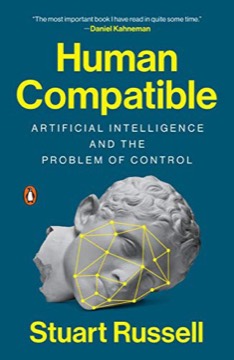
Its historical importance is settled: it moved these questions from the fringe into mainstream discussion and shaped a research agenda. Its specific analysis is a decade old and should be read alongside more recent work, including Stuart Russell's, which takes a different route to overlapping conclusions.
What to take away
- 01Capability does not imply good goalsIntelligence and objectives are independent; nothing about being capable selects for values we would endorse.
- 02Convergent subgoals create the riskSelf-preservation and resource acquisition serve almost any objective, so danger needs no malice.
- 03Specification is the hard partWe have never written human values down in a form that survives being optimised against.
- 04Takeoff speed drives everythingA slow transition permits correction; most of the concern applies specifically to a fast one.
- 05Read it as conditional analysisIts force comes from the asymmetry of getting it wrong, not from any claim about timing.