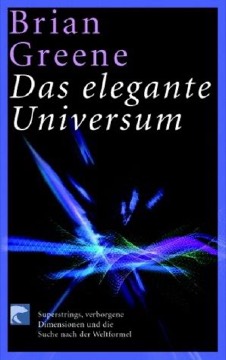
The Elegant Universe
Brian Greene's account of string theory and the problem it attempts to solve — the incompatibility of general relativity and quantum mechanics — written as the field's most successful popular exposition.
- First published
- 1999
- Publisher
- W. W. Norton
- Pages
- 456
- Shelf
- Science
- Level
- Deep
- ISBN-13
- 9780613250023
Record checked against
Catalogue note
- Reads as
- TechnicalAssumes and builds craft knowledge.
- Level
- Advanced / AdvancedAssumes you have read around the subject already.
- Approach
- Applied
- Written for
- Curious general readers, Specialists and serious readers
- Ideas
Saved in this browser only — no account, nothing sent anywhere. My library
Read this if
- You want to know how the universe is put together.
- You work in this area and want depth rather than an overview.
- You have read around this already and want a book that assumes it.
The problem it starts from
Greene's opening is the clearest part of the book: general relativity describes gravity and the large, quantum mechanics describes the small, and the two cannot both be correct in situations where both apply.
Those situations — black hole interiors, the earliest universe — are where physics currently has no answer. The conflict is not a technical inconvenience but a contradiction, and this is the motivation for everything that follows.
The two theories are not merely awkward together. In the regimes where both apply they contradict each other.
Devmark’s reading — not a quotation from the book
Relativity, explained properly
His first section covers special and general relativity with an unusual willingness to work through the reasoning rather than assert the results.
His treatment of why the constancy of light's speed forces time dilation, and of the equivalence principle leading to curvature, is among the better popular expositions available and is worth the book independent of the string material.
Quantum mechanics and the conflict
His account of the quantum picture, of the uncertainty principle, and of why applying quantum fluctuations to the fabric of space-time produces infinities that make the theory useless at very small scales.
The quantum foam image — space-time becoming violently turbulent below a certain scale — is his device for making the incompatibility visible rather than merely stated.
The string proposal
The central idea: replace point particles with one-dimensional vibrating strings, and the different particles become different vibrational patterns of the same fundamental object.
The immediate payoff is that strings have extension, which smooths out the short-distance behaviour that produced the infinities. The theory also requires a particle with the properties of the graviton, which is the claim that gravity emerges from it rather than being added.
Extra dimensions
His treatment of the requirement for additional spatial dimensions, and of Kaluza-Klein compactification — the proposal that they are curled up too small to observe.
His garden-hose analogy, in which a distant hose appears one-dimensional while a closer view reveals a circular dimension, is the standard explanation and he deploys it well. The number of possible compactification geometries turns out to be the theory's central difficulty.
The five theories and M-theory
His account of the second superstring revolution: five apparently distinct string theories turning out to be limits of a single eleven-dimensional framework related by dualities.
The unification is genuinely elegant and is the strongest argument the theory has produced. His exposition of duality — that two very different descriptions can be physically equivalent — is the most intellectually interesting material in the book.
Black holes and entropy
His chapter on the calculation of black hole entropy from string theory, matching the Bekenstein-Hawking formula derived independently.
This is the theory's clearest success and he presents it as such. It is a non-trivial agreement between two independent lines of reasoning, which is the kind of thing that ordinarily counts as strong evidence.
The testability problem
It must be addressed and Greene addresses it, though less centrally than critics would like. The theory makes no predictions that current or foreseeable experiments can test, and the enormous number of possible vacuum configurations makes it unclear whether it predicts anything specific at all.
Physicists including Lee Smolin and Peter Woit have argued at length that the field has absorbed resources and talent disproportionate to its results. A reader should encounter that argument rather than only this book's optimism.
The strongest objection is not that it is wrong but that it has not been shown capable of being wrong.
Devmark’s reading — not a quotation from the book
How it has aged
The optimism of the late nineties has not been borne out. Supersymmetry was expected to appear at accessible energies and has not been found, and the landscape problem has become more severe rather than less.
Greene's later books address some of this. A reader coming to this one should know they are reading the case at its most hopeful moment.
What it is good for
The first half is an excellent explanation of the two theories that actually describe the world, and that value is independent of what one thinks of strings.
The second half is the best available account of what string theorists are attempting and why they find it compelling, read as an argument from an advocate rather than as a report on a settled field.
What to take away
- 01The two theories contradict each otherNot merely awkward together: in black hole interiors and the early universe, both apply and disagree.
- 02Extension smooths the infinitiesReplacing points with strings is what removes the short-distance behaviour that breaks quantum gravity.
- 03Duality is the deep ideaTwo very different descriptions turning out to be physically equivalent is the field's most interesting result.
- 04Black hole entropy is the real successAn independent derivation matching an established formula is the kind of agreement that ordinarily counts.
- 05Read it as advocacyThe testability objection is serious, and this book is the case at its most optimistic moment.